
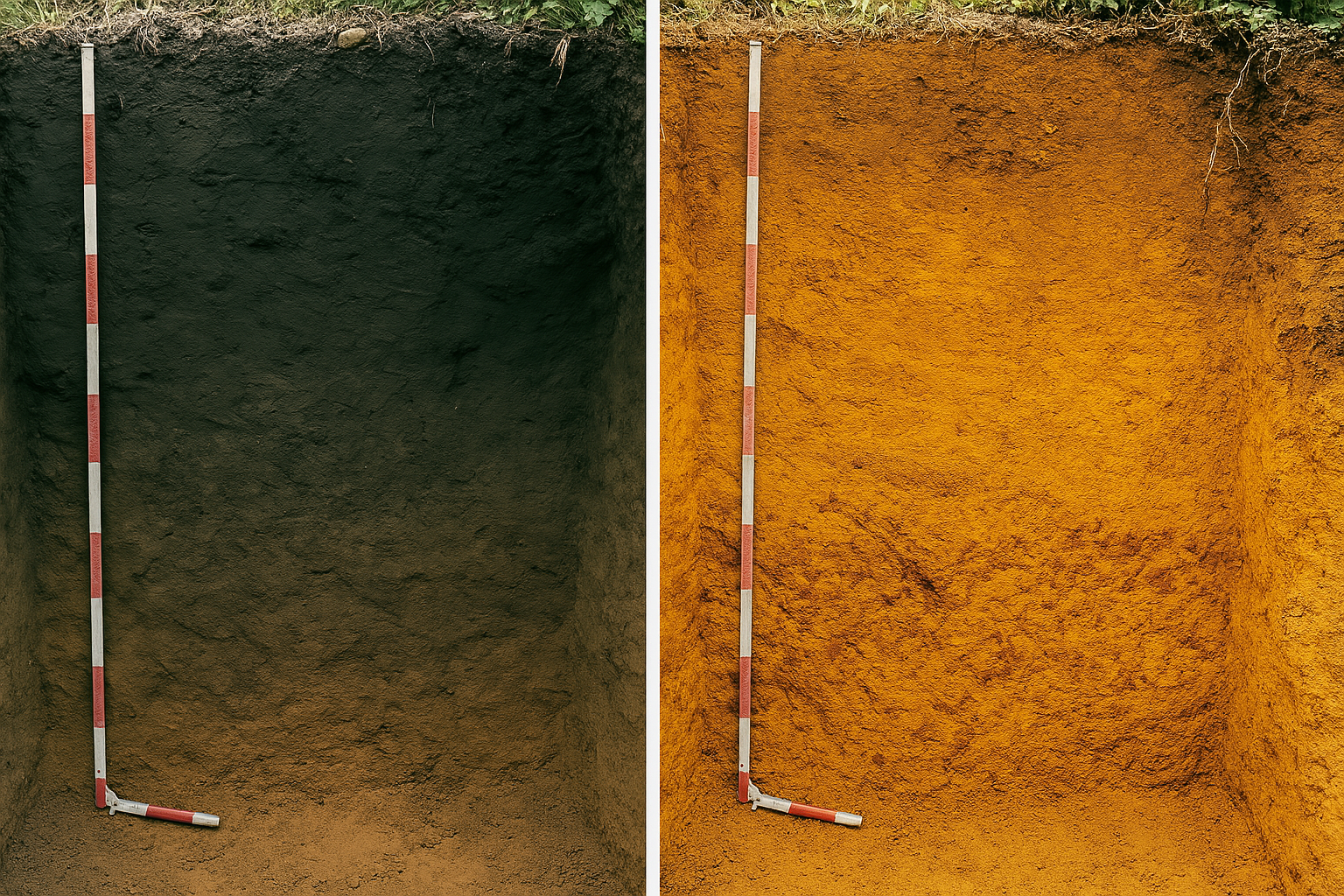
The Amazon rainforest is a place of incredible biodiversity, and it also holds clues to the fascinating lives of people who lived there long ago. One of the most intriguing mysteries is the existence of “Amazonian Dark Earths” (ADEs) – special patches of soil that are much darker and more fertile than the surrounding areas. Scientists have long wondered how these unique soils were formed. Were they a natural phenomenon, or did ancient people have a hand in creating them?
A recent study in the Journal of Archaeological Science sheds new light on this question, providing compelling evidence that humans played a significant role in the creation of ADEs.
Typical Amazonian soil isn’t very fertile. It’s often acidic and lacking in the nutrients that plants need to thrive. ADEs are a striking contrast. They’re rich in things like phosphorus, calcium, and carbon, making them excellent for growing crops. This has led some researchers to suggest that these soils were created by natural processes, like rivers depositing minerals over time. However, many believe that the ADEs are a result of ancient human activity.
To find out more, scientists studied the Caldeirão site in Brazil, an area known for its ADEs. The research team took a close look at the soil’s chemistry and the distribution of pottery fragments found within it. By using advanced mapping techniques, they were able to create a detailed picture of what the site looked like in the past.
The researchers discovered that the chemical makeup of the soil wasn’t the same everywhere. Instead, there were distinct variations, suggesting that different areas of the site were used in different ways or at different times. Interestingly, the areas with the richest soil also contained a lot of pottery, indicating a strong link between human activity and ADE formation.
The study also revealed a fascinating pattern in how the site developed over time. It appears that the area was initially organized in a semi-circular pattern, possibly representing an ancient village. Over time, this pattern changed, with the ADE spreading out more evenly across the landscape.
These findings strongly support the idea that humans were responsible for creating the ADEs. The variations in soil chemistry and the changes in settlement layout over time are hard to explain by natural processes alone. Instead, they point to the accumulation of things like food waste, ashAsh is the non-combustible inorganic residue that remains after organic matter, like wood or biomass, is completely burned. It consists mainly of minerals and is different from biochar, which is produced through incomplete combustion. Ash Ash is the residue that remains after the complete More from fires, and other materials that would have enriched the soil.
This research helps us to understand how ancient people lived in and shaped the Amazon. It shows that they weren’t just passive inhabitants of the rainforest, but active agents who transformed the environment around them. The story of the Amazonian Dark Earths is a testament to the ingenuity and long-lasting impact of human cultures.
Gregorio de Souza, Jonas, Jonas Alcaina-Mateos, Carla Lancelotti, Pablo Vidal-Torrado, Marcia R. Calegari, Wenceslau Geraldes Teixeira, et al. “Spatial analysis of Amazonian Dark Earth formation supports an anthropic origin at the Caldeirão site, Brazil.” Journal of Archaeological Science 176 (2025): 106169.



Leave a Reply