
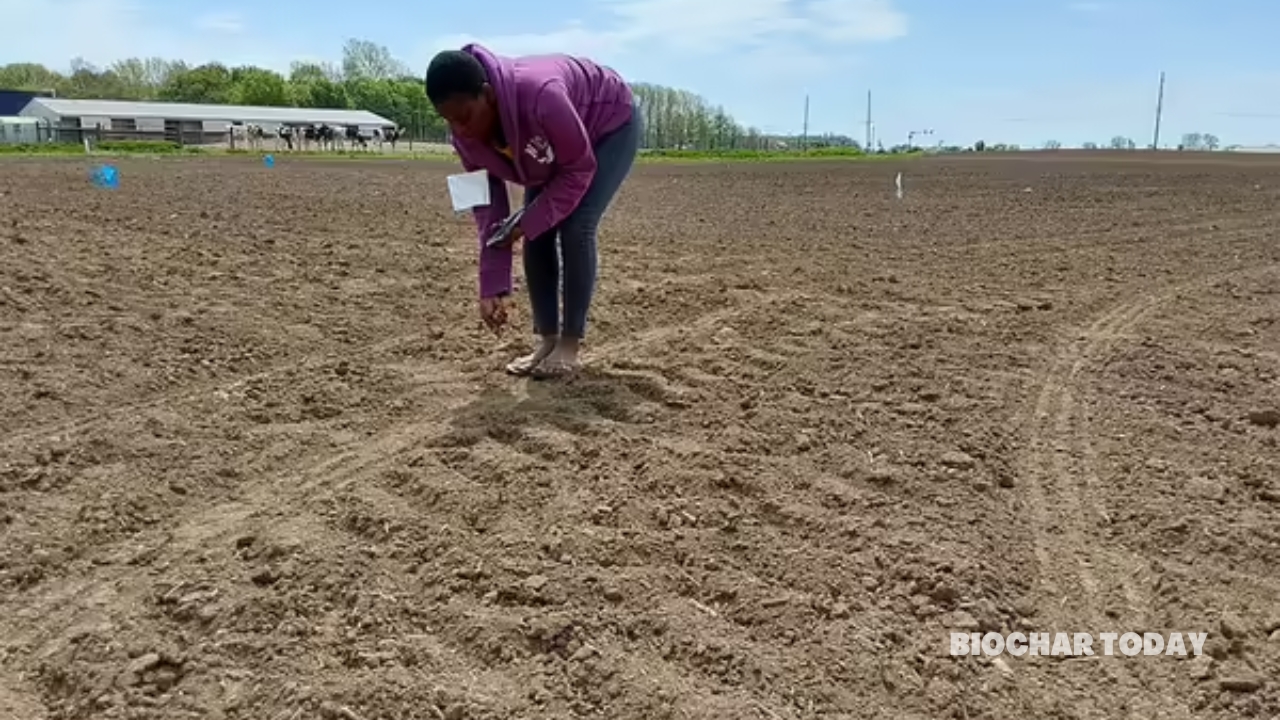
Researchers at the University of Illinois Urbana-Champaign have conducted a field and laboratory study to evaluate the efficacy of “designer” biocharBiochar is a carbon-rich material created from biomass decomposition in low-oxygen conditions. It has important applications in environmental remediation, soil improvement, agriculture, carbon sequestration, energy storage, and sustainable materials, promoting efficiency and reducing waste in various contexts while addressing climate change challenges. More pellets in capturing and recycling phosphorus from agricultural tile drainage. The study investigated the performance of these pellets—engineered from sawdust, bentonite clay, and lime sludge—under real-world conditions in Central Illinois. While laboratory tests using pure phosphate solutions showed promising results, the research aimed to determine how these materials perform when exposed to the complex chemical and biological dynamics of actual agricultural effluents.
The primary challenge addressed by the study is the unpredictable nature of phosphorus sorption in field environments compared to controlled laboratory settings. In the United States, particularly in the Midwest, tile drainage systems effectively aerate soil but simultaneously transport dissolved phosphorus into waterways, fueling harmful algal blooms. The researchers identified that while designer pellets perform well in simplified environments, agricultural runoff containing cow manure, pesticides, herbicides, and competing ions creates a highly reactive and variable matrix that interferes with the biochar’s binding efficiency.
To address these complexities, the research team developed a specialized biochar pellet designed to maximize surface area and chemical reactivity through the inclusion of lime sludge. The solution involved a two-phase experimental approach: first, placing the pellets at tile drain outlets for one year to monitor capture rates, and second, applying both “new” and “spent” (phosphorus-saturated) pellets directly to cornfield research plots. This strategy was designed to test a circular nutrient economy where biochar acts first as a filter for runoff and subsequently as a slow-release fertilizer for crop production.
The study’s outcomes revealed that pHpH is a measure of how acidic or alkaline a substance is. A pH of 7 is neutral, while lower pH values indicate acidity and higher values indicate alkalinity. Biochars are normally alkaline and can influence soil pH, often increasing it, which can be beneficial More is the critical regulator of phosphorus dynamics; higher soil pH levels were associated with increased phosphate removal via precipitation. However, the pellets exhibited less predictable behavior in the presence of complex organic matter and microbial populations found in cow manure. The results underscore that while designer biochar pellets hold significant potential for nutrient management, their application requires precise pre-testing of soil phosphorus levels and an understanding of site-specific chemistry. These findings indicate that moving beyond laboratory simplifications is essential for developing reliable biochar-based filtration systems for international agricultural applications.




Leave a Reply