
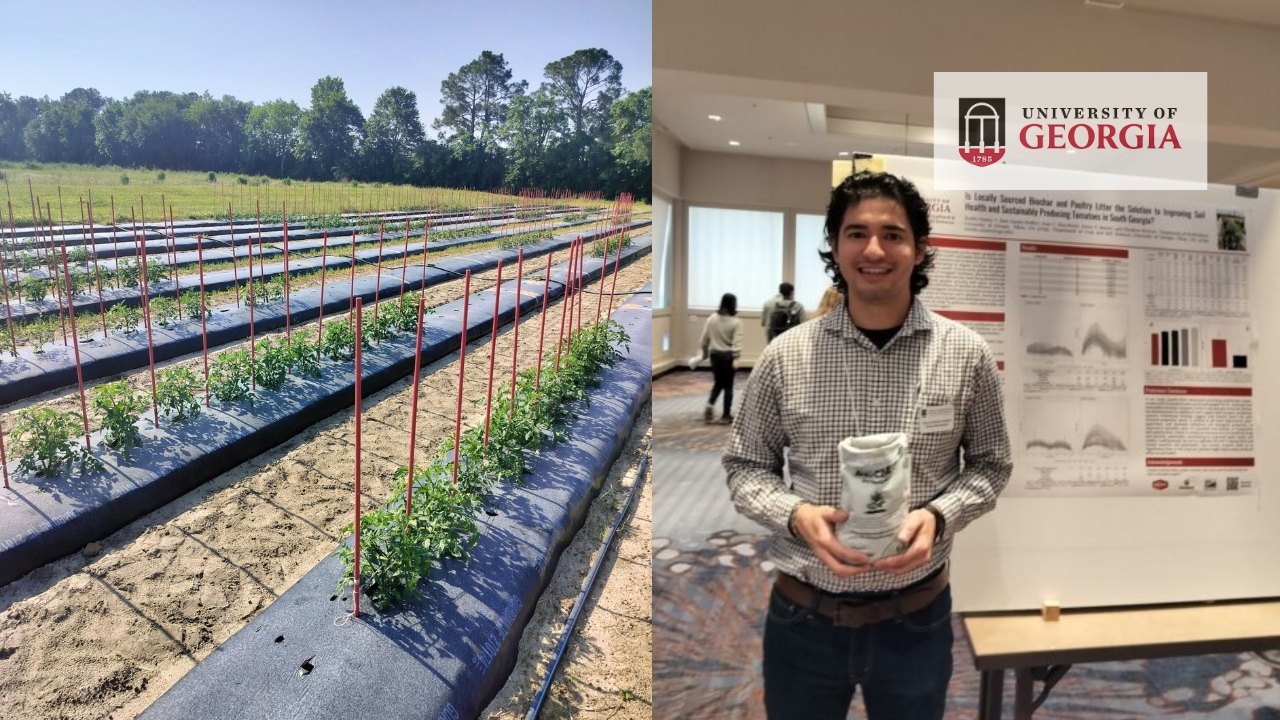
Researchers at the University of Georgia have concluded a two-year study evaluating the efficacy of biochar as a soil amendmentA soil amendment is any material added to the soil to enhance its physical or chemical properties, improving its suitability for plant growth. Biochar is considered a soil amendment as it can improve soil structure, water retention, nutrient availability, and microbial activity. More in plasticulture tomato production. The project, funded through a Southern Sustainable Agriculture Research and Education (SSARE) Graduate Student Grant, horticulture professor Ted McAvoy and graduate student Emilio Suarez Romero investigated the performance of pine wood chip biocharBiochar is a carbon-rich material created from biomass decomposition in low-oxygen conditions. It has important applications in environmental remediation, soil improvement, agriculture, carbon sequestration, energy storage, and sustainable materials, promoting efficiency and reducing waste in various contexts while addressing climate change challenges. More when combined with either organic poultry litter or synthetic fertilizers in south Georgia. The findings indicate that while biochar offers distinct advantages for soil stability and crop quality, its maximum agronomic and economic value is realized when integrated into holistic, organic-based systems. Specifically, the study highlighted that the combination of biochar and poultry litter significantly outperformed biochar paired with conventional inorganic fertilizers across multiple soil health and crop productivity metrics.
A central challenge addressed by the study was the inconsistent performance of biochar when treated as a standalone “silver bullet” for crop yields. In conventional systems using synthetic fertilizers, the researchers observed that active carbon levels actually decreased over the study period, and plant mortality rates were notably higher. Furthermore, nitrogen management remains a persistent difficulty in sandy southern soils, where synthetic nutrients are prone to leachingLeaching is the process where nutrients are dissolved and carried away from the soil by water. This can lead to nutrient depletion and environmental pollution. Biochar can help reduce leaching by improving nutrient retention in the soil. More. The research sought to determine if biochar could mitigate these issues and whether its benefits were universal or dependent on the specific nutrient source applied alongside it.
The proposed solution involved a integrated approach: applying biochar at rates ranging from 0 to 20 tons per acre in conjunction with poultry litter to create a more resilient soil matrix. This organic-based system leveraged the high surface area of biochar to hold the nutrients provided by the litter within the root zone. By substituting the rapid-release profile of synthetic fertigation with the slower, more stable nutrient release of poultry litter, the researchers aimed to foster a more active microbial environment. This strategy shifted the focus from merely adding a product to building a comprehensive biological system capable of sustaining long-term soil health and crop quality.
The outcomes of the University of Georgia study were significant, with the biochar-poultry litter mix yielding a 34 percent higher cation exchange capacity and a 5.6 percent increase in active carbon. In contrast, the synthetic fertilizer plots experienced a 67 percent higher plant mortality rate. Beyond soil health, biochar had a direct impact on fruit quality, reducing the physiological disorder known as “zippering” by up to 47 percent. The study also found a 144 percent gain in total inorganic nitrogen retention at the highest biochar application rates when combined with poultry litter. These results suggest that for growers in the United States, the strategic pairing of biochar with organic waste streams provides a clear path toward both environmental sustainability and enhanced crop resilience.



Leave a Reply