
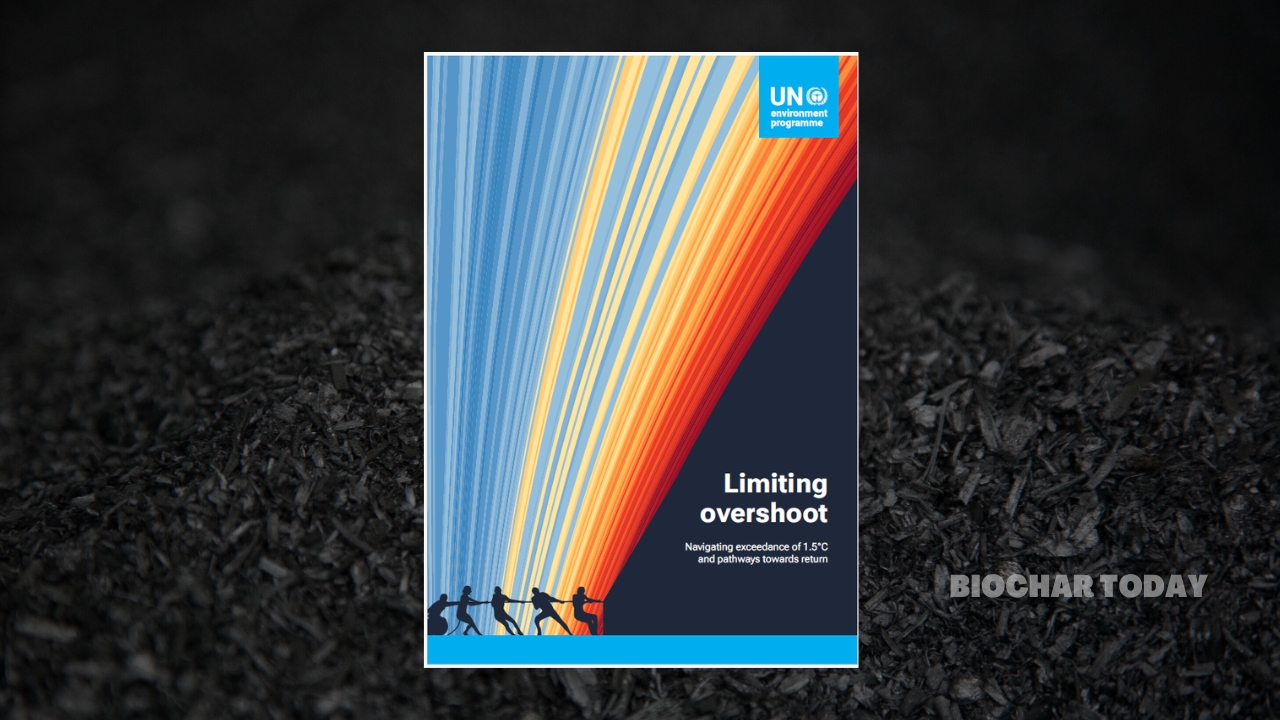
The United Nations Environment Programme (UNEP) has released a major spotlight report, Limiting Overshoot: Navigating Exceedance of 1.5°C and Pathways Towards Return, acknowledging that exceeding the 1.5°C global warming threshold established by the Paris Agreement is now virtually unavoidable in the near term. The publication outlines an “overshoot, peak, and decline” framework designed to manage temperature exceedance, limit peak warming, and eventually reduce global temperatures. The assessment emphasizes that while rapid decarbonization remains the primary climate priority, reaching and sustaining net-negative emissions will require unprecedented deployment of Carbon Dioxide Removal (CDR) pathways, including biocharBiochar is a carbon-rich material created from biomass decomposition in low-oxygen conditions. It has important applications in environmental remediation, soil improvement, agriculture, carbon sequestration, energy storage, and sustainable materials, promoting efficiency and reducing waste in various contexts while addressing climate change challenges. More.
The report addresses the severe ecological and economic risks associated with prolonged climate exceedance, ranging from irreversible tipping points to compounding losses in global food and agricultural security. Relying solely on conventional emissions reductions is no longer sufficient to secure a return to below 1.5°C by the end of the century. Furthermore, hard-to-abate industrial sectors and agricultural practices will continue to produce persistent residual emissions. Without scaling durable carbon removal, the duration and magnitude of global temperature overshoot will increase, significantly compounding climate impacts globally.
To navigate this challenge, UNEP outlines a strategic transition from net-zero targets to sustained net-negative emissions. The report places biochar alongside direct air capture, enhanced rock weathering, and geological storage as essential CDR approaches capable of sequestering carbon while providing biophysical co-benefits. Unlike short-term biological storage prone to reversal, durable pyrogenic carbon storage like biochar offers a practical, scalable mechanism to lock atmospheric carbon into stable forms. UNEP emphasizes that CDR must complement, rather than substitute for, deep emissions reductions and near-term methane mitigation.
The implementation of managed CDR strategies aims to limit peak global warming—potentially capping optimistic scenarios near 1.8°C—and initiate long-term atmospheric carbon drawdown. By deploying biochar alongside broader decarbonization efforts, project developers can deliver atmospheric carbon removal while enhancing agricultural resilience and soil health during peak warming. UNEP underscores that robust governance, standardized measurement protocols, and equitable market structures will be critical to responsibly scaling biochar and other removal technologies to meet the net-negative imperative.




Leave a Reply