
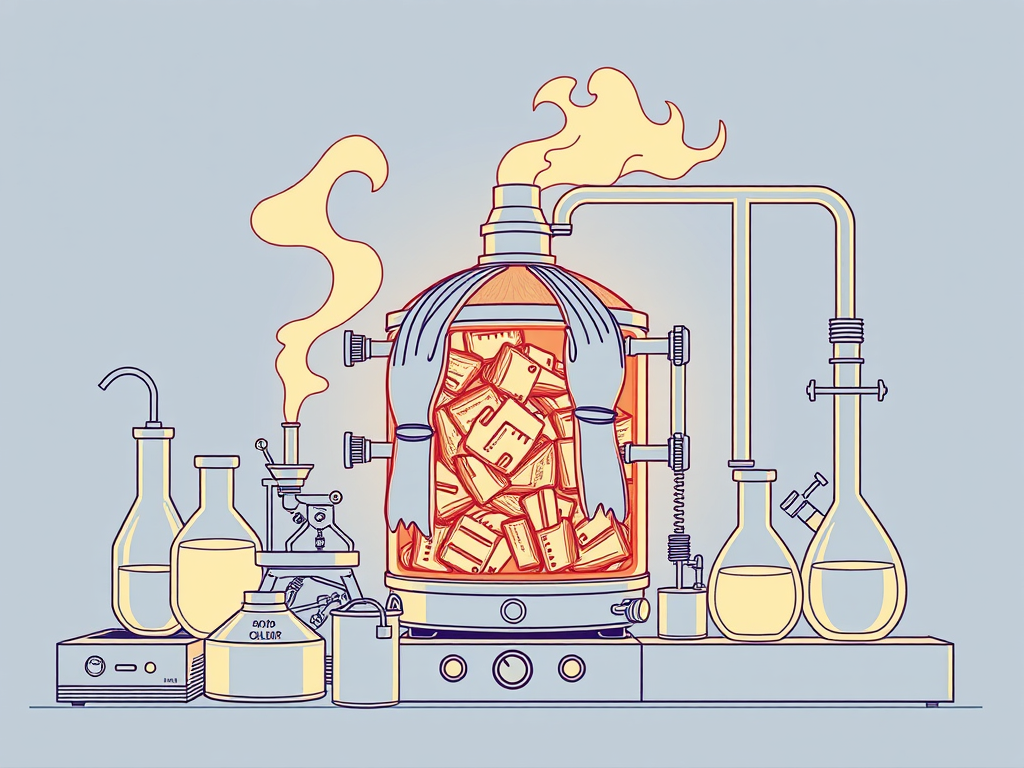
In a recent study published in the International Journal of Automotive and Mechanical Engineering, Abrar Ridwan, Budi Istana, Ridwan Abdurrahman, Israyandi, and Tri Aprio explored the potential of co-pyrolysis to transform mixed medical waste and biomassBiomass is a complex biological organic or non-organic solid product derived from living or recently living organism and available naturally. Various types of wastes such as animal manure, waste paper, sludge and many industrial wastes are also treated as biomass because like natural biomass these More into valuable bio-oil. This research addresses the growing challenge of medical waste, which has seen a dramatic increase, particularly during the COVID-19 pandemic. Improper disposal methods, like incineration, can release harmful pollutants and greenhouse gases, posing significant environmental and health risks. The authors investigated how varying temperature and residence timeResidence time refers to the duration that the biomass is heated during the pyrolysis process. The residence time can influence the properties of the biochar produced. More during co-pyrolysis could optimize bio-oil yield, offering a sustainable alternative for waste management.
Co-pyrolysis is a thermochemical process that converts multiple raw materials into new energy sources in the absence of oxygen. The team used a small-scale batch reactor with an electrically controlled band heater to conduct their experiments. They varied the temperature at 300°C, 400°C, and 500°C, and tested residence times of 10, 15, and 20 minutes. Each batch involved 60 grams of mixed medical glove waste (MGW) and HVSp paper (biomass) at a 75:25 ratio, selected for its previously demonstrated high bio-oil yield. Nitrogen gas flowed into the reactor at 0.5 liters per minute to maintain an inert atmosphere, preventing unwanted reactions like combustion.
The results were quite insightful, revealing a complex relationship between temperature, residence timeThis refers to the amount of time that the biomass is heated during the pyrolysis process. The residence time can influence the characteristics of the biochar, such as its porosity and surface area. More, and product yields. At 300°C, increasing residence time generally enhanced bio-oil yield, reaching a high of 25% at 20 minutes. However, at this lower temperature, the heat was primarily sufficient for evaporating water content, not fully decomposing cellulose. This suggests that while bio-oil production was observed, the conversion efficiency of the raw materials was limited.
A significant leap in bio-oil yield occurred at 400°C. Here, extending the residence time consistently increased bio-oil production, reaching an impressive 61% at 20 minutes. This is a substantial increase compared to the 300°C experiments, with bio-oil yield differences of 10% and 16% as residence time increased from 10 to 20 minutes. The researchers attributed this to more effective devolatilization reactions at higher temperatures, leading to better breakdown of organic compounds and increased liquid yield. This temperature seems to be optimal for maximizing bio-oil production from this specific feedstockFeedstock refers to the raw organic material used to produce biochar. This can include a wide range of materials, such as wood chips, agricultural residues, and animal manure. More mix.
However, the trend reversed at 500°C. While bio-oil yield was still significant, it decreased with longer residence times, falling from 55% at 10 minutes to 46% at 20 minutes. Conversely, the production of syngasSyngas, or synthesis gas, is a fuel gas mixture consisting primarily of hydrogen and carbon monoxide. It is produced during gasification and can be used as a fuel source or as a feedstock for producing other chemicals and fuels. More (non-condensable gas) increased. This phenomenon is explained by secondary cracking reactions of the co-pyrolysis vapor at very high temperatures, which further decompose the material into gas rather than liquid. This highlights a critical balance: while higher temperatures generally promote decomposition, excessively high temperatures can lead to a shift from liquid to gaseous products.
The bio-oil produced from these experiments exhibited promising characteristics as an alternative fuel. It had a high calorific value of 46.334 MJ/kg, comparable to that of gasoline (44.4 MJ/kg) and diesel (45.4 MJ/kg). While its viscosity was higher than that of SNI Biodiesel, its density was similar to diesel fuel. The moisture content of 0.611% was higher than that of SNI Biodiesel (0.05%), likely due to the paper biomass component, but still within acceptable limits for bio-oil products.
In conclusion, the study successfully demonstrated that co-pyrolysis of medical glove waste and HVS paper is a viable method for producing bio-oil. The optimal conditions identified were a temperature of 400°C and a residence time of 20 minutes, yielding the highest bio-oil percentage of 61%. This research provides valuable insights into converting hazardous medical waste and biomass into a high-value energy source, contributing to both waste management and renewable energy efforts.
Source: Ridwan, A., Istana, B., Abdurrahman, R., Israyandi, & Aprio, T. (2025). Investigating Bio-Oil Yield from Co-pyrolysis of Mixed Medical Waste and Biomass under Varying Temperature and Residence Time. International Journal of Automotive and Mechanical Engineering, 22(2), 12293–12303.





Leave a Reply