
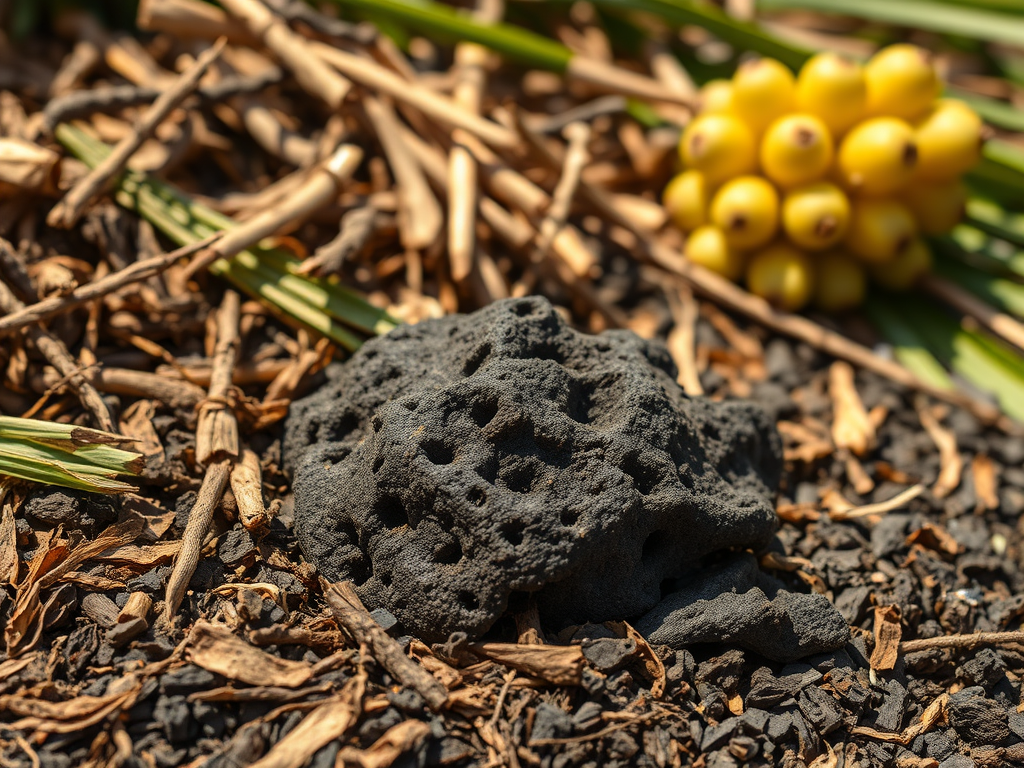
Rehali et al., in a study featured in Scientific African, explore the potential of converting date palm residues (DPR) into biocharBiochar is a carbon-rich material created from biomass decomposition in low-oxygen conditions. It has important applications in environmental remediation, soil improvement, agriculture, carbon sequestration, energy storage, and sustainable materials, promoting efficiency and reducing waste in various contexts while addressing climate change challenges. More, a valuable soil amendmentA soil amendment is any material added to the soil to enhance its physical or chemical properties, improving its suitability for plant growth. Biochar is considered a soil amendment as it can improve soil structure, water retention, nutrient availability, and microbial activity. More, through a process known as slow pyrolysisPyrolysis is a thermochemical process that converts waste biomass into bio-char, bio-oil, and pyro-gas. It offers significant advantages in waste valorization, turning low-value materials into economically valuable resources. Its versatility allows for tailored products based on operational conditions, presenting itself as a cost-effective and efficient More. Date palms, extensively cultivated in arid and semi-arid regions, generate substantial amounts of waste, posing environmental challenges. This research investigates a sustainable solution for managing this waste while creating a beneficial resource for agriculture.
The researchers utilized DPR collected from a date palm grove in southeastern Morocco, consisting of leaves, leaf stems, rachis, and fruit bunches. These residues were processed through slow pyrolysis at 500°C, yielding biochar with a high fixed carbon content (70.74%) and a porous structure, ideal for enhancing soil health and promoting plant growth. The study delves into the physicochemical properties of the produced biochar, highlighting its potential benefits for agricultural applications. The biochar demonstrated a high pHpH is a measure of how acidic or alkaline a substance is. A pH of 7 is neutral, while lower pH values indicate acidity and higher values indicate alkalinity. Biochars are normally alkaline and can influence soil pH, often increasing it, which can be beneficial More (9.19), indicating its ability to neutralize acidic soils, and a cation exchange capacity (CEC) of 68.05 cmol/kg, reflecting its capacity to retain essential nutrients.
Furthermore, the biochar exhibited a low nitrogen content (0.74%), suggesting its stability and potential for long-term carbon sequestration in the soil. This characteristic is crucial for mitigating climate change and promoting sustainable agriculture. The findings of this study underscore the potential of biochar production as a sustainable waste management strategy and a valuable resource for improving soil fertility. By transforming date palm waste into biochar, this research offers a promising solution for enhancing agricultural practices while addressing environmental concerns.
Source: Rehali, M., El Ghachtouli, N., Lange, F. S., & Bouamri, R. (2025). Valorization of Date Palm Residues for Biochar Production: Assessing Biochar Characteristics for Agricultural Application. Scientific African, https://doi.org/10.1016/j.sciaf.2025.e02599




Leave a Reply