
Key Takeaways
- Recycling local green waste into charcoal-like soil amendments provides a sustainable alternative to traditional chemical fertilization.
- Combining biocharBiochar is a carbon-rich material created from biomass decomposition in low-oxygen conditions. It has important applications in environmental remediation, soil improvement, agriculture, carbon sequestration, energy storage, and sustainable materials, promoting efficiency and reducing waste in various contexts while addressing climate change challenges. More with beneficial microorganisms allows farmers to achieve high crop growth without any synthetic nitrogen, phosphorus, or potassium inputs.
- This organic treatment significantly protects sensitive crops from the damaging effects of salty water and poor soil quality.
- The natural mixture helps plants absorb more essential nutrients while reducing the buildup of toxic sodium by forty-two percent.
- Using these bio-based materials supports a circular economy by turning woody waste into “black gold” for long-term soil health.
A recent study published in Scientific Reports, authors Soumaya Tounsi-Hammami, Munawwar Ali Khan, Mahra Alqemzi, Salama Ali Almehairi, and Aneesa Rasheed Anwar demonstrate a transformative approach to sustainable agriculture. Their research focuses on recycling green waste from date palm and ghaf trees into a carbon-rich biochar to improve the resilience of tomato seedlings. This innovation addresses the growing global challenge of maintaining crop productivity in arid regions where farmers frequently encounter the dual burden of nutrient-poor soils and high water salinity. By integrating local waste management with microbial biotechnology, the study provides a practical roadmap for reducing the heavy reliance on synthetic fertilizers that often leads to environmental degradation and nutrient runoff.
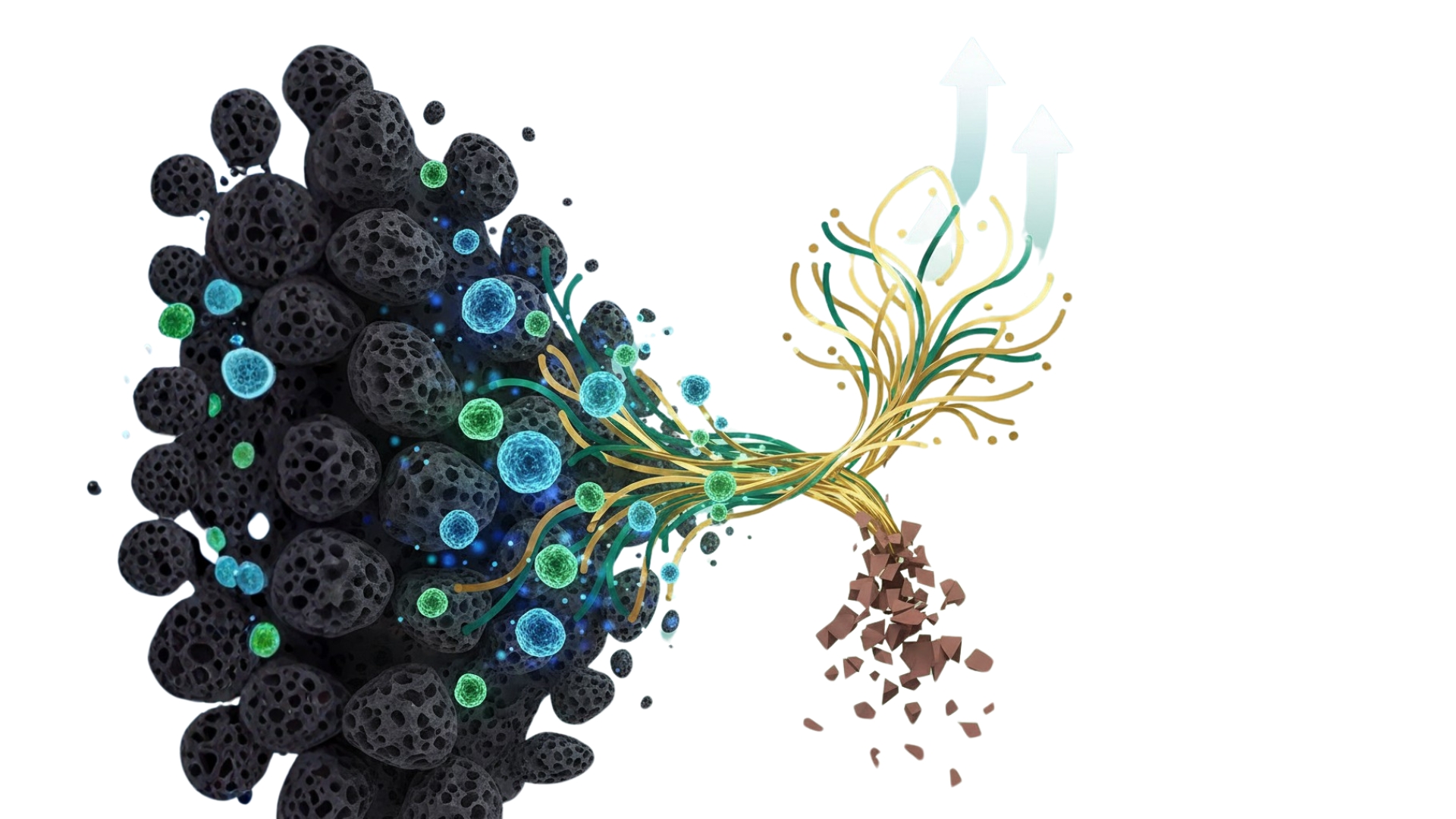
The findings reveal that the physical and chemical transformation of green waste into biochar creates a stable, porous material that acts as a long-term carbon sink in the soil. This biochar features a complex honeycomb-like structure that serves as a protective habitat for beneficial soil microbes. When applied alone, the biochar showed a significant ability to enhance soil nutrient retention and water-holding capacity. However, the most striking results emerged when the biochar was co-applied with a specialized mix of halotolerant Bacillus bacteria. This synergistic pairing created a high-performance growing environment that allowed tomato seedlings to thrive even when synthetic fertilizer was completely eliminated from the production cycle.
The quantitative benefits of this combined treatment were particularly evident under saline conditions, which typically stifle plant development. Seedlings treated with the biochar and bacterial mix showed massive increases in morphological parameters, including stem diameter and root length, ranging from 40% to 150% compared to plants receiving standard chemical fertilization. Physiological health also saw a dramatic boost, with leaf relative water content improving by 94%. These improvements are likely driven by the ability of the bacteria to produce growth-regulating hormones and the capacity of the biochar to trap toxic sodium ions through electrostatic attraction. This dual action prevents salt from moving into the plant tissue, thereby preserving the photosynthetic system and allowing for robust biomassBiomass is a complex biological organic or non-organic solid product derived from living or recently living organism and available naturally. Various types of wastes such as animal manure, waste paper, sludge and many industrial wastes are also treated as biomass because like natural biomass these More accumulation.
Beyond immediate growth metrics, the study highlights how this biological approach enhances the nutritional quality of the crops. The integrated treatment resulted in significantly higher levels of essential macro and micronutrientsThese are essential nutrients that plants need in small amounts, kind of like vitamins for humans. They include things like iron, zinc, and copper. Biochar can help hold onto these micronutrients in the soil, making them more available to plants. More, such as nitrogen, phosphorus, and iron, compared to plants grown under salt stress with conventional chemicals. This enrichment suggests that bio-based soil amendments do not just support plant survival but actively foster superior physiological vigor. By replacing synthetic inputs with recycled organic materials, the research supports the transition toward a circular bioeconomy that is both economically viable and climate-resilient. This strategy offers a sustainable solution for food security in hyper-arid environments, proving that agricultural waste can indeed be converted into a valuable resource for future farming.
Source: Tounsi-Hammami, S., Khan, M. A., Alqemzi, M., Almehairi, S. A., & Anwar, A. R. (2025). Green waste biochar and plant growth-promoting bacteria enhance tomato growth under combined nutrient deficiency and salinity stress. Scientific Reports.


Leave a Reply