
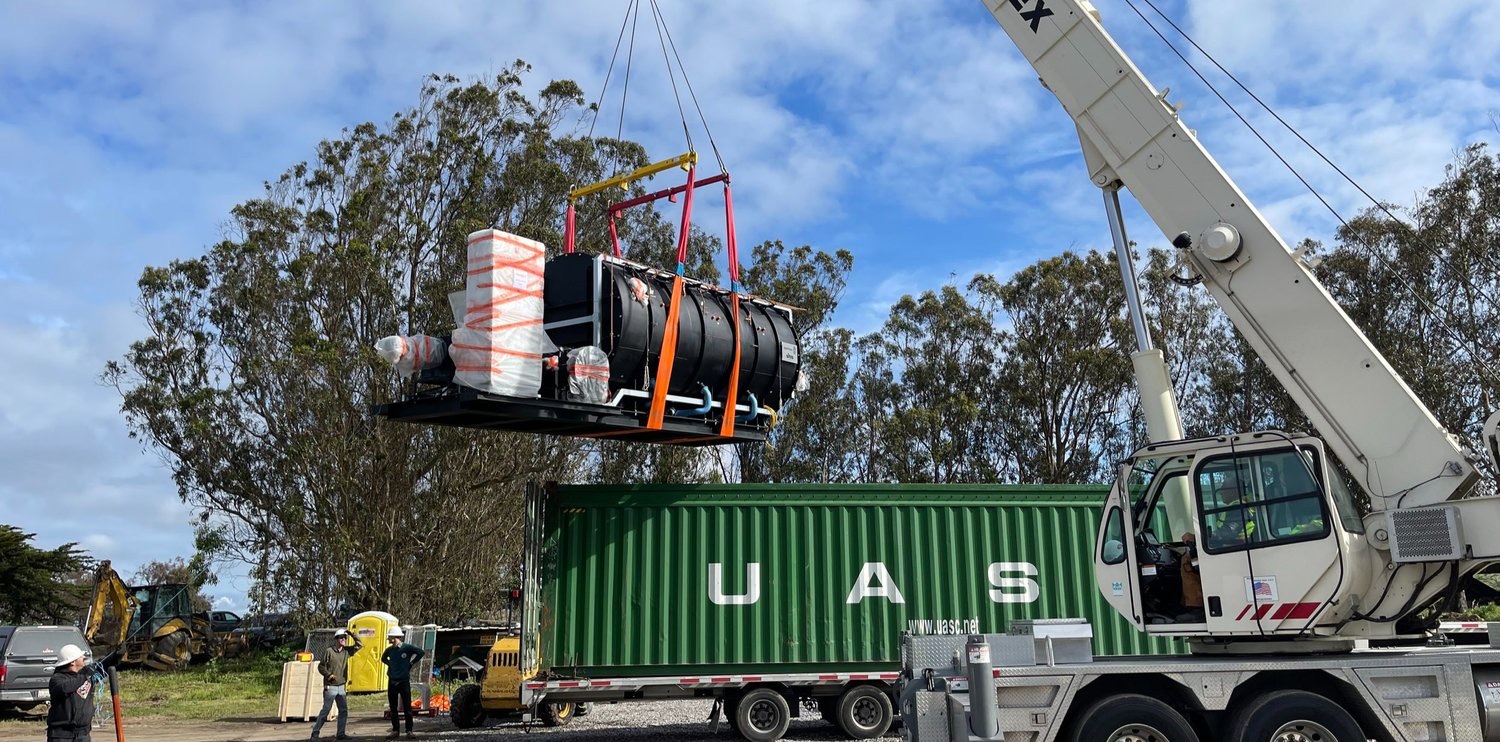
For two years, the Sitos Group operated a pilot-scale biocharBiochar is a carbon-rich material created from biomass decomposition in low-oxygen conditions. It has important applications in environmental remediation, soil improvement, agriculture, carbon sequestration, energy storage, and sustainable materials, promoting efficiency and reducing waste in various contexts while addressing climate change challenges. More production facility at ReGen Monterey, recently concluding the project. This initiative served as a practical proving ground for biochar production, advancing climate technology, carbon removal, and regenerative agriculture. The project aimed to demonstrate consistent and sustainable production of high-quality biochar, aligning with agricultural demands and carbon market specifications, utilizing slow pyrolysisPyrolysis is a thermochemical process that converts waste biomass into bio-char, bio-oil, and pyro-gas. It offers significant advantages in waste valorization, turning low-value materials into economically valuable resources. Its versatility allows for tailored products based on operational conditions, presenting itself as a cost-effective and efficient More technology.
The facility evolved beyond a simple proof-of-concept, becoming a hub for examining biochar’s role in agriculture, its potential for carbon dioxide removal (CDR), and its integration into circular economy models. Key activities included validating the slow pyrolysis technology under real-world conditions, refining operational practices, and establishing a robust proof of concept with stakeholders across climate and agricultural technology sectors.
Operational insights gained during the pilot are now foundational for commercial-scale projects. The type and quality of feedstockFeedstock refers to the raw organic material used to produce biochar. This can include a wide range of materials, such as wood chips, agricultural residues, and animal manure. More proved critical; clean agricultural biomassBiomass is a complex biological organic or non-organic solid product derived from living or recently living organism and available naturally. Various types of wastes such as animal manure, waste paper, sludge and many industrial wastes are also treated as biomass because like natural biomass these More with optimal moisture content and particle size significantly improved biochar yield and quality. Post-processing techniques, including quenching, curing, and composting, were essential for enhancing the agronomic value and storage stability of the biochar. Precise system controls over airflow, internal temperatures, and feedstock residence timeResidence time refers to the duration that the biomass is heated during the pyrolysis process. The residence time can influence the properties of the biochar produced. More directly influenced the physical and chemical properties of the final product.
The pilot facility exemplified a working circular economy. In collaboration with Keith Day Company, previously underutilized biomass was converted into biochar, a carbon-rich soil amendmentA soil amendment is any material added to the soil to enhance its physical or chemical properties, improving its suitability for plant growth. Biochar is considered a soil amendment as it can improve soil structure, water retention, nutrient availability, and microbial activity. More. This biochar was then blended into compost and applied to local agricultural lands. This closed-loop system not only enhanced soil health but also highlighted biochar’s immediate potential for resource efficiency and long-term carbon sequestration.
Beyond agriculture, the pilot significantly advanced the understanding of biochar as a reliable and measurable CDR solution. Sitos Group developed a comprehensive monitoring, reporting, and verification (MRV) system, tracking data from production to application, ensuring compliance with evolving carbon market standards. A notable achievement was securing a groundbreaking air permit for the pyrolysis system, formally recognizing it as not being an incinerator under 40 CFR 60 Subpart EEEE. This validates slow pyrolysis as a clean, climate-beneficial technology.
The insights from this pilot are now being applied to a commercial-scale biochar production facility in collaboration with Treehouse California Almonds. This new facility will incorporate the lessons learned, aiming for more efficient throughput, advanced system automation, and deeper integration with agricultural partners. The pilot reinforced the importance of systems thinking and responsible scaling in climate innovation, setting the stage for biochar’s broader impact.
Read More: End of an Era: Sitos Group Concludes Pilot at ReGen Monterey





Leave a Reply