
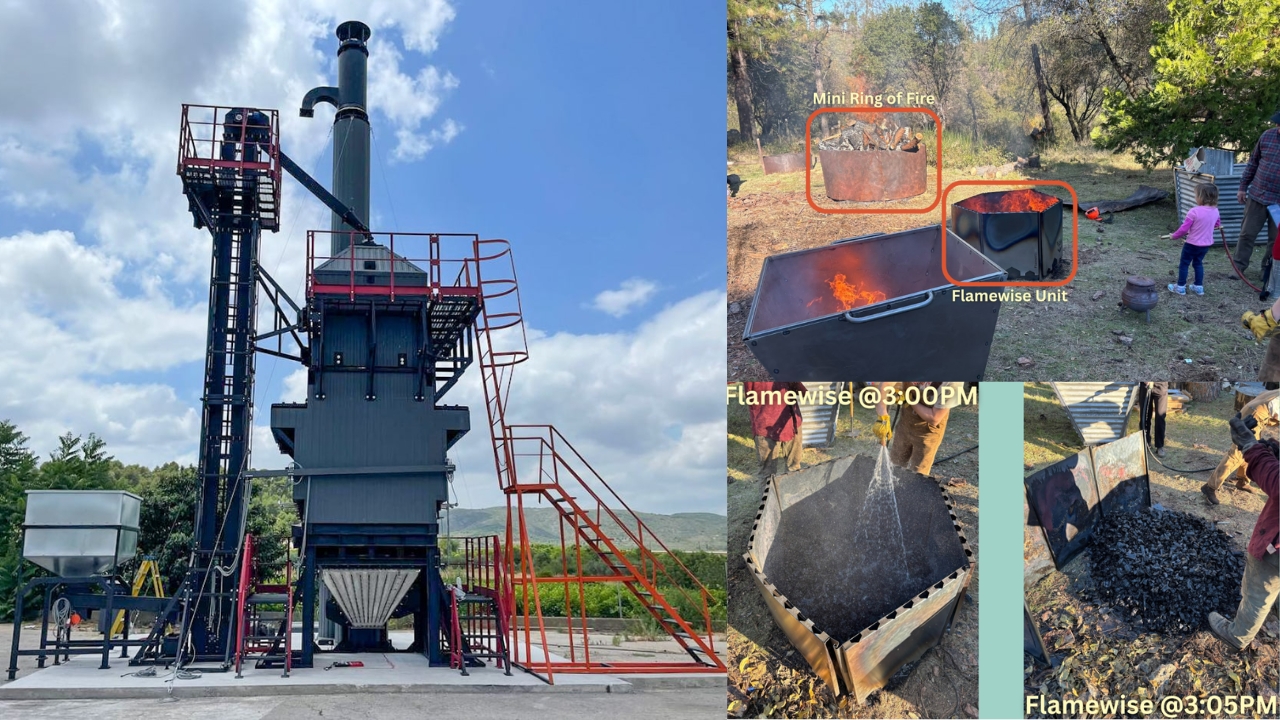
Recently, the Sierra Streams Institute (SSI), a California-based watershed research organization, conducted an field experiment to analyze the operational temperatures of mobile biokilns. Partnering with Tabor Teachout, President of the BiocharBiochar is a carbon-rich material created from biomass decomposition in low-oxygen conditions. It has important applications in environmental remediation, soil improvement, agriculture, carbon sequestration, energy storage, and sustainable materials, promoting efficiency and reducing waste in various contexts while addressing climate change challenges. More Coalition, the study utilized thermocouples to collect empirical data from rugged outdoor burn sites in the Sierra Nevada foothills. The investigation compared established kiln models with the Flamewise, a new design from Seattle, Washington, to establish baseline data for small-scale pyrolysisPyrolysis is a thermochemical process that converts waste biomass into bio-char, bio-oil, and pyro-gas. It offers significant advantages in waste valorization, turning low-value materials into economically valuable resources. Its versatility allows for tailored products based on operational conditions, presenting itself as a cost-effective and efficient More.
The industry currently faces a lack of data-backed science regarding biokiln performance in unmanaged outdoor environments. While laboratory-controlled pyrolysis is well-documented, mobile units used for land stewardship lack quantified thermal profiles. This knowledge gap creates uncertainty for operators like Teachout, who hypothesized that kiln temperatures generally remain below 600°F. Without precise data, it is difficult to optimize carbon yields or ensure that heat does not reach levels lethal to the local soil biome.
SSI addressed this challenge by deploying thermocouples and dataloggers at depths of 10 centimeters to monitor both internal combustion and surrounding soil temperatures. The experiment measured a traditional biokiln against the Flamewise unit during active fuel processing. Findings revealed that the Flamewise biokiln maintained lower temperatures for shorter durations, reading above 600°F for only 44 minutes compared to over two hours in other measured units. Additionally, the introduction of invasive species like Scotch Broom and Blackberry caused significant, localized temperature spikes during the process.
The outcomes of this study provide critical insights for the refinement of small-scale biochar equipment and techniques. The data confirmed that while internal spikes occurred, soil temperatures remained below the 140°F threshold that causes microbial sterilization. These results validate the safety of mobile kilns for forest health projects while highlighting the need for more deliberate mixing of feedstocks to stabilize pyrolysis levels. SSI intends to use these findings to design more accurate experiments that will enhance the viability of community-scale carbon sequestration.


Leave a Reply