
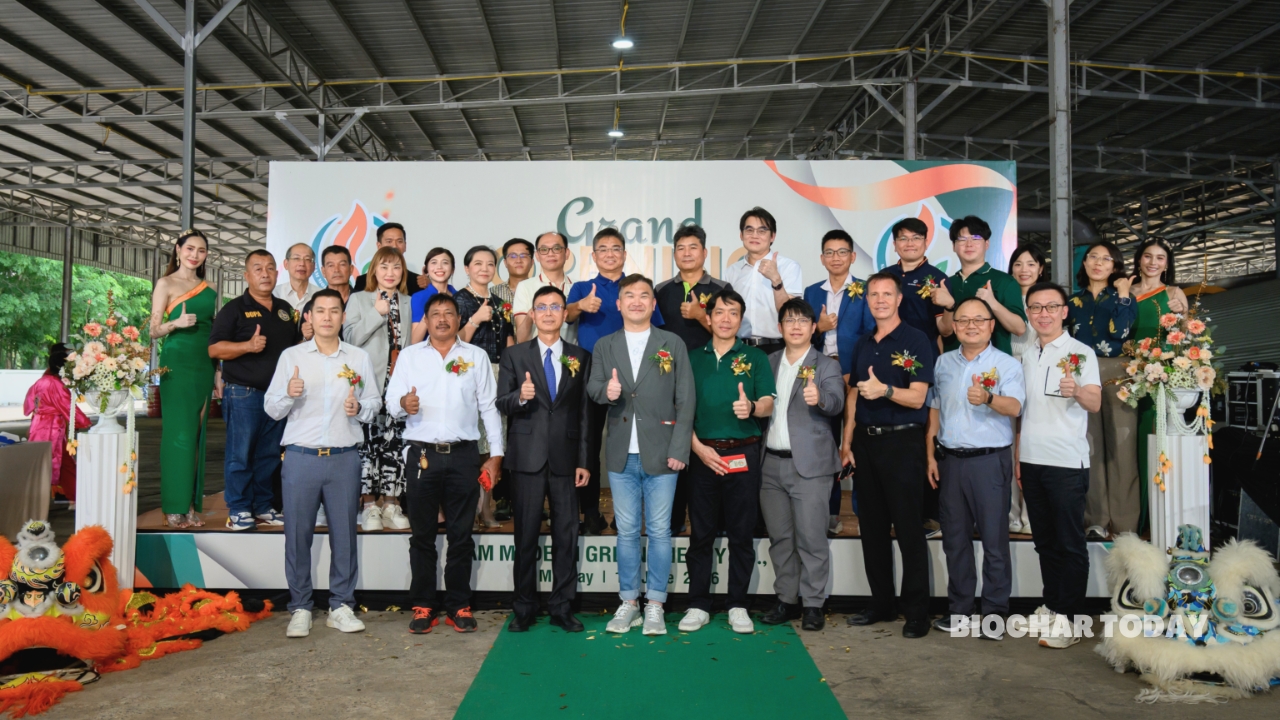
Siam Modern Green Energy (SMGE) officially celebrated the grand opening of its new manufacturing plant in Surat Thani, Thailand, on June 15, 2026. The opening ceremony brought together a diverse group of regional stakeholders, including Mr. Tseng, Director of the Economic Division at the Taipei Economic and Cultural Office in Thailand, alongside local Thai regulatory authorities and international delegates from organizations such as Siam Modern Palm, Green Jump, Kangsi Energy, and Sawa Ecosolutions Inc. The facility is designed to convert local agricultural waste into high-quality biocharBiochar is a carbon-rich material created from biomass decomposition in low-oxygen conditions. It has important applications in environmental remediation, soil improvement, agriculture, carbon sequestration, energy storage, and sustainable materials, promoting efficiency and reducing waste in various contexts while addressing climate change challenges. More and certified carbon removal credits, creating a formalized biochar industrial chain in Southeast Asia.
A central challenge addressed by the establishment of this facility is the inefficient disposal of regional agricultural residues and the resulting atmospheric carbon emissions. In agricultural hubs like Southern Thailand, vast quantities of biomassBiomass is a complex biological organic or non-organic solid product derived from living or recently living organism and available naturally. Various types of wastes such as animal manure, waste paper, sludge and many industrial wastes are also treated as biomass because like natural biomass these More waste are frequently burned or left to decompose, releasing unstable carbon dioxide directly into the atmosphere and exacerbating regional air pollution. Furthermore, the local economy lacks structured, transparent supply chains capable of transforming these abundant waste materials into verified, permanent carbon removal assets that satisfy international net-zero compliance and corporate environmental mandates.
To resolve these inefficiencies, SMGE implemented a processing framework that transforms local raw agricultural waste through systematic screening, crushing, and drying. The finalized feedstockFeedstock refers to the raw organic material used to produce biochar. This can include a wide range of materials, such as wood chips, agricultural residues, and animal manure. More is processed using advanced pyrolysisPyrolysis is a thermochemical process that converts waste biomass into bio-char, bio-oil, and pyro-gas. It offers significant advantages in waste valorization, turning low-value materials into economically valuable resources. Its versatility allows for tailored products based on operational conditions, presenting itself as a cost-effective and efficient More equipment, which locks volatile organic carbon into a stable crystalline structure, preventing the release of greenhouse gases. Strategically, the plant establishes a traceable carbon management ecosystem by integrating third-party verified Measurement, Reporting, and Verification (MRV) methodologies, which allows the company to issue high-integrity carbon removal certificates for global voluntary carbon markets.
The operational outcomes of the manufacturing facility scale across both economic and environmental metrics. By localizing the industrial supply chain, the plant generates sustainable employment opportunities and builds new revenue streams for regional farmers who provide the residual biomass feedstock. Environmental results include the permanent sequestration of atmospheric carbon dioxide for centuries, providing corporate buyers with verifiable assets to offset residual emissions. Ultimately, the commercial alignment between SMGE and its international partners from Taiwan, Malaysia, and Cambodia demonstrates a scalable infrastructure model for regional tax growth and agricultural resource circularity.




Leave a Reply