
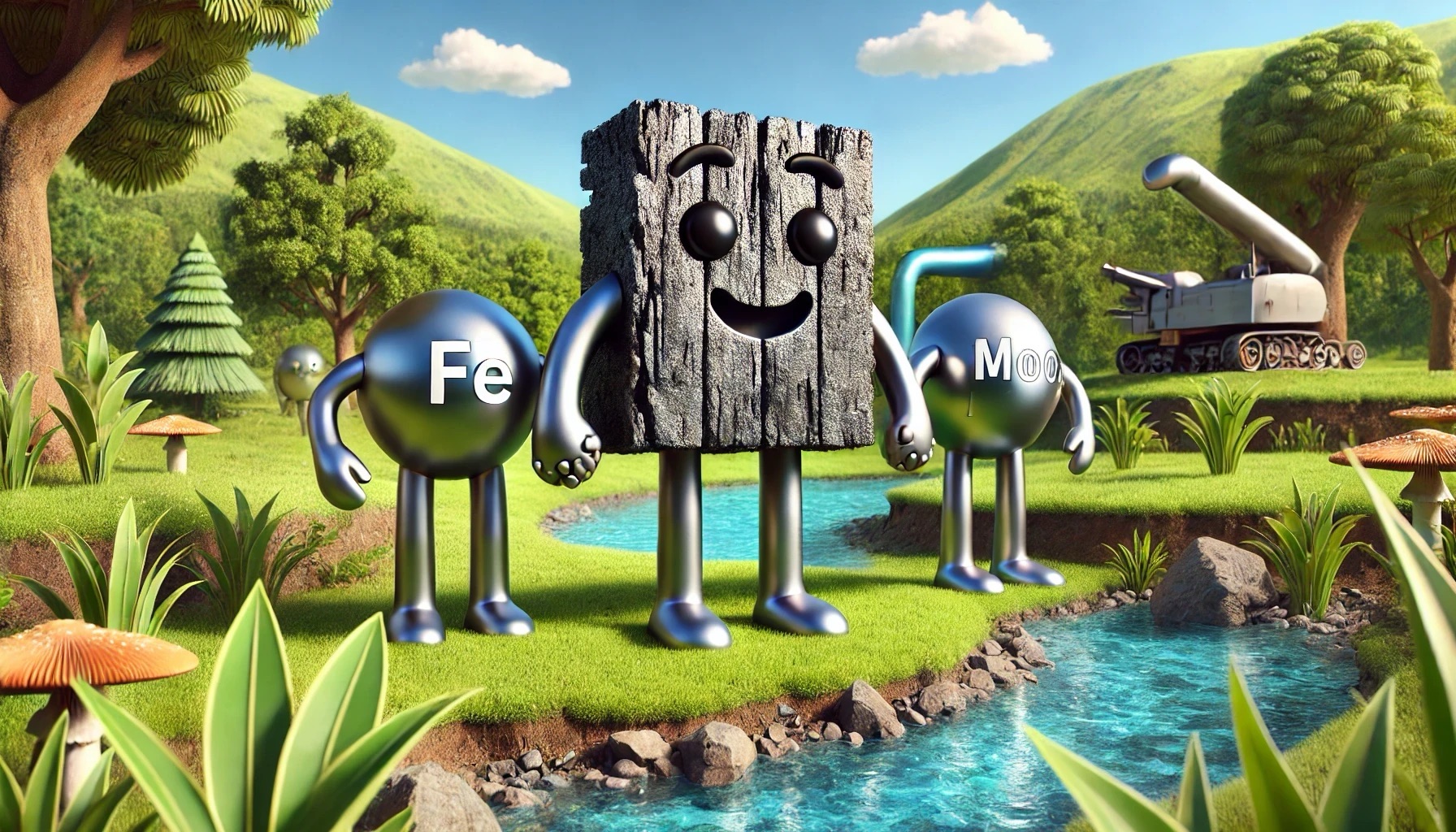

Researchers have developed a new approach to tackle organic pollutants in water using biochar loaded with bimetallic Fe/Mo (Fe/Mo-BC) as a catalyst. By integrating molybdenum dioxide (MoO2) as a co-catalyst, the cycling of iron ions (Fe2+/Fe3+) is significantly enhanced. This innovation facilitates the activation of peroxydisulfate (PDS), a powerful oxidizing agent, resulting in the effective degradation of pollutants like tetracycline (TC).
The Fe/Mo-BC catalyst demonstrates remarkable efficiency, degrading 74.49% of TC within just 10 minutes. It also performs well across a broad pHpH is a measure of how acidic or alkaline a substance is. A pH of 7 is neutral, while lower pH values indicate acidity and higher values indicate alkalinity. Biochars are normally alkaline and can influence soil pH, often increasing it, which can be beneficial More range (3–9), making it versatile for different environmental conditions. Advanced techniques like quenching experiments and electron paramagnetic resonance analyses revealed that the degradation process involves several reactive oxygen species (ROS), with singlet oxygen (1O2) and hydroxyl radicals (•OH) playing dominant roles.
Notably, the Fe/Mo-BC catalyst exhibits strong stability and reusability, maintaining its effectiveness through multiple cycles. This durability underscores its potential for practical, large-scale applications in wastewater treatment.
The study delves into the chemical pathways of TC degradation facilitated by the Fe/Mo-BC/PDS system, employing techniques like liquid chromatography-mass spectrometry (LC-MS) and density functional theory (DFT) calculations. These insights pave the way for further advancements in biochar-based materials for environmental remediation.
This innovative use of Fe/Mo co-doping in biochar presents a cost-effective, efficient, and adaptable solution for the degradation of persistent organic pollutants, addressing a critical need in environmental technology.




Leave a Reply