
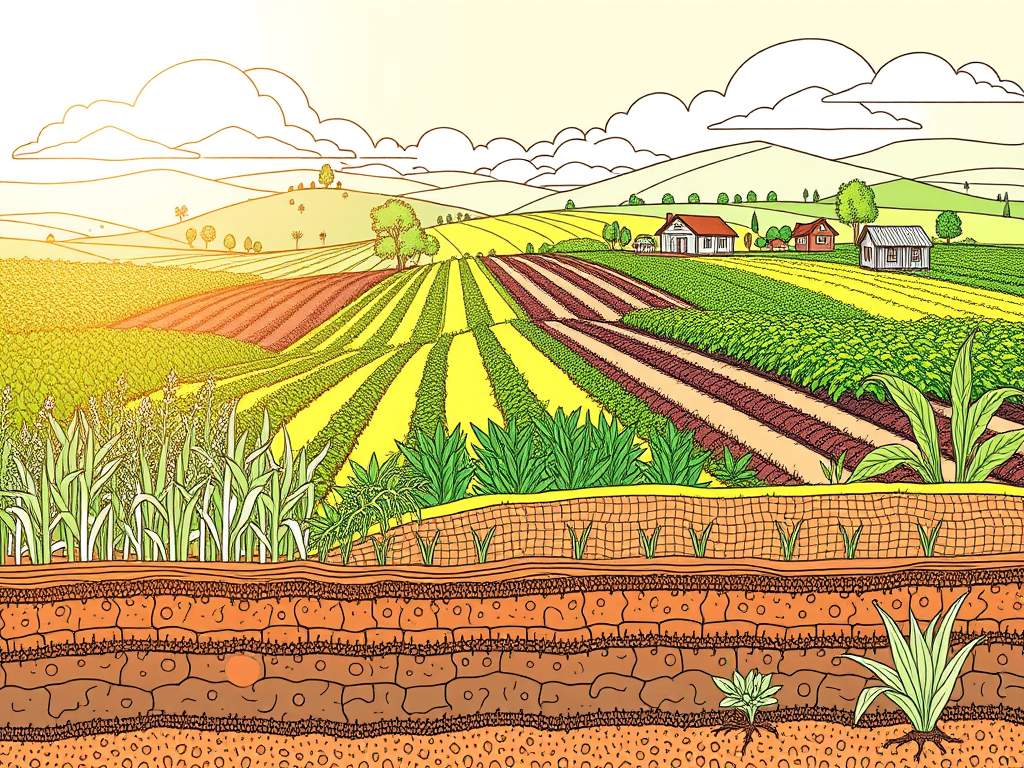
Conventional agricultural practices, including extensive tillage, monoculture farming, and excessive use of synthetic chemical fertilizers, have historically increased productivity but often at the cost of environmental degradation, particularly impacting soil ecosystems. Soil is the largest terrestrial carbon (C) reservoir, with soil organic carbon (SOC) levels reflecting the balance between C inputs and losses. Deteriorating soil health disrupts this balance, leading to reduced fertility, nutrient depletion, increased erosion, and amplified greenhouse gas (GHG) emissions like carbon dioxide (CO2) and nitrous oxide (N2O), thereby exacerbating climate change. A recent review in Catena by Abhay Kumar, Gabriele Antoniella, Emanuele Blasi, and Tommaso Chiti synthesizes the latest research on regenerative management strategies, offering a comprehensive analysis of their effects on SOC content and turnover in agricultural systems across various environments.
Regenerative agriculture focuses on restoring biological and ecological balance in soil. Key practices include conservation agriculture (e.g., reduced or no-tillage), crop rotation, cover cropping, organic management (e.g., manure and compost application), and agroforestry. These strategies promote soil C sequestration, enhance biogeochemical cycling, and increase resilience to environmental fluctuations. The review is based on an extensive analysis of 283 studies, encompassing both short and long-term field trials, providing a robust understanding of how sustainable soil management can enhance the SOC pool and C-sequestration.
One of the most significant findings is the impact of reduced tillage and no-tillage (NT) practices on SOC accumulation. A long-term study in Canada showed that NT combined with crop rotation increased SOC levels by 32% at Ridgetown and 49% at Elora, also improving crop productivity by 16% and 29% respectively. Another study found that reduced tillage (RT) and NT significantly increased SOC accumulation by 116% and 131% at 0-10 cm depth, with RT leading to a 159% increase in soil organic matter (SOM) at 10-25 cm depth compared to conventional tillage. These gains were positively correlated with a stable fungal network and enhanced microbial diversity, highlighting the importance of microbial communities in supporting agroecosystem sustainability under conservation tillage.
Crop rotation, the practice of alternating different crops on the same land, also proved to be a highly effective strategy for improving soil health and SOC levels. Integrating legumes like oats and alfalfa into potato rotations in semi-arid Inner Mongolia boosted soil biodiversity and enhanced soil physicochemical properties. A long-term double rice cropping system with diverse winter crops increased rice yield by 2.5-4.57% and enhanced SOC levels by 21% compared to a control with winter fallow.
Organic amendments, such as animal manure and biocharBiochar is a carbon-rich material created from biomass decomposition in low-oxygen conditions. It has important applications in environmental remediation, soil improvement, agriculture, carbon sequestration, energy storage, and sustainable materials, promoting efficiency and reducing waste in various contexts while addressing climate change challenges. More, further contribute to increasing SOC content and improving soil quality. Manure application has been shown to increase SOC by an average of 35% (10.7 Mg ha−1), particularly under conventional tillage systems. Long-term manure use enhances SOC stock by improving soil’s physical, chemical, and biological properties, such as reducing soil bulk density, enhancing porosityPorosity of biochar is a key factor in its effectiveness as a soil amendment and its ability to retain water and nutrients. Biochar’s porosity is influenced by feedstock type and pyrolysis temperature, and it plays a crucial role in microbial activity and overall soil health. Biochar More, and increasing nutrient availability. Biochar, a carbon-rich material produced from biomassBiomass is a complex biological organic or non-organic solid product derived from living or recently living organism and available naturally. Various types of wastes such as animal manure, waste paper, sludge and many industrial wastes are also treated as biomass because like natural biomass these More pyrolysisPyrolysis is a thermochemical process that converts waste biomass into bio-char, bio-oil, and pyro-gas. It offers significant advantages in waste valorization, turning low-value materials into economically valuable resources. Its versatility allows for tailored products based on operational conditions, presenting itself as a cost-effective and efficient More, can increase SOC levels by up to 30%, depending on the biochar type and application rate. Field studies have demonstrated that biochar amendments can significantly increase SOC (32-84%), particulate organic carbon (93-323%), and microbial biomass carbon (31-93%) over controls.
Agroforestry, which integrates trees with crops or livestock, offers significant benefits for C sequestration, biodiversity, and soil health. Silvoarable agroforestry, by integrating trees within agricultural landscapes, enhances soil C storage and improves soil health. Studies in Indonesia and Sub-Saharan Africa revealed that agroforestry systems maintain higher SOC levels compared to monoculture farming. Similarly, silvopastoral systems, combining trees and livestock, have been shown to sequester an average of 4.38 Mg ha−1yr−1 of carbon in soil globally.
While regenerative practices offer substantial environmental benefits and economic advantages through reduced input costs and increased yields, their initial implementation can involve high investment costs and a learning curve for farmers. However, the long-term benefits of improved soil health, increased productivity, and enhanced climate resilience far outweigh these challenges. The review emphasizes the need for continued research, policy innovation, and comprehensive support for farmers to facilitate the widespread adoption of these sustainable agricultural approaches.
Source: Kumar, A., Antoniella, G., Blasi, E., & Chiti, T. (2025). Recent advances in regenerative sustainable agricultural strategies for managing soil carbon and mitigating climate change consequences. Catena, 258, 109208.



Leave a Reply