
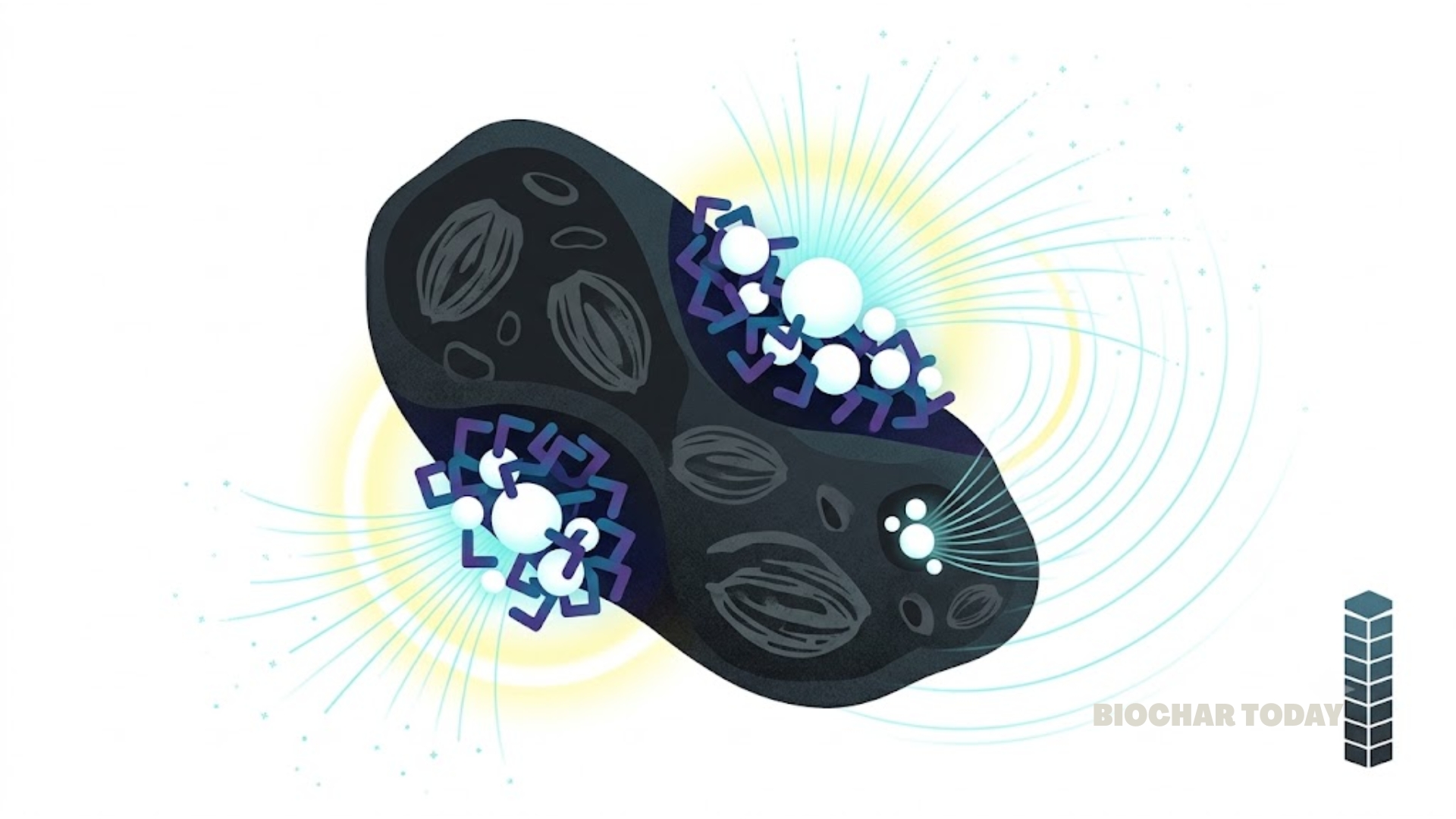
Key Takeaways
- Rice husk biocharBiochar is a carbon-rich material created from biomass decomposition in low-oxygen conditions. It has important applications in environmental remediation, soil improvement, agriculture, carbon sequestration, energy storage, and sustainable materials, promoting efficiency and reducing waste in various contexts while addressing climate change challenges. More altered with phosphate chemical anchors achieves a ten percent calcium peroxide loading capacity.
- Stable calcium and phosphorus bonds allow for a sustained, slow release of oxygen into the water.
- Chemical anchoring ensures steady performance that remains largely unchanged by surrounding acidity or salt levels.
- Standard charcoalCharcoal is a black, brittle, and porous material produced by heating wood or other organic substances in a low-oxygen environment. It is primarily used as a fuel source for cooking and heating. More activation creates massive surface area for fast loading but results in rapid oxygen dump.
- Surface hydrogen to carbon ratios and specific oxygen groups regulate the long-term release speed.
Sustained oxygen supply is essential for maintaining healthy aerobic conditions in commercial aquaculture setups and deep soil remediation projects. Traditional applications utilize solid oxygen compounds like calcium peroxide to counter oxygen depletion, but these raw materials suffer from extreme environmental sensitivity. A major challenge in practical field usage is that varying water conditions severely disrupt the release behavior. Acidic conditions cause an immediate burst release that burns through the oxygen supply too quickly, while high initial dissolved oxygen concentrations create barriers that halt the reaction entirely. This volatility limits reliability, making specialized protective carriers necessary to stabilize the compound.
To address these interfacial reaction limits, researchers engineered three distinct rice husk biochar carriers using nitric acid oxidation, potassium hydroxide activation, and phosphate loading. The experimental team systematically tracked how each modified carrier influenced total compound loading capacity and subsequent oxygen release kinetics under stressful environmental fluctuations. They placed the composite materials into controlled aquatic testing chambers to evaluate performance across a wide spectrum of shifting acid levels, diverse background salt concentrations, and high initial dissolved oxygen environments.
The findings revealed that the choice of engineering strategy completely dictates the operational lifetime and stability of the oxygen-supplying material. The biochar treated with potassium hydroxide generated an immense specific surface area, which allowed for a maximum physical loading capacity of over fifteen percent but triggered an uncontrolled, rapid oxygen release that wrapped up within three days. Conversely, modifying the biochar with nitric acid collapsed the internal pore pathways and created a strongly acidic surface that actively repelled the calcium ions, resulting in a failed loading capacity of just over one percent.
The phosphate modification emerged as the most balanced and resilient strategy, establishing an exceptional chemical interface. Instead of relying on fragile physical entrapment within open pores, the phosphate groups formed tough, stable inner-sphere calcium-phosphate mineral bonds that locked the calcium peroxide onto the carbon skeleton. This chemical diffusion mechanism fundamentally shifted the release behavior from a volatile reaction-controlled process to a slow, dissolution-controlled system. Oxygen could only be freed as the calcium-phosphate chemical anchors slowly dissolved over time, successfully stretching the active release duration to a steady seven days.
This molecular anchoring granted the composite material superior environmental robustness, effectively shielding the reaction from external fluctuations. While the oxygen release of alternative mixtures fluctuated wildly when background water properties changed, the chemically anchored phosphate composite decoupled its kinetics from the surrounding environment. Its total oxygen release efficiency remained remarkably stable and resilient against product feedback, even when forced into high initial dissolved oxygen conditions that normally stall hydrolysis. Ultimately, this precise structural modification provides a predictive design framework for developing smart, functionalized materials capable of delivering a reliable and steady oxygen supply to fragile ecosystems.
Source: Zhang, W., Jiang, S., Wang, Y., Huang, Y., & Liu, Z. (2026). Chemical anchoring of CaO2 on phosphate-modified rice husk biochar for stabilized oxygen release. Biochar, 8(1), 58.




Leave a Reply