
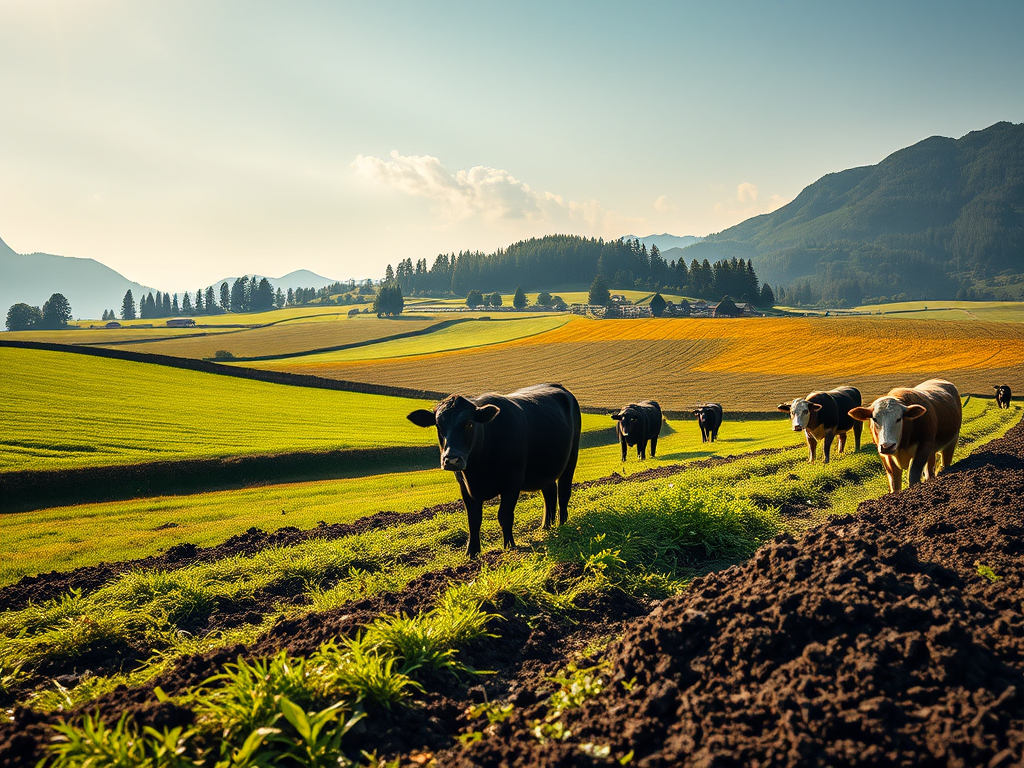
The global agricultural sector faces a dual challenge: it is both significantly affected by climate change and a major source of greenhouse gas emissions. Accounting for approximately one-third of all human-induced emissions, agriculture is under pressure to adopt more sustainable practices. A promising approach involves the use of biocharBiochar is a carbon-rich material created from biomass decomposition in low-oxygen conditions. It has important applications in environmental remediation, soil improvement, agriculture, carbon sequestration, energy storage, and sustainable materials, promoting efficiency and reducing waste in various contexts while addressing climate change challenges. More to sequester carbon and reduce emissions. A recent study published in Agroscope Science by authors Andreas Roesch, Nadège Vaucher, Antonia Mantonanaki, Martin Stüssi, Jens Lansche, and Nikolas Hagemann, provides a comprehensive life cycle assessment of biochar use in Swiss farming, offering clear, quantitative evidence of its potential to mitigate climate change.
The research explores how biochar can be integrated into the agricultural value chain through a concept known as “cascade use.” In Switzerland, biochar is rarely applied directly to soil. Instead, it is often used in animal husbandry—in feed or bedding—which allows it to eventually enter the soil as part of the manure. The study modeled eight different scenarios, from adding biochar to animal bedding and using it as a swimming layer on manure storage to direct soil application on vegetable farms. The primary goal was to quantify the overall climate impact, or global warming potential (GWP), by considering three key factors: the emissions from biochar production, the changes in on-farm emissions from its use, and the long-term carbon sequestration in the soil.
The findings confirm that the most significant climate benefit of biochar comes from its ability to sequester carbon. The study found that carbon sequestration, which permanently locks away carbon in the soil, outweighs the modelled effects of other emission reductions by a factor of more than 50, with each kilogram of biochar storing up to 2.40 kg of CO2-eq. This demonstrates that while other co-benefits, such as a reduction in soil-borne N2O emissions, are present, they play a secondary role in climate change mitigation. One exception was found in the scenario where biochar was used as a swimming layer on liquid manure storage. While it effectively reduced ammonia emissions from the storage, the increased nitrogen content in the manure led to higher field emissions after application, resulting in a net increase in GWP. This highlights the importance of understanding the entire life cycle of biochar applications to ensure positive environmental outcomes.
The study’s life cycle assessment also accounted for the emissions generated during biochar production itself. The GWP for producing one kilogram of biochar varied depending on the feedstockFeedstock refers to the raw organic material used to produce biochar. This can include a wide range of materials, such as wood chips, agricultural residues, and animal manure. More, ranging from 0.063 kg CO2-eq for landscape conservation wood to 0.373 kg CO2-eq for straw. These production emissions, however, are dwarfed by the long-term carbon sequestration benefits. The overall net GWP for all scenarios, except the manure swimming layer, showed a decrease, with the net GWP decreasing by 2.40 kg CO2-eq for every kilogram of biochar applied.
The research culminates in a national-level extrapolation of its findings, providing a powerful quantitative insight. The study found that implementing biochar on Swiss farms represented by their models could reduce the GWP of the entire agricultural sector they represent by up to 411,000 tons of CO2-eq. This is a substantial reduction, corresponding to nearly 4.9% of the total GWP for these farms. It’s important to note that this figure is based on a scenario that exceeds current legal application limits. For a scenario that complies with current Swiss regulations, the largest GWP reduction is still significant, reaching 301,680 tons of CO2-eq, or approximately 3.6%. This robust analysis underscores biochar’s potential as a climate mitigation and adaptation tool in agriculture.
Source: Roesch, A., Vaucher, N., Mantonanaki, A., Stüssi, M., Lansche, J., & Hagemann, N. (2025). Life cycle assessment of different biochar application scenarios in Swiss agriculture. Agroscope Science, 210/2025.





Leave a Reply