
Key Takeaways
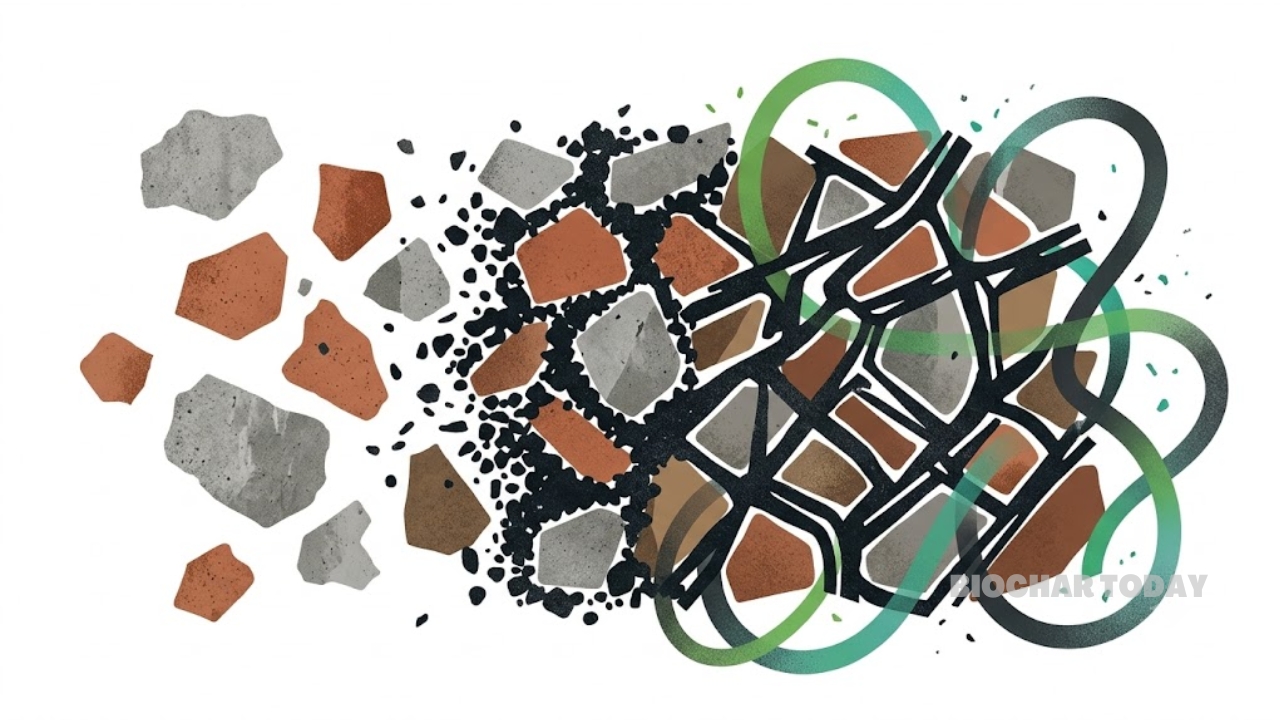
- Combining construction waste powder with biocharBiochar is a carbon-rich material created from biomass decomposition in low-oxygen conditions. It has important applications in environmental remediation, soil improvement, agriculture, carbon sequestration, energy storage, and sustainable materials, promoting efficiency and reducing waste in various contexts while addressing climate change challenges. More creates artificial building aggregates that actively capture and store carbon dioxide gas.
- Treating biochar with an alkali solution removes surface tar, opening up its pore structure for better water and gas movement.
- Biochar pores act as pathways that allow carbon dioxide to penetrate deeper into artificial aggregates rather than remaining on the surface.
- Subjecting these artificial aggregates to carbon dioxide curing increases their compressive strength by up to eight hundred fifty-one percent.
- Alkali-modified biochar delivers the strongest long-term carbon capture performance and mechanical strength compared to untreated or water-washed biochar.
A research team led by Weizhuo Zhang, Shihao Zhou, Zhenhua Huang, Renjie Niu, Junjie Hu, Yanpu Chen, Zhengdong Wang, Lei Cheng, Guangming Xie, Junyao Liu, and Jun Liu investigated the carbon sequestration potential and mechanical performance of concrete waste-biochar aggregate. Published in Green Energy and Resources, the study focused on upcycling construction waste powder—a low-reactivity byproduct generated during recycled aggregate production—into high-value artificial cold-bonded aggregates using bamboo-derived biochar and carbon dioxide curing treatments.
Construction waste powder contains high-calcium components capable of binding atmospheric carbon dioxide to form stable calcium carbonate, but the formation of a dense outer carbonate shell during carbonation typically blocks gas diffusion and slows long-term carbonation. To overcome this diffusion barrier, the authors incorporated five percent biochar into a binder mixture consisting of ten percent ordinary Portland cement and ninety percent construction waste powder. The researchers evaluated three biochar processing states: unmodified biochar, water-washed biochar, and alkali-modified biochar treated with a sodium hydroxide solution.
Physical and mechanical testing revealed that carbonation curing substantially improved aggregate performance across all mix formulations. Curing under accelerated carbon dioxide conditions increased single-particle compressive strength by one hundred seventeen to eight hundred fifty-one percent compared to uncarbonated reference samples. While water-washed biochar exhibited the highest early strength gains at three days of pre-curing, alkali-modified biochar demonstrated superior long-term performance, achieving the highest single-particle strength gains and total density at twenty-eight days.
Carbonation tracking demonstrated that biochar particles served as micro-channels for carbon dioxide transport through the aggregate matrix. In aggregates without biochar, carbonation rapidly formed a dense calcium carbonate surface layer that restricted internal carbon dioxide diffusion, causing carbonation uptake to drop by over forty-one percent between fourteen and twenty-eight days of curing. In contrast, aggregates containing alkali-modified biochar experienced only a two-and-a-half percent drop in carbonation uptake over the same period, confirming that the porous biochar network offset matrix densification and enabled sustained internal carbon sequestration.
Microstructural and chemical analyses using X-ray diffraction and scanning electron microscopy explained the underlying synergistic mechanism. Bamboo biochar in its raw state retained hydrophobic biomassBiomass is a complex biological organic or non-organic solid product derived from living or recently living organism and available naturally. Various types of wastes such as animal manure, waste paper, sludge and many industrial wastes are also treated as biomass because like natural biomass these More tar residues that partially clogged its internal pores. Alkali modification effectively stripped away this surface tar layer, exposing the underlying porous structure and enhancing surface hydrophilicity. The unblocked pores accelerated both internal water transport for cement hydration and carbon dioxide gas diffusion for deep carbonation. Furthermore, deprotonated surface functional groups on the modified biochar provided nucleation sites that promoted calcium hydroxide crystallization and calcium silicate hydrate gel formation around the biochar particles.
The authors concluded that combining alkali-modified biochar with construction waste powder provides a dual-environmental benefit by turning solid construction waste into carbon-capturing building materials. The resulting lightweight artificial aggregates sequester between eight and nineteen percent carbon dioxide by weight while reaching crushing strengths up to six point eight megapascals, establishing a practical pathway for low-carbon concrete manufacturing and industrial carbon utilization.
Source: Zhang, W., Zhou, S., Huang, Z., Niu, R., Hu, J., Chen, Y., Wang, Z., Cheng, L., Xie, G., Liu, J., & Liu, J. (2026). Research on the carbon sequestration potential and performance of modified biochar promoting carbon capture artificial aggregates. Green Energy and Resources, 100216.




Leave a Reply