
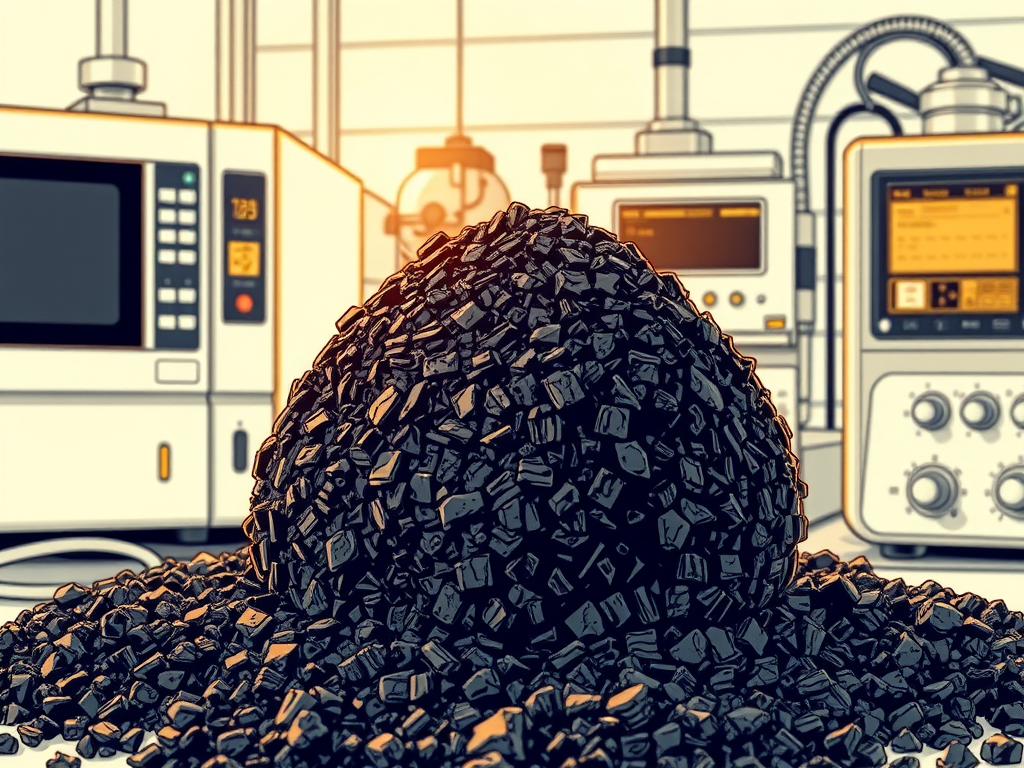
In a recent study published in the International Journal of Renewable Energy Development, Safa Waleed Shakir and Atheer Mohammad Al-Yaqoobi delved into the exciting potential of microwave-assisted pyrolysisPyrolysis is a thermochemical process that converts waste biomass into bio-char, bio-oil, and pyro-gas. It offers significant advantages in waste valorization, turning low-value materials into economically valuable resources. Its versatility allows for tailored products based on operational conditions, presenting itself as a cost-effective and efficient More (MAP) to transform Dodonaea viscosa branches into high-quality biocharBiochar is a carbon-rich material created from biomass decomposition in low-oxygen conditions. It has important applications in environmental remediation, soil improvement, agriculture, carbon sequestration, energy storage, and sustainable materials, promoting efficiency and reducing waste in various contexts while addressing climate change challenges. More. This research is significant because Dodonaea viscosa is a drought-tolerant plant abundant in arid and semi-arid regions like Iraq, making its utilization for value-added products a sustainable approach to waste management and resource optimization. The study not only highlights an efficient method for producing biochar but also details the resulting material’s enhanced characteristics, crucial for various environmental and industrial applications.
Biochar has gained considerable attention for its diverse applications, including soil amendmentA soil amendment is any material added to the soil to enhance its physical or chemical properties, improving its suitability for plant growth. Biochar is considered a soil amendment as it can improve soil structure, water retention, nutrient availability, and microbial activity. More, heavy metal removal, water and gas treatment, and use in electrochemical and catalytic fields. The properties of biochar are highly dependent on the feedstockFeedstock refers to the raw organic material used to produce biochar. This can include a wide range of materials, such as wood chips, agricultural residues, and animal manure. More and the pyrolysis conditionsThe conditions under which pyrolysis takes place, such as temperature, heating rate, and residence time, can significantly affect the properties of the biochar produced. More, such as temperature, pyrolysis duration, heating rate, and particle size. Traditional pyrolysis methods, which often rely on external heating, can lead to uneven temperature distribution within the biomassBiomass is a complex biological organic or non-organic solid product derived from living or recently living organism and available naturally. Various types of wastes such as animal manure, waste paper, sludge and many industrial wastes are also treated as biomass because like natural biomass these More. Microwave pyrolysis, however, offers internal and uniform heating, significantly improving conversion efficiency and allowing for rapid and even heating of the material. This makes MAP a crucial method for activating and modifying the biochar surface to achieve desired properties.
Shakir and Al-Yaqoobi meticulously investigated how various parameters—microwave power levels, biomass particle sizes, and pyrolysis duration—influenced both the yield and quality of the Dodonaea viscosa biochar. The experiments were conducted within a 25-minute pyrolysis timeframe. Their findings revealed that the maximum biochar yield of 49.8% was achieved with larger biomass particles (2-2.5 mm) at lower power levels (130 W). Conversely, increasing the power to 650 W and using smaller particles (0.5-1 mm) led to a reduction in yield. For instance, the yield for 2-2.5 mm particles decreased from 82% at 5 minutes and 130 W to 49.8% at 25 minutes. This inverse relationship between power level and biochar yield is attributed to increased reaction temperatures at higher power, which promotes the release of volatile components and complex structural breakdown of raw materials.
Beyond yield, the researchers performed extensive characterization using advanced analytical techniques including energy-dispersive X-ray spectrometry (EDX), scanning electron microscopy (SEM), X-ray diffraction (XRD), Fourier transform infrared spectrophotometry (FTIR), and Brunauer-Emmett-Teller (BET) analysis. These analyses were critical in understanding the surface area, pore volume, elemental composition, and structural changes of the produced biochar.
A standout finding from the EDX analysis was a significant increase in carbon content to 89.7% at higher power levels, accompanied by a decrease in oxygen content to 4.9%. This indicates enhanced carbonization, leading to biochar with superior chemical and physical properties. The SEM images corroborated these findings, showing a remarkable improvement in pore formation, particularly at higher power levels. At 650 W, the biochar exhibited exceptionally well-ordered, honeycomb-like pores, indicative of extensive volatilization during pyrolysis. This porous structure is crucial for the material’s effectiveness in various applications.
XRD analysis revealed a transformation from the crystalline structure of the native Dodonaea viscosa branch to a more amorphous structure in the biochar. This amorphous form is highly desirable as it leads to a larger surface area, more pores, and an increased number of active sites, all of which enhance the biochar’s capacity for adsorption, catalysis, and improving soil quality. The formation of amorphous carbon also promotes the creation of carboxyl, hydroxyl, and carbonyl groups, further boosting the biochar’s chemical reactivity.
The BET analysis confirmed these improvements in porosityPorosity of biochar is a key factor in its effectiveness as a soil amendment and its ability to retain water and nutrients. Biochar’s porosity is influenced by feedstock type and pyrolysis temperature, and it plays a crucial role in microbial activity and overall soil health. Biochar More. At 520 W for 25 minutes, the biochar’s surface area remarkably increased from an initial 3.034 m2/p to 21.634 m2/g, with the pore diameter increasing from 2.653 nm to 13.215 nm. This indicates an enhancement in pore density, which is vital for applications like water and gas treatment. Although the surface area started to decline above 520 W, likely due to pore widening or merging, the results demonstrate the effective tunability of biochar properties through microwave power.
Compared to conventional pyrolysis, MAP offers substantial advantages, including higher biochar surface areas and lower energy consumption. The Dodonaea viscosa MAP-derived biochar, with its 21.63 m2/g surface area and low energy consumption (1.07-2.5 kJ/g), showcased a balanced performance, making it a promising and scalable feedstock for various applications, especially in resource-limited environments.
This research underscores the significant potential of microwave-assisted pyrolysis of Dodonaea viscosa branches for producing high-quality biochar. The ability to control properties like carbon content, porosity, and surface area by adjusting pyrolysis parameters opens doors for tailored biochar applications in areas like electricity production, water and gas treatment, soil improvement, and carbon dioxide reduction. This study not only provides valuable insights into the behavior of Dodonaea viscosa during pyrolysis but also paves the way for sustainable utilization of an underutilized biomass resource.
Source: Shakir, S. W., & Al-Yaqoobi, A. M. (2025). Parametric and characteristic evaluation of microwave-assisted pyrolysis for the generation of biochar from Dodonaea viscosa branches. International Journal of Renewable Energy Development, 14(4), 781-793.



Leave a Reply