
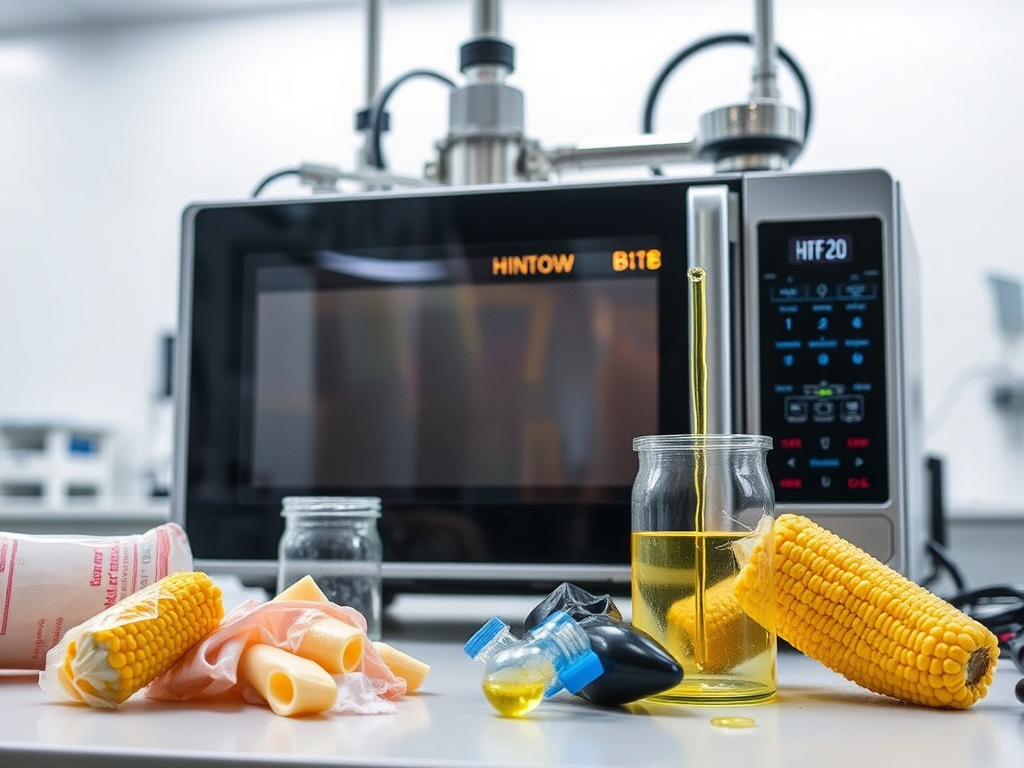
In a comprehensive review article published in the Journal of Thermal Engineering, Hafiz Miqdad Masood and his co-authors Javeed Ashraf, Khurram Shahzad, Rafi Ullah Khan, Nida Imran, and Zeeshan Zafar, delve into the latest advancements in converting waste plastic and biomassBiomass is a complex biological organic or non-organic solid product derived from living or recently living organism and available naturally. Various types of wastes such as animal manure, waste paper, sludge and many industrial wastes are also treated as biomass because like natural biomass these More into valuable chemical products. The paper, a significant contribution to the field of sustainable energy and waste management, highlights a promising technology known as microwave-assisted catalytic co-pyrolysis. The researchers found that this method can be highly effective, with the most compelling results showing optimal bio-oil yields of 72.1% from a mixture of corncob and high-density polyethylene (HDPE). This innovative approach offers a path forward for addressing the mounting environmental crisis caused by plastic and biomass waste, turning them from a problem into a resource.
The core of the research explores how a process called pyrolysisPyrolysis is a thermochemical process that converts waste biomass into bio-char, bio-oil, and pyro-gas. It offers significant advantages in waste valorization, turning low-value materials into economically valuable resources. Its versatility allows for tailored products based on operational conditions, presenting itself as a cost-effective and efficient More can be enhanced with microwave technology. Pyrolysis is the thermal decomposition of materials at high temperatures in an oxygen-free environment, but the traditional method can be energy-intensive and less efficient. The authors found that using microwave-assisted pyrolysis (MAP) provides greater yields and cleaner product profiles compared to conventional techniques. For instance, a comparison of different pyrolysis methods showed that at a relatively low temperature of 300°C, microwave pyrolysis yielded 58% char , whereas a traditional high-temperature carbonization method at 180°C produced 77% char. The real advantage, however, lies in the ability to produce valuable bio-oil, which is the focus of this review. The authors emphasize that the process is an effective way to produce high-calorific-value fuels from waste materials.
Another key finding from the review is the critical role of catalysts in fine-tuning the process. The use of catalysts like zeolites and biocharBiochar is a carbon-rich material created from biomass decomposition in low-oxygen conditions. It has important applications in environmental remediation, soil improvement, agriculture, carbon sequestration, energy storage, and sustainable materials, promoting efficiency and reducing waste in various contexts while addressing climate change challenges. More promotes product selectivity and quality, allowing researchers to control what is produced from the waste mixture. For example, studies using catalysts in catalytic fast pyrolysis (CFP) have shown remarkable selectivity toward specific aromatic hydrocarbons, such as benzene, toluene, and xylene (BTX). The review also noted that adding specific catalysts can increase the production of bio-oil. This targeted approach not only increases the economic viability of the process but also ensures the final products are of high quality.
Beyond catalysts, the researchers found that adding microwave absorbers to the waste mixture is crucial for the process’s efficiency. Biomass, a common component in this process, does not absorb microwaves well. However, adding an absorber like char from a previous pyrolysis process can dramatically improve the outcome. For instance, one experiment showed that adding just 5% char increased the maximum operational temperature from a meager 177°C to an impressive 590°C, thereby making the process viable for a variety of feedstocks. Furthermore, the study also reveals that adding high-density polyethylene (HDPE) to a catalyst-free process increased the gas product yield from 15.5% to 17.9%. This is significant because it highlights how specific components can improve the overall efficiency and yield of the final products.
The review confirms that converting solid waste into a variety of valuable chemicals, including bio-oil, syngasSyngas, or synthesis gas, is a fuel gas mixture consisting primarily of hydrogen and carbon monoxide. It is produced during gasification and can be used as a fuel source or as a feedstock for producing other chemicals and fuels. More, and biochar, is a viable and important goal for creating a circular economy. It is also clear from the findings that the microwave-assisted process has the potential to be scaled up from a laboratory setting to a large industrial operation, which is a major challenge for many new technologies. The authors conclude that further optimization of microwave treatment settings and a more thorough techno-economic assessment are necessary to fully commercialize this technology. By turning waste into a resource, this research provides a promising path toward a more sustainable future.
Source: Masood, H. M., Ashraf, J., Shahzad, K., Khan, R. U., Imran, N., & Zafar, Z. (2025). Recent advancements, challenges in recycling of waste plastic using microwave assisted catalytic co-pyrolysis of biomass and waste plastic for production of value added chemicals: a review. Journal of Thermal Engineering, 11(4), 1176-1192.



Leave a Reply