
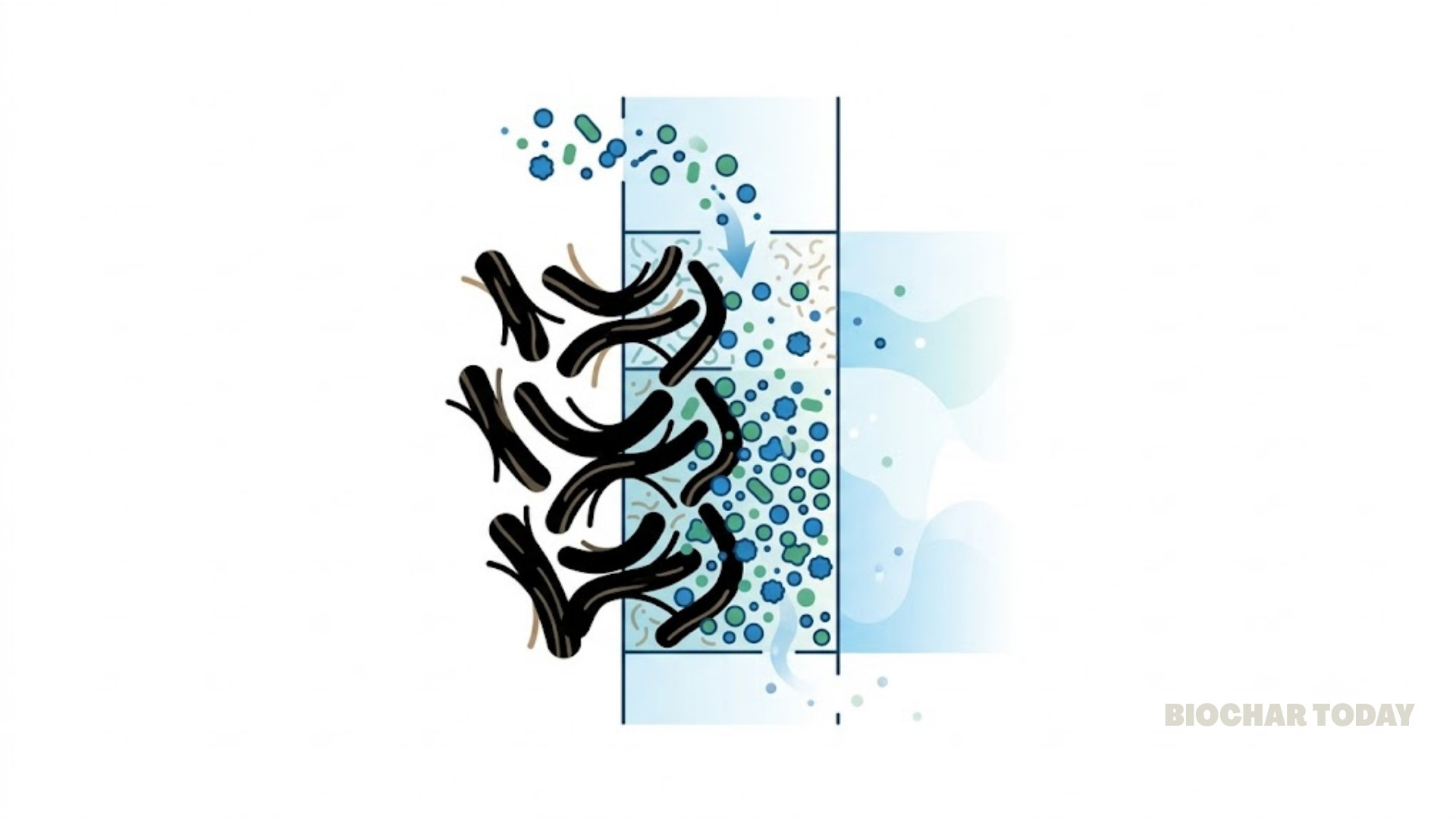
Key Takeaways
- Amending quartz sand with ten percent malt spent rootlets biocharBiochar is a carbon-rich material created from biomass decomposition in low-oxygen conditions. It has important applications in environmental remediation, soil improvement, agriculture, carbon sequestration, energy storage, and sustainable materials, promoting efficiency and reducing waste in various contexts while addressing climate change challenges. More pyrolyzed at eight hundred fifty degrees Celsius increases Escherichia coli retention efficiency from seventeen point eight percent to ninety-four point one percent.
- Increasing biochar content shifts the primary bacterial retention mechanism in saturated porous media from physical straining to direct, irreversible surface attachment.
- Higher solution ionic strength reduces bacterial adsorption capacity onto the biochar, decreasing the Freundlich capacity parameter from two hundred ten point five to thirty-five point eight.
- Bacterial inactivation kinetics during batch contact periods are best described by the non-linear Weibull model, while adsorption kinetics follow a pseudo-first-order rate model.
Pathogenic microorganism transport through sandy soils and engineered filtration beds presents a major contamination risk to global groundwater resources. Agricultural runoff, irrigation with treated wastewater, and land application of fecal materials introduce waterborne pathogens into the subsurface, contributing to widespread diarrheal disease outbreaks and sanitation risks. Sand filtration systems are commonly used to mitigate pathogen transport; however, coarse quartz sand alone provides limited surface area and minimal sorption sites, allowing a high proportion of bacteria to pass directly into underlying aquifers.
To address these filtration limits, researchers pyrolyzed malt spent rootlets—an abundant industrial waste product from the brewing industry—at eight hundred fifty degrees Celsius to create a high-surface-area biochar amendment. The resulting material exhibited a specific surface area of two hundred ninety square meters per gram, a porous honeycomb structure, and a point of zero charge of eight point one. Because the experimental water pHpH is a measure of how acidic or alkaline a substance is. A pH of 7 is neutral, while lower pH values indicate acidity and higher values indicate alkalinity. Biochars are normally alkaline and can influence soil pH, often increasing it, which can be beneficial More ranged between six point six and seven point six, the biochar retained a net positive surface charge, creating favorable conditions for attracting negatively charged bacterial cells.
Batch sorption tests showed that E. coli adsorption onto the biochar follows pseudo-first-order kinetics and Freundlich isotherm behavior, reflecting multilayer attachment across a heterogeneous surface. Natural bacterial inactivation during the contact period was successfully isolated and modeled using the Weibull distribution. When the ionic strength of the solution was increased from one millimolar to one hundred fifty millimolar potassium chloride, the Freundlich adsorption capacity constant dropped from two hundred ten point five to thirty-five point eight. This reduction occurs because elevated ionic strength compresses the electrical double layer around both surfaces, weakening the electrostatic attraction driving bacterial attachment.
Saturated column transport experiments combined with numerical modeling using the one-dimensional biocolloid transport equation revealed a distinct shift in retention mechanisms as biochar content increased. In unamended sand and sand amended with five percent biochar, physical straining within narrow pore throats served as the numerically dominant retention path. At a ten percent biochar application rate, direct attachment became the primary governing mechanism, driven by a thirteen point four-fold increase in the attachment rate coefficient. Furthermore, the detachment rate coefficient fitted to zero across all column configurations, indicating that bacterial attachment to the biochar surface was practically irreversible under the tested flow conditions.
By repurposing a low-cost brewery byproduct into an effective filtration media amendment, this study provides a dual environmental solution. Utilizing malt spent rootlets biochar in engineered sand filters enhances the removal of waterborne pathogens, offering a sustainable strategy for protecting vulnerable groundwater aquifers from microbial contamination.
Source: Giannopoulos, C. P., Kolotouros, C. A., & Manariotis, I. D. (2026). Sorption and transport of Escherichia coli CN-13 in saturated sand columns amended with biochar derived from malt spent rootlets. Biochar, 8(1), 130.



Leave a Reply