
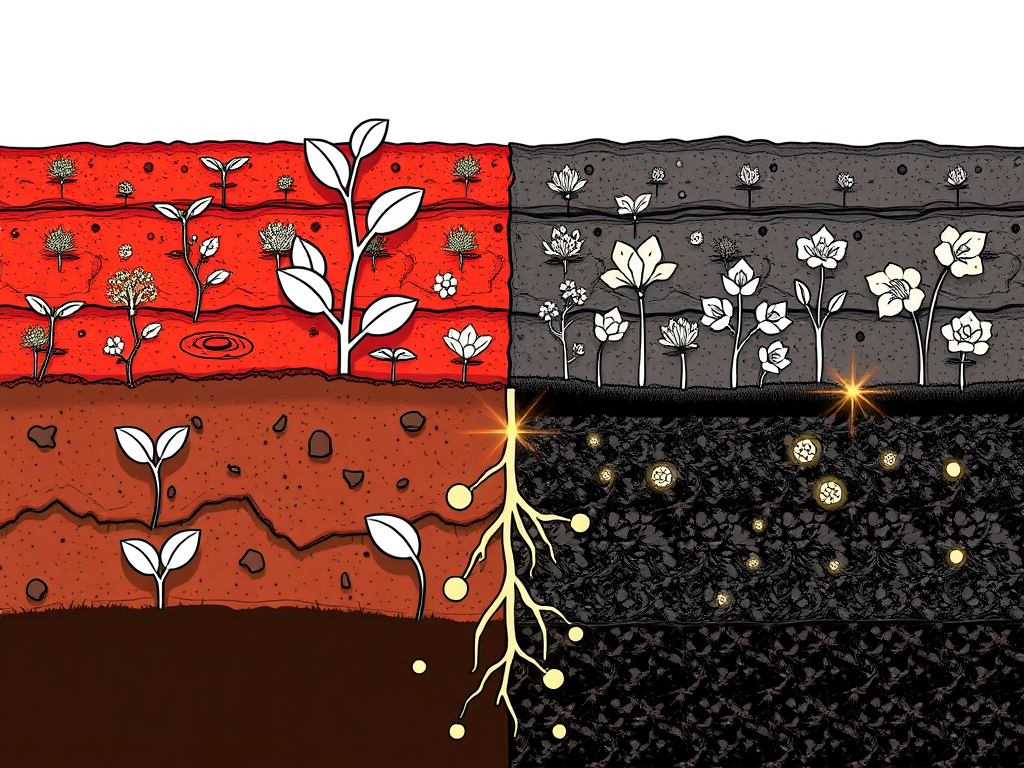
In a recent study published in Environmental Sciences Europe, Muhammad Numan Khan, Jing Huang, and their colleagues investigated the impact of modified biocharBiochar is a carbon-rich material created from biomass decomposition in low-oxygen conditions. It has important applications in environmental remediation, soil improvement, agriculture, carbon sequestration, energy storage, and sustainable materials, promoting efficiency and reducing waste in various contexts while addressing climate change challenges. More on phosphorus dynamics and biochemical properties in different soil types. While biochar is increasingly recognized for its role in soil remediation, its specific effects on phosphorus fractionation and soil biochemistry across various soil conditions have been less explored. This research addresses that gap, focusing on nonmodified wheat straw biochar (WBC) and magnesium-modified wheat straw biochar (Mg-WBC) in two distinct soils: Qiyang (QY) red soil and Harbin (HAR) black soil.
The study involved a controlled experiment with varying doses of WBC and Mg-WBC (1% and 2.5% by weight). The results showed that both types of biochar significantly improved overall soil characteristics. A key finding was the notable increase in the activity of alkaline phosphatase and catalase enzymes, which are vital for nutrient cycling and soil health. Interestingly, acidic phosphatase activity initially increased at the 1% dose but then decreased at the 2.5% dose for both biochars.
Moreover, the addition of biochar, particularly at the 2.5% dose, led to significant increases in both microbial biomassBiomass is a complex biological organic or non-organic solid product derived from living or recently living organism and available naturally. Various types of wastes such as animal manure, waste paper, sludge and many industrial wastes are also treated as biomass because like natural biomass these More carbon and phosphorus in both QY and HAR soils. This indicates a healthier and more active microbial community, which plays a crucial role in nutrient availability.
Regarding phosphorus fractions, the study found a substantial increase in labile phosphorus (P), which is the most readily available form for plants and microbes. Labile-P increased by 28–77% in QY soil and by 15–47% in HAR soil, across all tested doses of WBC and Mg-WBC. Moderately-labile-P showed a more complex response: it decreased by 2–3% in QY soil and 3–6% in HAR soil at the 1% application rate, but increased by 9–11% in QY and 3–6% in HAR at the 2.5% rate. Crucially, nonlabile-P, which is typically unavailable to plants, decreased significantly by 27–38% in QY soil and 15–35% in HAR soil. This transformation of nonlabile P into more accessible forms is a major benefit for soil fertility.
The research also highlighted differences in how the biochars affected the two soil types. Mantel’s test indicated that soil organic carbon had a stronger influence in the QY soil, while available phosphorus and microbial biomass carbon were more impacted in the HAR soil. Further analysis using a partial least square path model (PLS-PM) revealed that biochar had a more pronounced effect on acidic soil (QY), and notably, Mg-WBC significantly enhanced phosphorus availabilityPhosphorus is another essential nutrient for plant growth, but it can sometimes be locked up in the soil and unavailable to plants. Biochar can help release phosphorus from the soil and make it more accessible to plants, reducing the need for chemical fertilizers. More in both soil types.
These findings suggest that Mg-modified biochar is an effective strategy for boosting soil fertility and increasing phosphorus availability in labile and moderately labile forms. The study provides specific recommendations for its use in different soil conditions, underscoring its potential as a sustainable agricultural amendment to improve nutrient management and promote ecosystem sustainability.
Source: Khan, M. N., Huang, J., Shah, A., Xiaoyu, H., Han, T., Núñez-Delgado, A., Hayatu, N. G., Ahmed, I., Liu, W., Singh, A. K., Zhu, X., & Zhang, H. (2025). Impact of modified biochar on phosphorus fractionation and biochemical properties for different soils. Environmental Sciences Europe, 37(1), 80.




Leave a Reply