
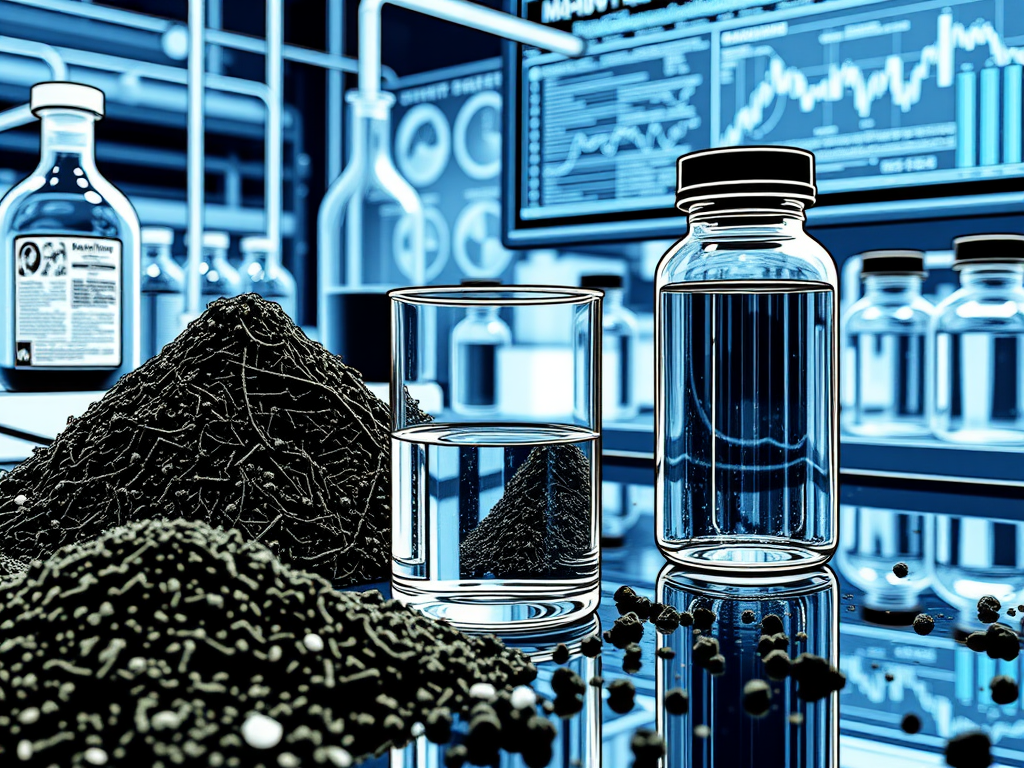
Antibiotic contamination in water sources is a growing concern, particularly for widely used drugs like tetracycline. A recent study published in Inorganic Chemistry Communications by Wen Tan and colleagues explores an innovative strategy that combines Fenton sludge biocharBiochar is a carbon-rich material created from biomass decomposition in low-oxygen conditions. It has important applications in environmental remediation, soil improvement, agriculture, carbon sequestration, energy storage, and sustainable materials, promoting efficiency and reducing waste in various contexts while addressing climate change challenges. More (FSBC) and periodate (PI) activation for efficient tetracycline degradation. The research not only demonstrates an eco-friendly way to repurpose industrial waste but also incorporates machine learning (ML) to optimize the biochar’s synthesis and catalytic performance.
Fenton sludge, a byproduct of wastewater treatment, is rich in iron oxides and has been identified as a promising material for environmental applications. The researchers converted this waste into FSBC by mixing it with sugarcane bagasse and subjecting it to pyrolysisPyrolysis is a thermochemical process that converts waste biomass into bio-char, bio-oil, and pyro-gas. It offers significant advantages in waste valorization, turning low-value materials into economically valuable resources. Its versatility allows for tailored products based on operational conditions, presenting itself as a cost-effective and efficient More. The resulting biochar demonstrated strong catalytic properties, enabling the activation of periodate, a potent oxidant that generates reactive oxygen species for breaking down tetracycline molecules. Experimental results showed that FSBC, when combined with PI, removed over 92% of tetracycline across a broad pHpH is a measure of how acidic or alkaline a substance is. A pH of 7 is neutral, while lower pH values indicate acidity and higher values indicate alkalinity. Biochars are normally alkaline and can influence soil pH, often increasing it, which can be beneficial More range (3–11). Mechanistic analysis revealed that singlet oxygen and superoxide radicals played dominant roles in the degradation process. Additionally, the system proved highly resistant to most common anions, except citrate and phosphate, which slightly hindered efficiency by depleting reactive radicals.
To further enhance performance, the researchers applied ML models, including Random Forest and Gradient Boosted Decision Trees, to analyze key factors influencing biochar efficiency. The models identified pyrolysis temperature (optimal range: 583–661°C), Fenton sludge-to-bagasse ratio (1.75–3), and binder concentration (0–12.5%) as critical parameters. The ML-driven approach successfully predicted optimal preparation conditions, reducing trial-and-error experimentation and improving catalyst performance.
This study highlights the potential of combining waste-to-resource strategies with machine learning to enhance water purification technologies. By leveraging Fenton sludge biochar and periodate activation, researchers have developed a scalable, efficient, and environmentally friendly method for removing antibiotics from wastewater.
Source: Tan, W., Chen, Y., Liu, Y., Pan, H., Liu, X., Shi, Q., Li, Z., & Zhao, C. (2025). Periodate activation by a Fenton sludge biochar for enhanced tetracycline degradation: Identification of key factors through machine learning. Inorganic Chemistry Communications, 176, 114295.



Leave a Reply