

Key Takeaways
- Scientists have developed a simple way to turn fruit tree waste into high-quality biocharBiochar is a carbon-rich material created from biomass decomposition in low-oxygen conditions. It has important applications in environmental remediation, soil improvement, agriculture, carbon sequestration, energy storage, and sustainable materials, promoting efficiency and reducing waste in various contexts while addressing climate change challenges. More that helps fight climate change.
- By dipping branches in limewater before burning them, the researchers saved much more carbon than traditional open-air burning.
- The lime creates a protective shield that prevents the carbon from turning into greenhouse gases during the heating process.
- This method is cheap and easy enough for farmers to use directly in their orchards without expensive factory equipment.
- Using this technique could help fruit orchards become carbon neutral by locking away thousands of pounds of carbon in the soil every year.
The researchers, led by Liang Xiao and Wenhan Li and published in the journal Biochar, have addressed a significant bottleneck in environmental technology: the high cost of producing biochar. Biochar is a charcoal-like substance made from organic waste that can store carbon in the ground for centuries, yet its production usually requires expensive, airtight machinery to prevent the material from simply burning away into ashAsh is the non-combustible inorganic residue that remains after organic matter, like wood or biomass, is completely burned. It consists mainly of minerals and is different from biochar, which is produced through incomplete combustion. Ash Ash is the residue that remains after the complete More. This study introduces a field-ready strategy using litchi branches, a common agricultural waste in southern China, by utilizing a synergistic water-fire interaction that mimics the natural formation of fertile black soils found in the Amazon. By treating the wood with a simple limewater solution, the team created a cost-effective method for farmers to produce high-quality biochar right in their own fields, bypass the need for specialized industrial infrastructure, and significantly reduce the logistical expenses of transporting heavy biomassBiomass is a complex biological organic or non-organic solid product derived from living or recently living organism and available naturally. Various types of wastes such as animal manure, waste paper, sludge and many industrial wastes are also treated as biomass because like natural biomass these More.
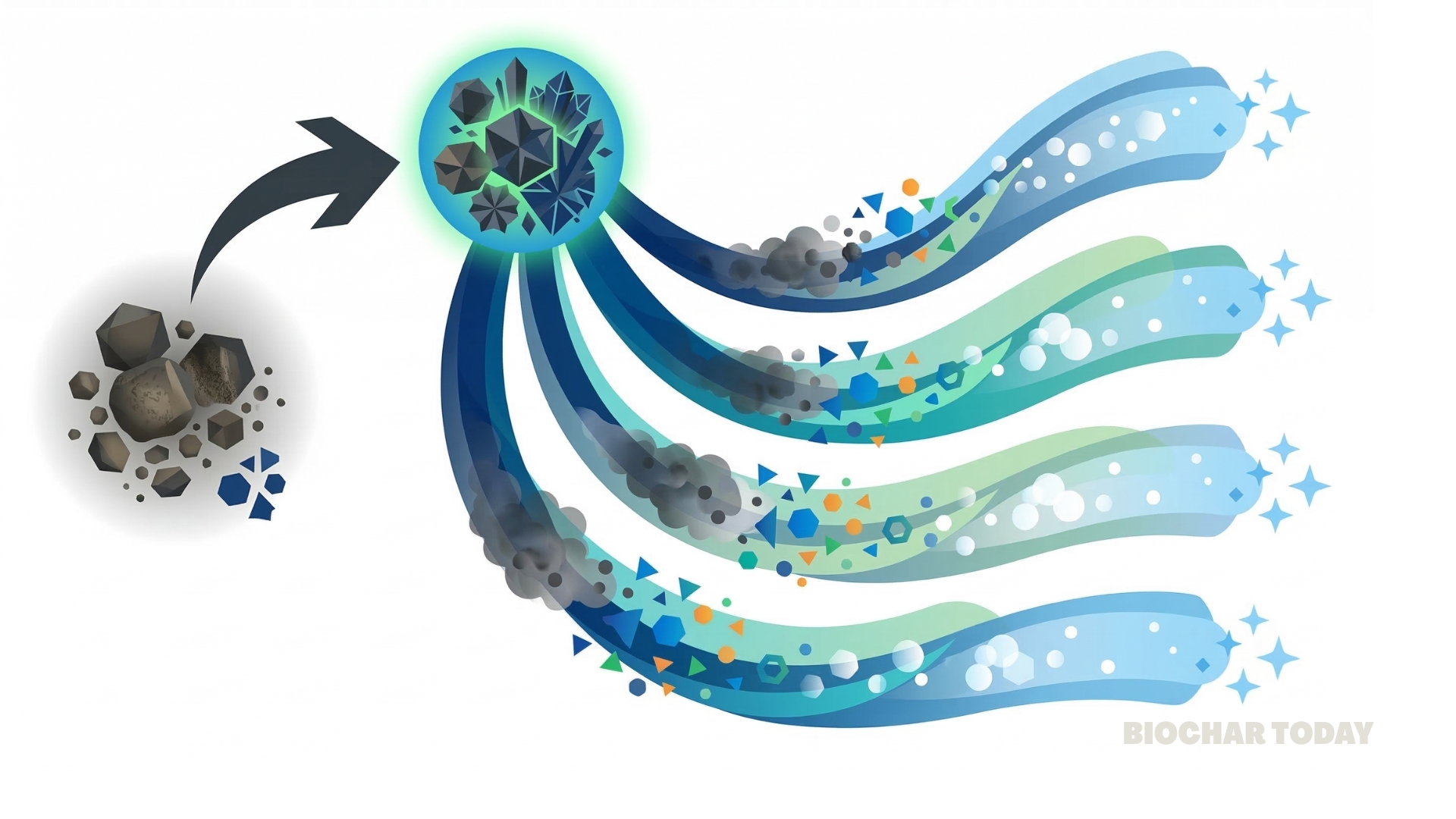
The core of this innovation lies in the physical and chemical protection provided by the calcium in the limewater. When the treated litchi branches are ignited in the open air, the outer layer of lime reacts to form a calcium carbonate coating. This mineral barrier acts like the walls of a miniature reactor, physically blocking oxygen from reaching the inner core of the wood. This creates a self-limited oxygen environment where the wood can carbonize into biochar rather than being consumed by flames. The results of this process were striking, as the carbon conversion rate jumped from fifty-two percent in untreated samples to eighty-six percent in those treated with the limewater immersion and coating. Furthermore, the final product met international standards for high-grade biochar, boasting a carbon content of over eighty percent and a significantly larger surface area, which is vital for improving soil health and holding nutrients.
Beyond the physical barrier, the study revealed that calcium ions play a sophisticated chemical role in stabilizing the carbon. Through advanced imaging and spectroscopy, the authors observed that the calcium actually binds with the organic structures of the wood during the rapid heating process. These mineral-carbon complexes are much more stable and resistant to breaking down, meaning the carbon stays locked in the biochar instead of being released as carbon dioxide or carbon monoxide. This chemical bridging helps preserve delicate functional groups on the surface of the biochar, which are the parts of the material that help plants grow better and filter pollutants from the soil. This dual action of physical shielding and chemical strengthening ensures that the resulting biochar is both more abundant and more effective at long-term carbon storage.
The practical implications for agriculture and climate policy are substantial, particularly for the management of large-scale fruit orchards. Litchi cultivation produces a vast amount of waste through annual pruning, which is often burned or left to rot, releasing carbon back into the atmosphere. The researchers calculated that if a typical orchard adopted this local production model, it could sequester approximately six thousand kilograms of carbon per hectare. This amount of storage is enough to more than offset the entire carbon footprint of the orchard’s cultivation and supply chain, which is estimated at nine thousand kilograms of carbon dioxide equivalent. By turning a waste product into a valuable soil amendmentA soil amendment is any material added to the soil to enhance its physical or chemical properties, improving its suitability for plant growth. Biochar is considered a soil amendment as it can improve soil structure, water retention, nutrient availability, and microbial activity. More, this method provides a circular resource model that supports low-emission farming while providing a scalable solution for global climate mitigation.
Source: Xiao, L., Li, W., Wu, J., Li, Y., Yuan, G., Wang, Y., Xu, Q., Feng, L., Hao, X., & Han, F. X. (2026). Enhanced carbon retention in Litchi biochar via in-situ limewater coating and self-limited oxygen pyrolysisPyrolysis is a thermochemical process that converts waste biomass into bio-char, bio-oil, and pyro-gas. It offers significant advantages in waste valorization, turning low-value materials into economically valuable resources. Its versatility allows for tailored products based on operational conditions, presenting itself as a cost-effective and efficient More regulated by water-fire interaction. Biochar, 8(27).

Leave a Reply