
Key Takeaways
- The Problem: Nitrogen fertilizer (nitrate) from farms washes out of the soil, polluting groundwater and rivers. This also wastes the fertilizer, as plants can’t use it.
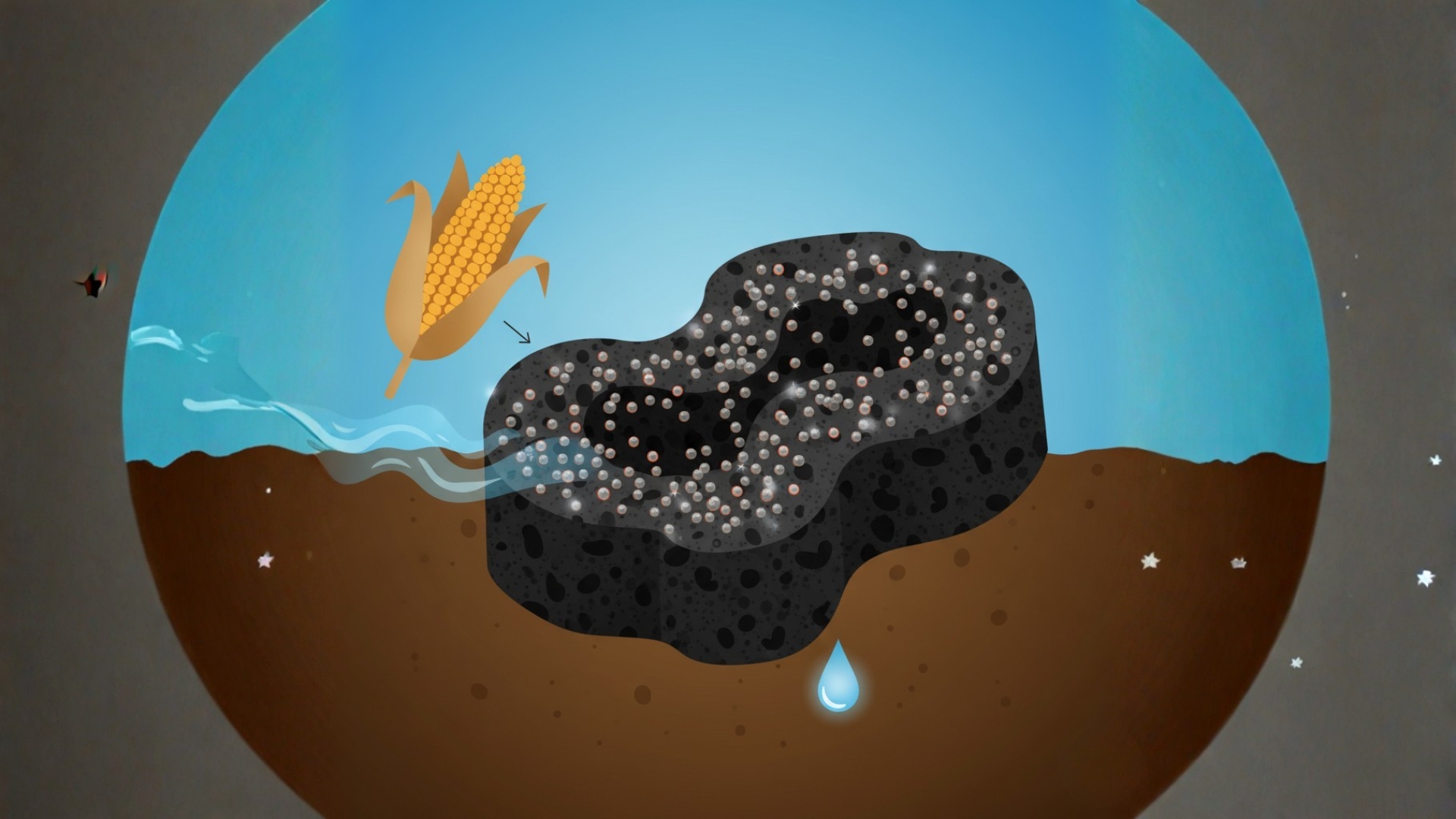
- The Solution: Researchers created a “smart sponge” by loading biocharBiochar is a carbon-rich material created from biomass decomposition in low-oxygen conditions. It has important applications in environmental remediation, soil improvement, agriculture, carbon sequestration, energy storage, and sustainable materials, promoting efficiency and reducing waste in various contexts while addressing climate change challenges. More made from corn stalks with tiny nanoscale zero-valent iron (nZVI) particles.
- How it Works: The material performs two jobs. The biochar’s porous structure adsorbs (traps) the nitrogen, while the iron particles chemically reduce (transform) the harmful nitrate into beneficial ammonium, which plants can eat.
- The Best Recipe: The most effective composite, nZVI@BC0.6, cut nitrate leachingLeaching is the process where nutrients are dissolved and carried away from the soil by water. This can lead to nutrient depletion and environmental pollution. Biochar can help reduce leaching by improving nutrient retention in the soil. More in a soil experiment by 71.31%.
- The Co-Benefit: The same material also held onto 53.12% more ammonium—the form of nitrogen plants prefer—keeping this valuable nutrient in the root zone
Nitrogen is the building block of life and a cornerstone of modern agriculture, but it has a dark side. When nitrogen fertilizer is applied to fields, a large portion is not used by the plants. Instead, it converts into nitrate (NO3−−N), a highly mobile form that leaches out of the soil with rain and irrigation. This “nitrogen loss” is a one-two punch: it wastes farmers’ money and creates a massive environmental problem, contaminating groundwater, acidifying soil, and fueling toxic algal blooms. Meanwhile, ammonium (NH4+−N), a beneficial form of nitrogen that plants can easily use, is often lost from the soil too quickly. In a new study published in the journal Biochar, researchers Lan Luo, Jie Li, and their colleagues have engineered a powerful solution: a “smart” composite material that can both stop nitrate pollution and hold onto valuable ammonium.
The team’s strategy was to combine two potent materials: biochar (BC) and nanoscale zero-valent iron (nZVI). Biochar, is known for its incredibly porous structure, which acts like a sponge to adsorb contaminants. But biochar alone is mostly a physical trap. The real chemical power comes from nZVI, which is a strong reductant. This means it can donate electrons to chemically transform pollutants. However, nZVI has a critical flaw: when used alone, its tiny particles tend to clump together and “rust” (oxidize) on contact with air or water, quickly losing their reductive power. The researchers’ solution was to use the biochar as a support structure, loading the nZVI particles into its pores. This keeps the iron particles separated, stable, and highly reactive.
Finding the “Goldilocks” ratio of iron to biochar was critical. The team prepared four different composites with varying iron-to-carbon (Fe/C) ratios, labeling them nZVI@BC0.2, nZVI@BC0.4, nZVI@BC0.6, and nZVI@BC0.8. Through a series of tests, one sample emerged as the clear champion: nZVI@BC0.6. This composite, with a 0.6 Fe/C ratio, achieved the best overall performance, striking the perfect balance between high reactivity and stability.
The study revealed precisely how this material works. First, the process is dominated by chemical reactions, not just physical trapping. Adsorption kinetic data fit a “pseudo-second-order” model, which confirms that chemical adsorption is the primary mechanism. Second, the material’s effectiveness is highly dependent on pHpH is a measure of how acidic or alkaline a substance is. A pH of 7 is neutral, while lower pH values indicate acidity and higher values indicate alkalinity. Biochars are normally alkaline and can influence soil pH, often increasing it, which can be beneficial More. In acidic (low pH) conditions, the nZVI is extremely reactive and efficient, achieving up to 95.65% nitrate removal in solution tests. Under these conditions, it actively converts the nitrate (NO3−−N) into beneficial ammonium (NH4+−N). In neutral or alkaline (high pH) conditions, the reaction pathway shifts to primarily create harmless nitrogen gas (N2).
The “active ingredient” in the winning nZVI@BC0.6 sample was its high concentration of Fe2+ (70.8%). This form of iron is the electron donor that fuels the entire nitrate-reduction reaction. Interestingly, using too much iron, as in the nZVI@BC0.8 sample, actually backfired. The excess iron re-oxidized, Fe2+ content plummeted, and the material’s nitrate removal efficiency was impaired. The 0.6 ratio was the sweet spot. The team also identified that specific chemical functional groups on the composite’s surface, namely Fe-O (iron-oxygen) and C-O (carbon-oxygen), were critical to the process, acting as anchoring sites for nitrate and helping to facilitate the electron transfer.
The most compelling results came from a soil column experiment designed to mimic real-world agricultural leaching. Here, nZVI@BC0.6 proved its dual-action benefits. When compared to untreated soil, the soil amended with nZVI@BC0.6 dramatically slowed nitrogen loss. After 14 days, the concentration of nitrate in the leachate (the water draining from the bottom) was reduced by an impressive 71.31%. Just as importantly, the composite increased the retention of valuable NH4+-N in the soil by 53.12%. This means the material not only stops pollution but also keeps fertilizer in the root zone where plants can use it, improving nitrogen use efficiency.
This research highlights a cost-effective and sustainable strategy for a major agricultural challenge. By combining the adsorptive power of biochar with the reductive power of nano-iron, the nZVI@BC0.6 composite provides a powerful tool to mitigate nitrogen leaching, improve soil fertility, and protect our water resources.
Source: Luo, L., Li, J., James, A., Hu, C., Zhang, G., & Pan, J. (2025). Effective removal of nitrate nitrogen from water and soil using biochar-loaded nano zero-valent iron: performance and mechanisms. Biochar, 7(117).





Leave a Reply