
Key Takeaways
- Researchers transformed an invasive plant species into a specialized biocharBiochar is a carbon-rich material created from biomass decomposition in low-oxygen conditions. It has important applications in environmental remediation, soil improvement, agriculture, carbon sequestration, energy storage, and sustainable materials, promoting efficiency and reducing waste in various contexts while addressing climate change challenges. More composite that removes dangerous fluoride pollution from water.
- This new material absorbs more than four times as much fluoride as standard magnesium-based water filters.
- The filter remains stable and effective across a broad range of water acidity levels, from slightly acidic to strongly alkaline.
- Common water minerals like nitrates and sulfates do not interfere with the material’s ability to trap fluoride.
- Using invasive weeds to make water purification materials offers a low-cost way to control unwanted plants while cleaning polluted water.
Excess fluoride in drinking water and industrial wastewater poses a global public health threat, affecting hundreds of millions of people and causing conditions such as dental and skeletal fluorosis. In a study published in Biochar X, researchers Yao Tong, Donglin Wang, Lingqing Gu, Yujie Tai, Xianjie Tang, Xi Zhang, Rongdi An, Til Feike, and Jiunian Guan developed a carbon-based composite capable of stripping fluoride ions from contaminated water with high efficiency. By combining nano-scale magnesium oxide with pyro-hydrochar derived from the invasive plant Rhus typhina, the team created a sustainable material that addresses both water pollution and invasive species management.
The composite demonstrated an exceptional maximum fluoride adsorption capacity of 469.64 milligrams per gram at room temperature, substantially outperforming previously reported magnesium-based adsorbents that typically capture less than 100 milligrams per gram. When tested against its individual components, the combined composite captured 86.44 milligrams per gram in comparative trials, far exceeding the sum of unmodified pyro-hydrochar at 4.31 milligrams per gram and standalone nano-magnesium oxide at 43.54 milligrams per gram. This strong synergy occurs because the porous carbon framework prevents magnesium oxide nanoparticles from clumping together, exposing far more active binding sites to the surrounding water while reducing internal diffusion resistance.
The material also maintained stable fluoride removal across a wide acidity spectrum ranging from pHpH is a measure of how acidic or alkaline a substance is. A pH of 7 is neutral, while lower pH values indicate acidity and higher values indicate alkalinity. Biochars are normally alkaline and can influence soil pH, often increasing it, which can be beneficial More 5.0 to 11.0. In natural and industrial waters, extreme acidity or alkalinity often ruins adsorption performance by altering surface charges or causing competing ions to block binding sites. However, the acidic oxygen-containing functional groups on the carbon surface provided natural buffering that neutralized excess hydroxide ions in alkaline conditions. Performance only declined sharply under extreme conditions at pH 3.0, where fluoride converts into neutral hydrofluoric acid molecules, and at pH 13.0, where strong negative charges repel fluoride ions.
Water chemistry tests further confirmed the composite’s practical selectivity. Common coexisting anions such as nitrate and sulfate, even at concentrations up to ten millimoles per liter, caused no significant drop in fluoride uptake. Only high concentrations of bicarbonate exceeding one millimole per liter hindered performance, as bicarbonate ions share a nearly identical hydrated size with fluoride and compete directly for binding sites while raising water alkalinity.
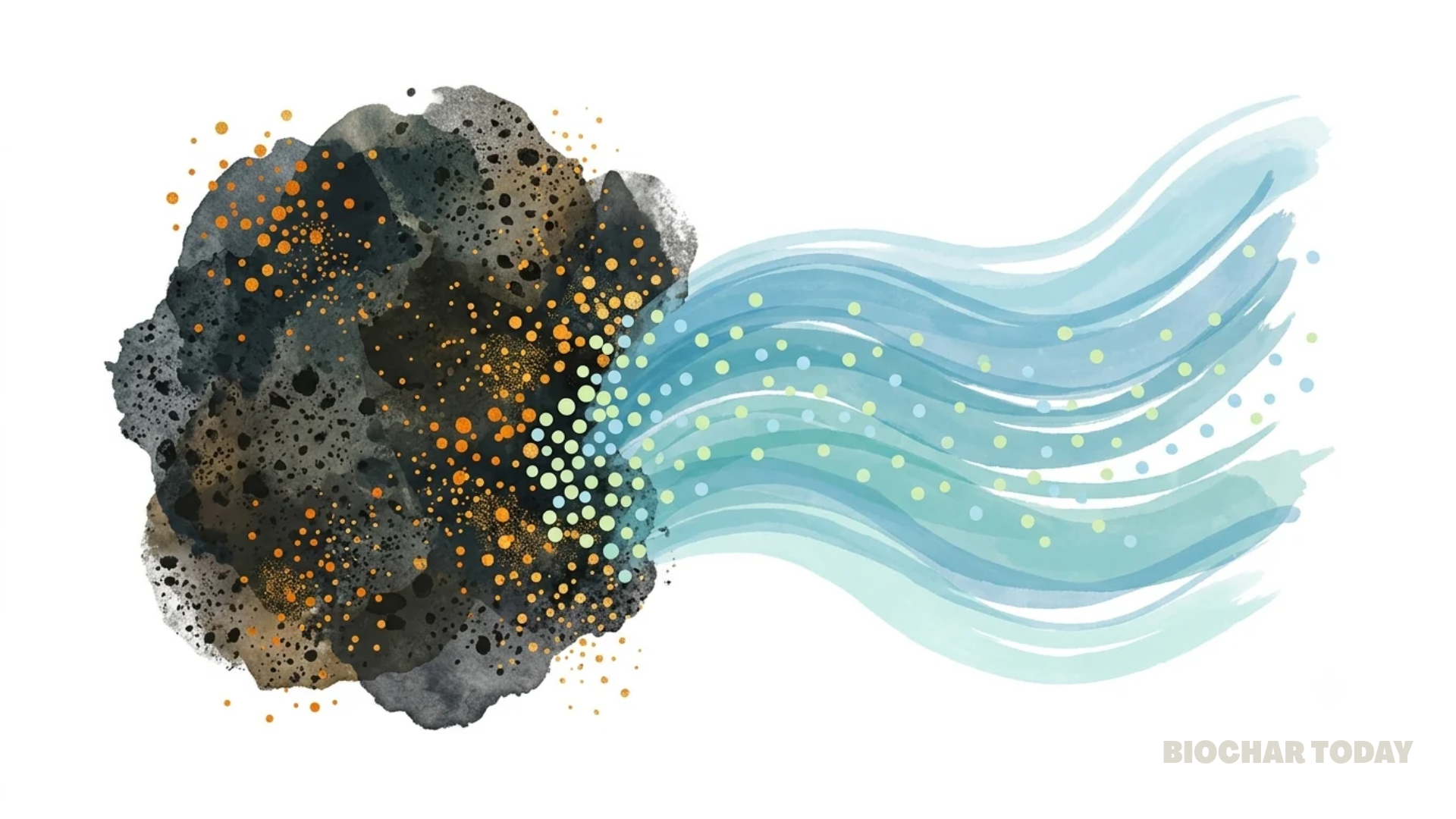
Detailed chemical and structural analyses revealed that fluoride removal is a spontaneous process driven primarily by chemisorption, which accounted for roughly 58 percent of total uptake. Once fluoride ions diffuse into the composite’s coral-reef-like porous network, they are immobilized through multiple simultaneous pathways. Positively charged magnesium sites attract negatively charged fluoride ions electrostatically, while surface hydroxyl and aromatic groups form hydrogen bonds. Simultaneously, magnesium oxide reacts with water to form magnesium hydroxide, triggering anion exchange and direct complexation that locks fluoride away as insoluble magnesium fluoride precipitates. By converting abundant invasive plant residues into an effective water treatment medium, this approach provides a practical, low-carbon strategy for industrial wastewater purification and ecological restoration.
Source: Tong, Y., Wang, D., Gu, L., Tai, Y., Tang, X., Zhang, X., An, R., Feike, T., & Guan, J. (2026). Nano-MgO/pyro-hydrochar for enhancing adsorption of fluoride ion from aqueous solution: performance, influencing factors, and mechanisms. Biochar X, 2, e023.

Leave a Reply