
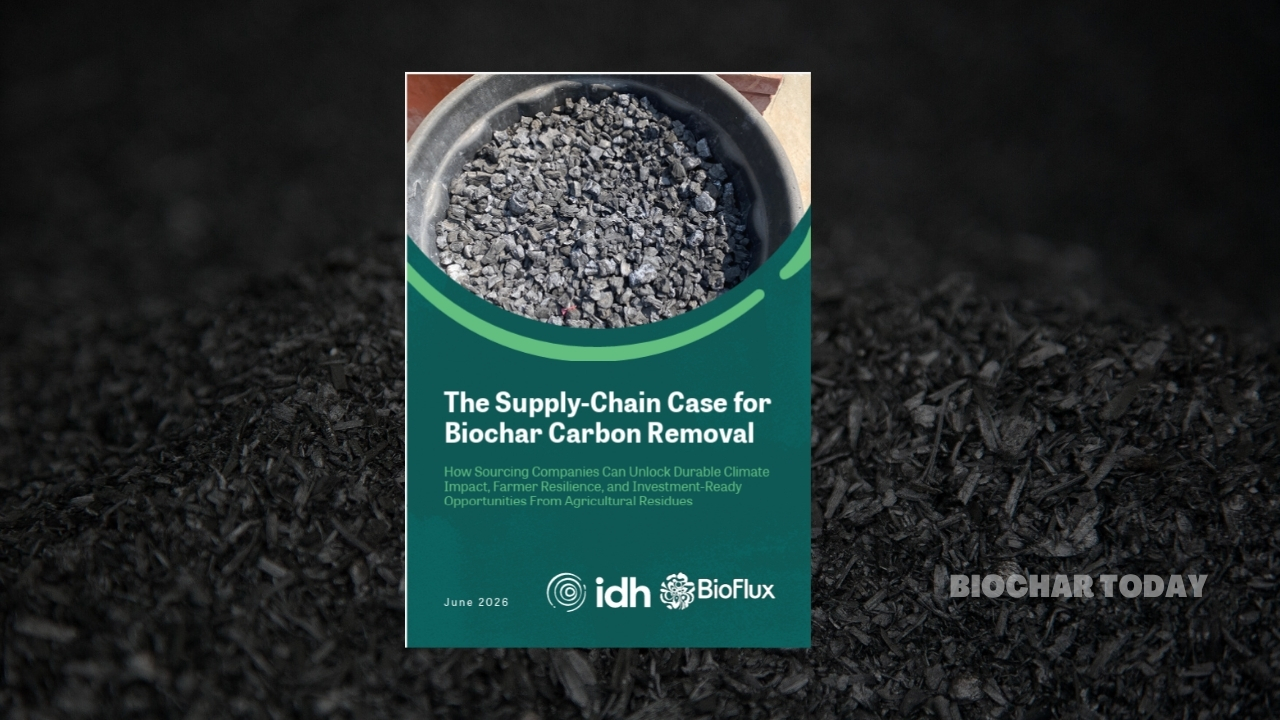
IDH (The Sustainable Trade Initiative), alongside Colombia-based investment hub reVive and consulting firm BioFlux, published a white paper examining the economic and operational viability of biocharBiochar is a carbon-rich material created from biomass decomposition in low-oxygen conditions. It has important applications in environmental remediation, soil improvement, agriculture, carbon sequestration, energy storage, and sustainable materials, promoting efficiency and reducing waste in various contexts while addressing climate change challenges. More within agricultural supply chains. The joint report analyzes how integrating biochar systems can convert agricultural residues into durable carbon sinks while improving soil health and supply chain resilience. By evaluating project economics, technology models, and carbon market dynamics, the publication establishes a strategic framework for corporations and investors looking to deploy pyrolytic systems across international sourcing landscapes.
A major challenge facing agricultural supply chains involves balancing scope 3 decarbonization mandates with practical, farm-level economics and yield stability. While agricultural residues are abundant, agri-businesses frequently struggle to evaluate which biochar project models align with specific supply-chain contexts, varying feedstockFeedstock refers to the raw organic material used to produce biochar. This can include a wide range of materials, such as wood chips, agricultural residues, and animal manure. More characteristics, and farmer engagement structures. Furthermore, uncertainty around carbon credit monetization, high upfront capital costs, and variable agronomic outcomes often creates investment bottlenecks, preventing companies from scaling pyrolytic carbon removal across decentralized smallholder and commercial farming networks.
To resolve these market knowledge gaps, the report delineates structured project frameworks that connect residue management directly with carbon accounting and soil amendmentA soil amendment is any material added to the soil to enhance its physical or chemical properties, improving its suitability for plant growth. Biochar is considered a soil amendment as it can improve soil structure, water retention, nutrient availability, and microbial activity. More strategies. Developed using insights from reVive’s technical assistance programs in Colombia, the paper details operational models ranging from farm-level systems to centralized processing facilities. It outlines methodologies for navigating carbon-market requirements, establishing benefit-sharing mechanisms with smallholders, and implementing robust monitoring systems to validate both long-term carbon permanence and agronomic returns.
The collaborative publication provides investors and corporate procurers with an analytical baseline to assess project readiness and manage operational risks. By clarifying the economic drivers and required conditions for scalable deployment, the report enables agricultural stakeholders to integrate high-integrity biochar carbon removal directly into corporate supply chain strategies, strengthening regional soil resilience while advancing global decarbonization targets.





Leave a Reply