
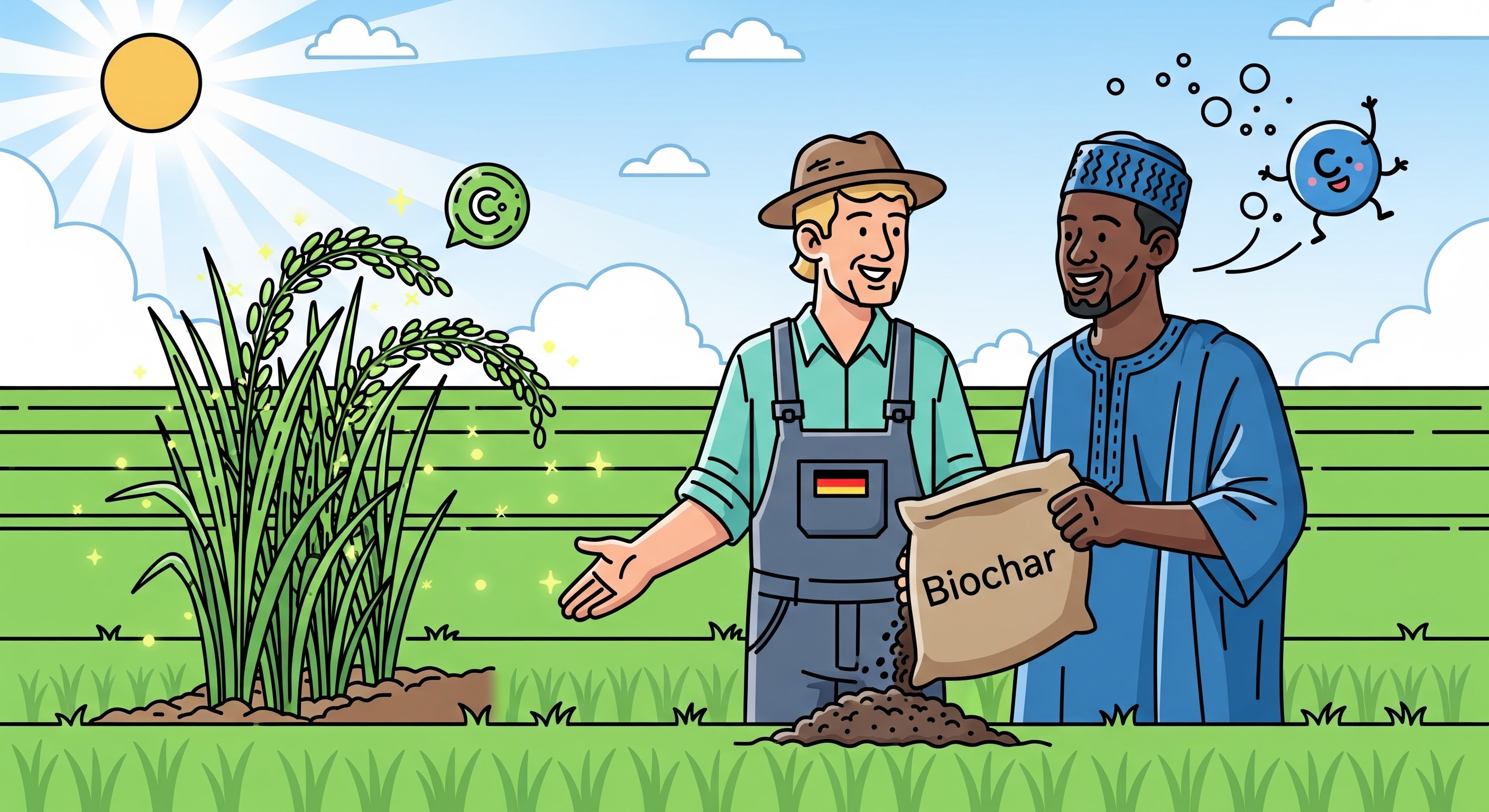
In a significant move towards sustainable agriculture, the German government, through the Deutsche Gesellschaft für Internationale Zusammenarbeit (GIZ), has initiated a project to bolster climate-smart rice farming in Nigeria. The Carbon Offsetting Rice Emissions (CORE) project is a three-year pilot program designed to support 12,000 smallholder farmers across three Nigerian states: Benue, Nasarawa, and Kano. The initiative, a collaboration with Olam Agri, is funded by the German Federal Ministry for Economic Cooperation and Development (BMZ) and represents a forward-thinking approach to mitigating climate change within the agricultural sector.
The CORE project is particularly notable for its integration of biocharBiochar is a carbon-rich material created from biomass decomposition in low-oxygen conditions. It has important applications in environmental remediation, soil improvement, agriculture, carbon sequestration, energy storage, and sustainable materials, promoting efficiency and reducing waste in various contexts while addressing climate change challenges. More as a key component of its climate-smart strategy. Along with alternate wetting and drying techniques, the use of biochar is being promoted to improve soil health and significantly reduce greenhouse gas (GHG) emissions from rice cultivation. This targeted approach not only addresses environmental concerns but also seeks to create tangible economic benefits for the farmers involved. Nigeria’s agriculture sector, while accounting for 25% of the country’s GDP, contributes a disproportionate 33% of its national GHG emissions, highlighting the urgency of such interventions. Moreover, the country reportedly loses approximately $100 million annually to climate-related flooding, underscoring the broader need for climate resilience.
By implementing these innovative practices, the project lays the groundwork for farmers to access and participate in carbon markets, offering a new stream of income by rewarding their adoption of sustainable methods. The initiative highlights Germany’s continued commitment to climate finance, as demonstrated by their substantial contributions of 9.94 billion euros in 2023. This project serves as a practical example for the global community, demonstrating how international partnerships can empower local communities and drive environmental progress through proven, nature-based solutions. For those in the biochar sector, the project offers a clear, large-scale case study of biochar’s application in a major agricultural value chain.
SOURCE: Germany to support 12,000 Nigerian farmers on climate-smart rice production


Leave a Reply