
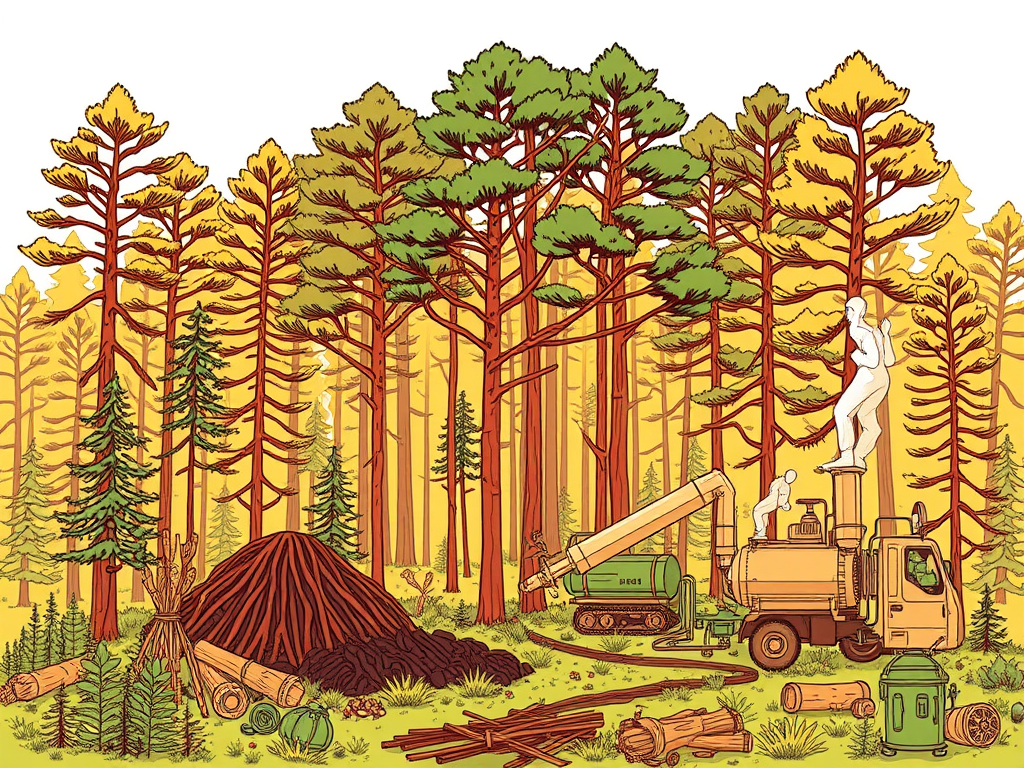
A recent study published in Industrial Crops & Products by Lixuan Wang, Jibin Ning, Xinyu Xu, Guang Yang, Lijiang Zhu, Ruijie Zhang, Weilong Zhang, Zhaoguo Li, and Hongzhou Yu investigates a dual-benefit approach to managing forest residual biomassBiomass is a complex biological organic or non-organic solid product derived from living or recently living organism and available naturally. Various types of wastes such as animal manure, waste paper, sludge and many industrial wastes are also treated as biomass because like natural biomass these More: converting it into solid biofuel. This innovative strategy not only transforms waste into a renewable energy source but also significantly reduces the risk of devastating wildfires.
Wildfires pose a substantial global threat, contributing significantly to carbon emissions and environmental degradation. For instance, between 1997 and 2016, global average carbon emissions from wildfires amounted to approximately 2.2 petagrams (Pg) per year, accounting for about 22% of total annual fossil fuel combustion emissions. High-latitude forests, like those in Siberia and China, are particularly vulnerable due to the immense accumulation of forest residual biomass—deadwood, fallen branches, and dry foliage—which acts as highly flammable fuel. Traditional fuel management methods, such as controlled burns and land clearing, are often costly, produce pollutants, and carry significant safety risks. This research offers a sustainable alternative by converting these hazardous fuels into biocharBiochar is a carbon-rich material created from biomass decomposition in low-oxygen conditions. It has important applications in environmental remediation, soil improvement, agriculture, carbon sequestration, energy storage, and sustainable materials, promoting efficiency and reducing waste in various contexts while addressing climate change challenges. More. The study focused on Dahurian larch, Mongolian Scots pine, Mongolian oak, and Manchurian ashAsh is the non-combustible inorganic residue that remains after organic matter, like wood or biomass, is completely burned. It consists mainly of minerals and is different from biochar, which is produced through incomplete combustion. Ash Ash is the residue that remains after the complete More, four main forest types in North Asia. Researchers produced 60 different types of biochar from the surface fuels (dead leaves) of these trees through anaerobic pyrolysisPyrolysis is a thermochemical process that converts waste biomass into bio-char, bio-oil, and pyro-gas. It offers significant advantages in waste valorization, turning low-value materials into economically valuable resources. Its versatility allows for tailored products based on operational conditions, presenting itself as a cost-effective and efficient More at temperatures ranging from 300°C to 700°C, with durations of 1, 2, and 3 hours.
The characterization of the produced biochar revealed significant findings. Biochar yields ranged from 25.50% to 58.00%, with carbon content between 56.55% and 80.09% dry matter. Coniferous biomass (Dahurian larch and Mongolian Scots pine) generally yielded biochar with lower ash (5.74%-18.44% DM) and volatile matterVolatile matter refers to the organic compounds that are released as gases during the pyrolysis process. These compounds can include methane, hydrogen, and carbon monoxide, which can be captured and used as fuel or further processed into other valuable products. More (4.62%-14.42% DM) but higher fixed carbon (71.41%-82.95% DM) compared to broad-leaved biomass (Mongolian oak and Manchurian ash). This composition contributes to higher heating values and improved fuel characteristics.
The energy recovery from biomass into biofuel ranged from 80.68% to 34.67%, with Dahurian larch biochar showing the highest recovery at 80.68%. The higher heating values (HHVs) for biochar from Dahurian larch, Mongolian Scots pine, and Mongolian oak were comparable to subbituminous coal, indicating their potential for use in steam power plants and cement manufacturing. Biochar produced at lower temperatures (300°C–400°C) exhibited better and faster ignition and combustion performance. Conversely, biochar produced at higher temperatures (600°C–700°C) burned more stably and completely, generating less smoke and carbon monoxide (CO). The elemental composition, particularly carbon, was identified as the most significant factor influencing biochar performance and energy recovery.
The study also developed prediction equations for Higher Heating Value (HHV) and Ash-Free Calorific Value (AFCV) using machine learning models, specifically Random Forest algorithms and the SHAP (SHapley Additive exPlanations) algorithm. Models based on ultimate analysis (elemental composition) demonstrated superior prediction performance compared to those based on proximate analysis. This suggests that elemental composition is a more reliable predictor for the calorific value of forest biofuel.
In conclusion, this research highlights the significant potential of converting forest residual biomass into solid biofuel. This approach not only provides a valuable renewable energy source that can substitute fossil fuels but also offers a proactive solution to mitigate wildfires by reducing combustible material in forests. The findings advocate for the use of coniferous leaves, particularly Dahurian larch, as preferred raw material, with optimization of pyrolysis temperatures to maximize combustion performance and environmental benefits.
Source: Wang, L., Ning, J., Xu, X., Yang, G., Zhu, L., Zhang, R., Zhang, W., Li, Z., & Yu, H. (2025). The performance and prediction of converting forest residual biomass into solid biofuel, saving fossil fuel and reducing forest fire. Industrial Crops & Products, 233, 121363.



Leave a Reply