
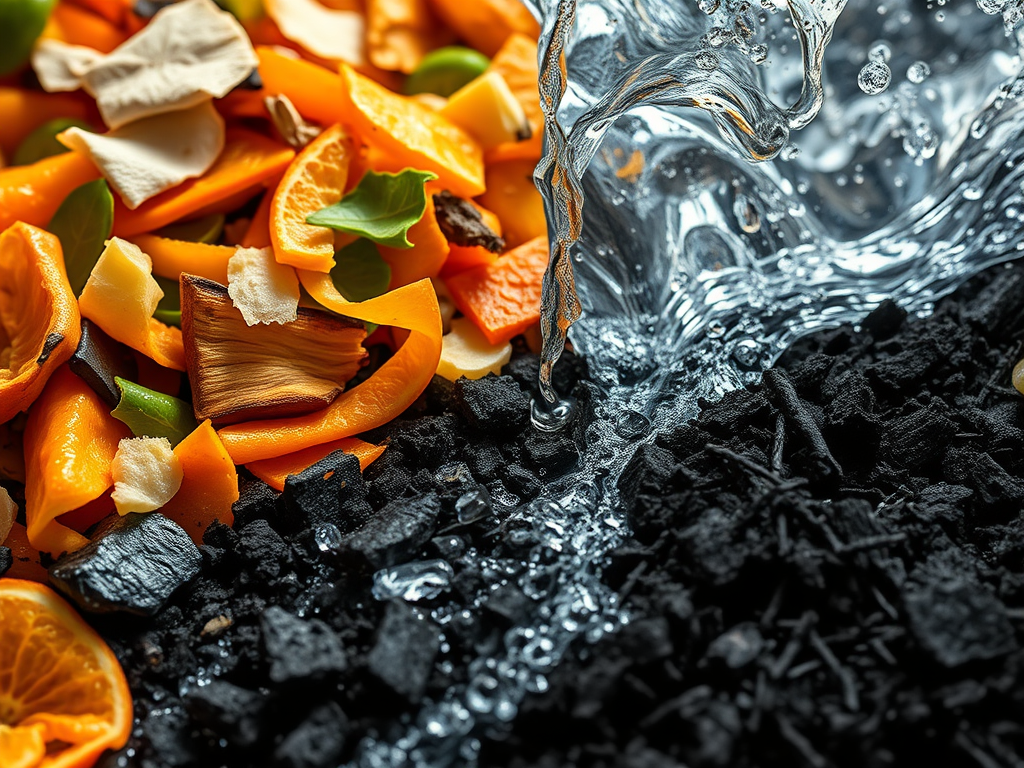
Imagine a world where the peels from your morning orange or the husks from your popcorn could become powerful tools for cleaning polluted water. This isn’t science fiction; it’s the promising reality explored in a recent study published in Scientific Reports by Małgorzata Sieradzka and her team. Their research demonstrates a highly effective method to transform common food industry waste into high-performance biocharBiochar is a carbon-rich material created from biomass decomposition in low-oxygen conditions. It has important applications in environmental remediation, soil improvement, agriculture, carbon sequestration, energy storage, and sustainable materials, promoting efficiency and reducing waste in various contexts while addressing climate change challenges. More, capable of significantly removing hazardous pollutants from aquatic environments.
The global demand for food is projected to surge by 59-98% by 2050, inevitably leading to a proportional increase in food industry waste. This presents a considerable challenge for waste management and environmental sustainability. The circular economy model offers a solution by converting such organic waste into valuable products through thermochemical processes like pyrolysisPyrolysis is a thermochemical process that converts waste biomass into bio-char, bio-oil, and pyro-gas. It offers significant advantages in waste valorization, turning low-value materials into economically valuable resources. Its versatility allows for tailored products based on operational conditions, presenting itself as a cost-effective and efficient More, thereby reducing the environmental and socio-economic burdens of disposal. Unlike agricultural waste, food industry by-products offer a consistent and predictable supply, making them ideal for large-scale conversion into carbon-rich materials.
Sieradzka and her colleagues focused on valorizing rapeseed cake, maize cobs, and walnut shells—common food industry residues—through slow pyrolysis at 600∘C. The resulting biochars exhibited varying properties, with walnut shell biochar showing a particularly significant surface area of 356 m2/g and carbon content exceeding 80% for both maize cobs and walnut shells. While initial biochar yields ranged from 22% to 26%, the real breakthrough came with post-pyrolysis activation processes.
The researchers employed both physical (steam activation at 850∘C) and chemical activation (using H3PO4 and ZnCl2) to enhance the biochar’s performance. Chemical activation proved remarkably effective, substantially increasing the surface area for rapeseed cake and maize cobs, exceeding 300 m2/g, and for walnut shell biochar, reaching approximately 50 m2/g. Specifically, chemically activated maize cob biochar reached a surface area of 537.59 m2/g, while chemically activated walnut shell biochar achieved 557.09 m2/g. This enhanced porosityPorosity of biochar is a key factor in its effectiveness as a soil amendment and its ability to retain water and nutrients. Biochar’s porosity is influenced by feedstock type and pyrolysis temperature, and it plays a crucial role in microbial activity and overall soil health. Biochar More is crucial for adsorbing pollutants.
The activated biochars were then tested for their ability to remove organic (phenol) and inorganic (lead, Pb2+) pollutants from water. The results were compelling: chemically activated walnut shell biochar achieved a remarkable 100% removal of Pb2+ and 82% removal of phenol in batch experiments. Even non-activated walnut shell biochar demonstrated high efficiency, adsorbing 97% of lead and 63% of phenol. The study confirmed that chemical activation significantly improves the biochar’s sorption capacity by increasing the number of functional groups available for pollutant interaction.
Beyond impressive removal rates, the study also addressed environmental safety. Phytotoxicity tests using Lemna minor (duckweed) showed that plant growth inhibition was less than 25% for all tested biochars, including the chemically activated samples, classifying them as non-toxic according to ISO 20079 standards. This crucial finding confirms that these engineered biochars can be safely applied in environmental remediation without posing acute risks to aquatic organisms.
This research aligns with several Sustainable Development Goals (SDGs), demonstrating how converting food industry waste into high-performance biochar supports cleaner water (SDG 6), responsible consumption and production (SDG 12), climate action through carbon sequestration (SDG 13), and improved soil health (SDG 15). The development of such multi-purpose environmental tools from waste streams holds significant promise for a sustainable future.
Source: Sieradzka, M., Jerzak, W., Mlonka-Mędrala, A., Marszałek, A., Dudziak, M., Kalemba-Rec, I., … & Magdziarz, A. (2025). Valorisation of food industry waste into high-performance biochar for environmental applications. Scientific Reports, 15(1), 26195.

Leave a Reply