

Key Takeaways
- Soil Sampling Fails: The study showed that standard soil sampling is “unfit” for counting biocharBiochar is a carbon-rich material created from biomass decomposition in low-oxygen conditions. It has important applications in environmental remediation, soil improvement, agriculture, carbon sequestration, energy storage, and sustainable materials, promoting efficiency and reducing waste in various contexts while addressing climate change challenges. More carbon. It overestimated the amount of carbon added by as much as 6.9t/ha.
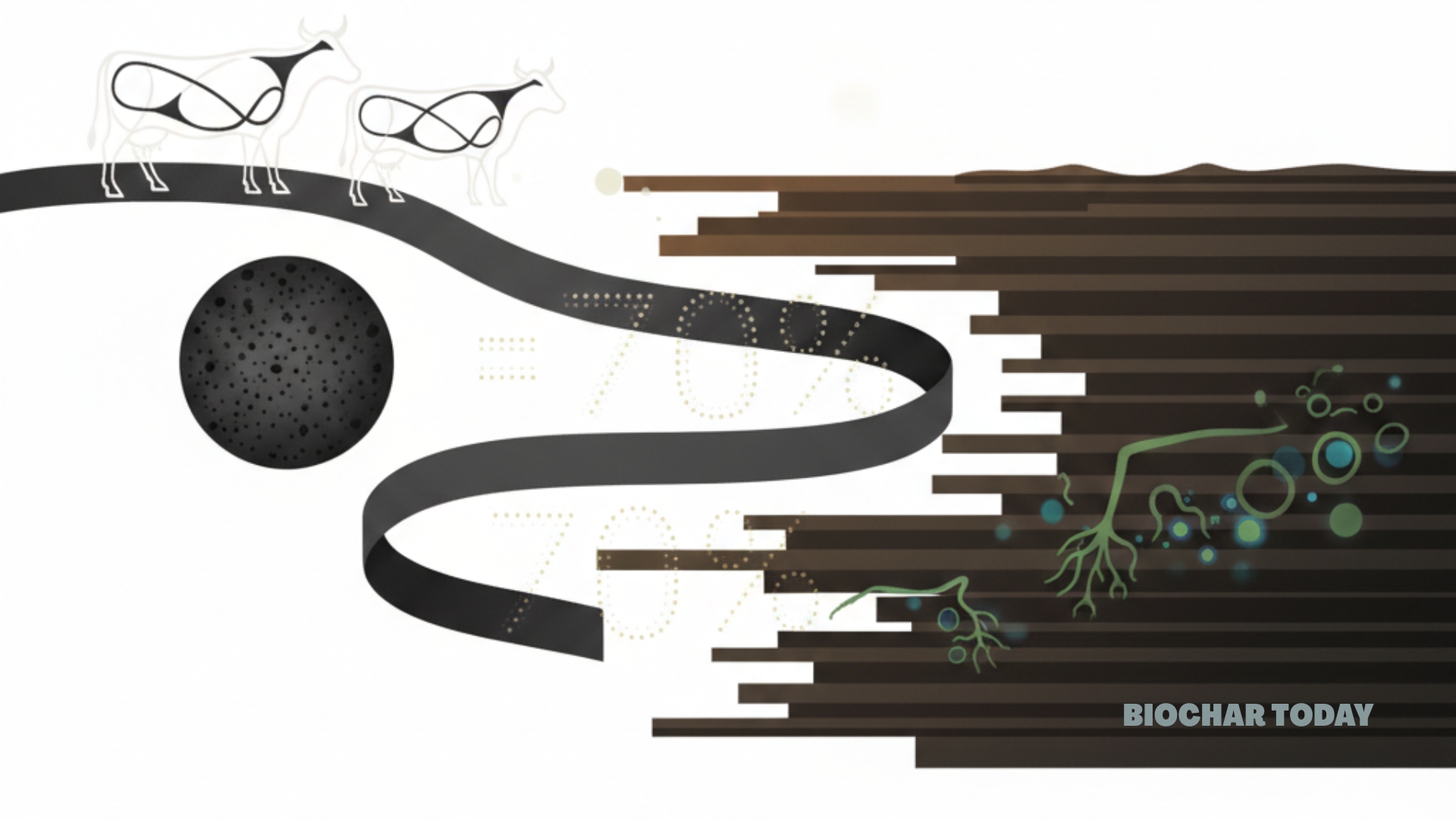
- A “Lumpy” Problem: Biochar (a solid) does not mix evenly into soil (another solid), like chocolate chips in cookie dough. Taking a tiny sample to analyze gives a random result, not an accurate average.
- Regulations Are Flawed: The EU’s REDII-IR, which mandates soil sampling for biochar, is based on a scientifically flawed method that creates uncertainty and high costs for farmers and producers.
- A Better Way Exists: A more accurate method is to (1) test and certify the biochar before it’s applied to know its exact carbon content, and (2) use an audit to prove it was actually put in the soil.
- Baselines Are Also Unreliable: The study found that even before adding biochar, the natural carbon level in a tiny, “homogeneous” area was wildly inconsistent, making it nearly impossible to establish a reliable baseline to measure against.
Biochar is a leading technology for Carbon Dioxide Removal (CDR). By taking carbon from plants and locking it into a solid form that can be added to soil, it promises a way to fight climate change while improving agriculture. But this raises a critical multi-billion-dollar question: how do you accurately measure and verify that carbon to assign a monetary value for carbon credits or biofuel incentives? A new study led by David Chiaramonti and colleagues, published in BiomassBiomass is a complex biological organic or non-organic solid product derived from living or recently living organism and available naturally. Various types of wastes such as animal manure, waste paper, sludge and many industrial wastes are also treated as biomass because like natural biomass these More and Bioenergy, provides definitive experimental evidence that the most common-sense-sounding method—taking soil samples—is completely unfit for the job. The research highlights a major flaw in current European Union (EU) regulations that could hamper investments in this green technology.
The core of the problem lies in a disagreement between regulations. The EU’s Renewable Energy Directive (REDII-IR) requires operators to quantify the carbon added to a field by taking soil samples. In contrast, other international bodies, like the International Civil Aviation Organization (ICAO) and the draft EU Carbon Removal Certification Framework (CRCF), do not require this. They simply require the biochar itself to be certified (to know its carbon content) and the act of deployment to be audited (to prove it was actually put in the ground) . To see which method holds up, the researchers conducted a highly controlled experiment in a small, 75 m2 homogeneous field in Italy. They created three plots: a control plot with no biochar, a plot where biochar was mixed in the field like a farmer would, and a plot where biochar was perfectly mixed with soil in the lab.
The team then added a precise amount of biochar—equivalent to $10~t/ha$ (tonnes per hectare)—which, based on its 88.8% carbon content, meant they added exactly 8.9t/ha of new organic carbon to the soil. The team’s sampling was far more rigorous than required by regulations, taking 5 independent samples from each tiny 25m2 plot, equivalent to a density of 10,000 samples over the 5-hectare area mentioned in the REDII rules. After measuring the baseline carbon in the control plot , the expected carbon stock in the treated plots should have been 60.0t/ha.
What they actually measured was statistically significant… and completely wrong. The “perfectly mixed” lab plot showed 62.0t/ha of carbon—an overestimation of 2.0t/ha. The “real-world” field-mixed plot was even worse, measuring 66.9t/ha of carbon. The soil sampling method over-predicted the amount of carbon added by 6.9t/ha, or nearly 11.5\%. The authors found that even before adding biochar, the baseline soil carbon measurements across the tiny, uniform area were already wildly inconsistent, varying by as much as 7.4t/ha with a high standard deviation.
The authors explain this failure with a simple analogy: mixing biochar (a solid) into soil (another solid) is not like mixing sugar in water; it is like mixing chocolate chips into cookie dough. The biochar particles are “unevenly distributed”. The EU’s soil sampling protocol is akin to verifying the total amount of chocolate in a 5-hectare batch of dough by taking 15 small spoonfuls, mixing them, and then testing a single 0.2-gram crumb.. Whether that tiny crumb happens to contain a biochar particle or not is purely a matter of chance, making the result a random number, not a quantitative assessment.
The study concludes that soil sampling is “unfit” to quantitatively monitor, report, and verify (MRV) biochar carbon for the purpose of allocating carbon credits. The findings strongly support the ICAO and draft EU-CRCF methods as being scientifically superior. The solution, the authors state, is to stop trying to sample the soil. Instead, regulations should require full, upstream certification of the biochar to determine its stable carbon content before application, combined with a third-party audit to ensure it is deployed correctly. This approach is not only more accurate but also less costly, providing the reliability the carbon market needs to scale.
Source: Chiaramonti, D., Lotti, G., Tozzi, F., Casini, D., Vaccari, F. P., Sanei, H., Luconi, M., & Buffi, M. (2026). Is soil sampling appropriate for quantitative carbon accounting for biochar? An experimental investigation to assess soil carbon accumulation. Biomass and Bioenergy, 205, 108537.



Leave a Reply