
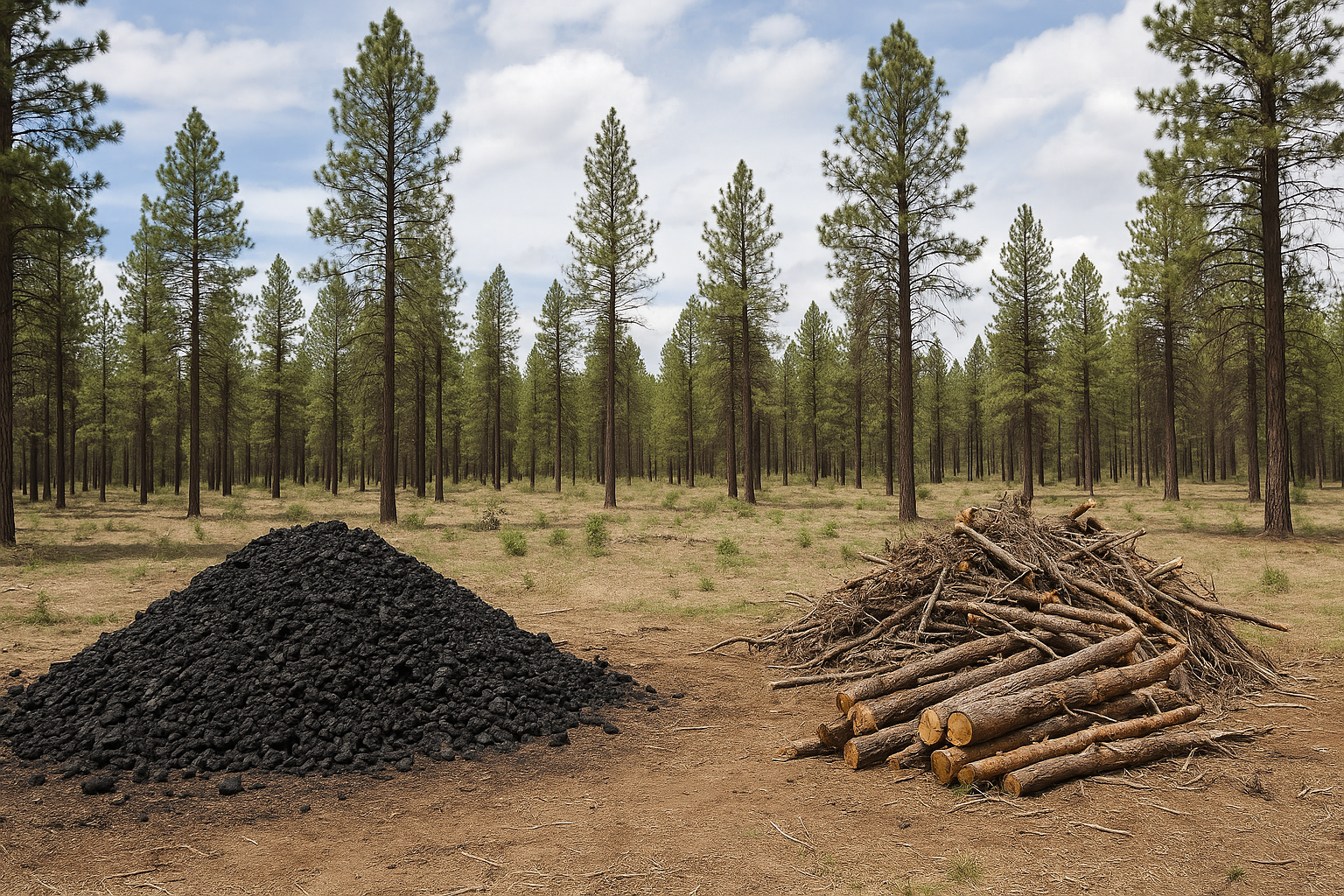
New forestry legislation under consideration in both chambers of Congress could provide a significant boost to biocharBiochar is a carbon-rich material created from biomass decomposition in low-oxygen conditions. It has important applications in environmental remediation, soil improvement, agriculture, carbon sequestration, energy storage, and sustainable materials, promoting efficiency and reducing waste in various contexts while addressing climate change challenges. More development in the United States. The Fix Our Forests Act (S. 1462), introduced by Senator John Curtis (R-Utah) in April 2025, includes provisions aimed at expanding biochar research, commercialization, and demonstration projects.
The bipartisan bill—cosponsored by Senators John Hickenlooper (D-Colo.), Tim Sheehy (R-Mont.), and Alex Padilla (D-Calif.)—was recently reviewed by the Senate Committee on Agriculture, Nutrition and Forestry. A corresponding bill is also pending in the House of Representatives.
Section 301 of S. 1462 outlines the creation of programs to support biochar initiatives through grants and policy development. The proposed legislation emphasizes multiple goals, including improving forest health, promoting carbon sequestration, stimulating job creation, and developing biochar markets.
If enacted, the bill would mandate the USDA, the Bureau of Land Management, and the Department of Energy to fund biochar demonstration projects in partnership with eligible entities. A key requirement is that at least half of the biomassBiomass is a complex biological organic or non-organic solid product derived from living or recently living organism and available naturally. Various types of wastes such as animal manure, waste paper, sludge and many industrial wastes are also treated as biomass because like natural biomass these More feedstockFeedstock refers to the raw organic material used to produce biochar. This can include a wide range of materials, such as wood chips, agricultural residues, and animal manure. More for these projects must come from forest thinning or management activities on public lands.
Additionally, the U.S. Department of the Interior, in collaboration with the DOE, would be tasked with launching or expanding a competitive research grant program, open to institutions like land-grant universities.
This legislative effort signals growing federal interest in leveraging biochar as a tool for sustainable forestry and climate mitigation.





Leave a Reply