
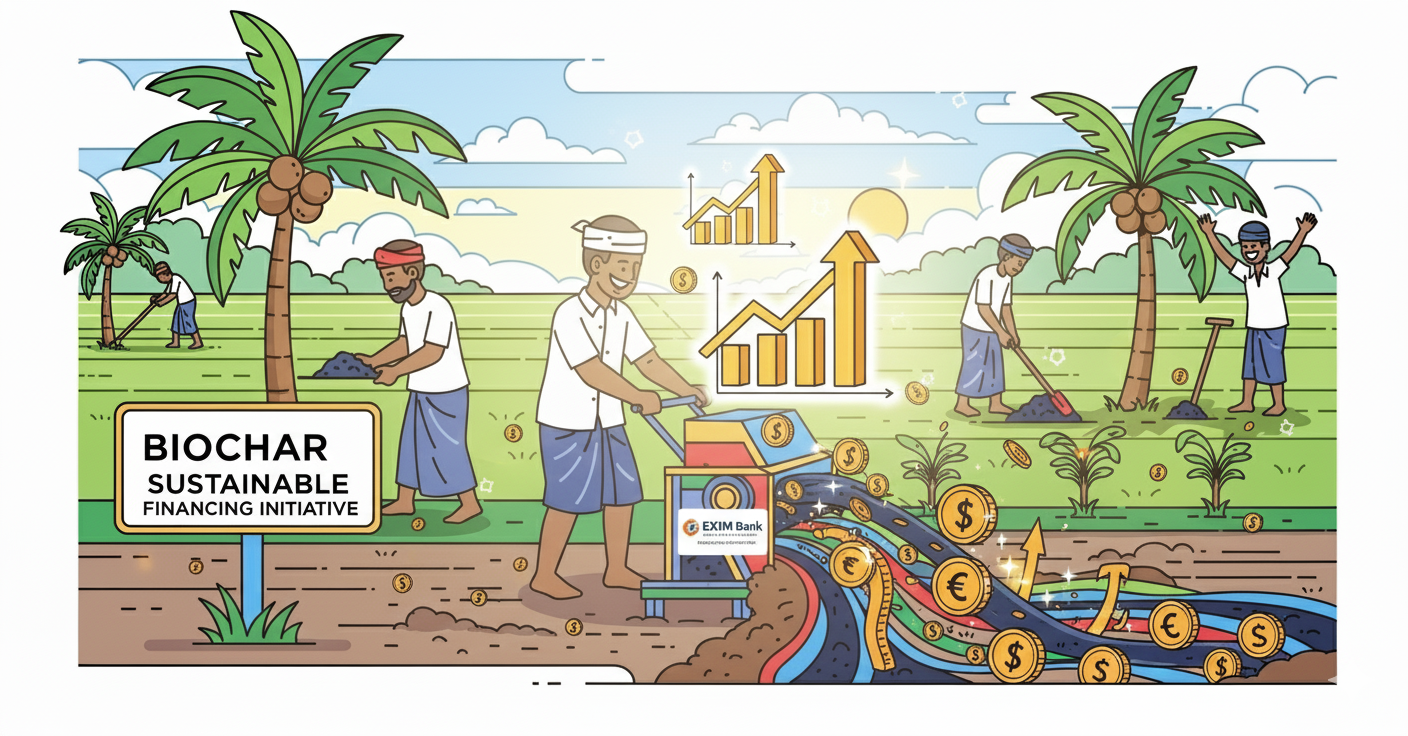
EXIM Bank Malaysia has announced that its collaborative C-Sink biocharBiochar is a carbon-rich material created from biomass decomposition in low-oxygen conditions. It has important applications in environmental remediation, soil improvement, agriculture, carbon sequestration, energy storage, and sustainable materials, promoting efficiency and reducing waste in various contexts while addressing climate change challenges. More project, undertaken with non-profit Wild Asia, has achieved international certification from Carbon Standards International. This milestone, awarded on May 28, 2025, and valid through December 2026, positions EXIM Bank as Malaysia’s first financial institution to back a certified carbon sink project. The certification was granted following a verification process by third-party verifier CERES, and it enables the issuance of C-Sink Carbon Removal Credits.
The C-Sink project focuses on converting agricultural biomassBiomass is a complex biological organic or non-organic solid product derived from living or recently living organism and available naturally. Various types of wastes such as animal manure, waste paper, sludge and many industrial wastes are also treated as biomass because like natural biomass these More, specifically palm residues, into biochar. This process is carried out by smallholder farmers in Sabah using Wild Asia’s Centralised BIO Transformation Units (CBTU). The biochar product serves a dual purpose: it acts as a long-term carbon sink by locking carbon in the soil for centuries and also enhances soil fertility, water retention, and overall farm resilience. Each CBTU can engage up to 150 farmers and support up to 50 hectares of farmland.
According to EXIM Bank Malaysia CEO, Datuk Nurbayu Kasim Chang, this certification is a crucial step towards the bank’s sustainability and innovation goals. The project not only contributes to climate objectives but also generates green jobs and supports a regenerative approach to agriculture for smallholders. The pilot phase has already generated seven verified carbon credits, with an annual capacity projected to scale to 100 credits. By 2027, the project estimates a potential removal of 200-300 tonnes of CO2 per CBTU each year.
The initiative is part of EXIM Bank’s wider Green Global Initiative, which aims to mobilise up to RM1.5 billion in sustainable financing by 2027. The project’s success highlights how community-led, low-cost solutions can deliver verifiable climate impacts with global credibility. This model is seen as a way to create new revenue streams for farmers while supporting sustainable palm oil supply chains.
SOURCE: EXIM Bank’s Biochar Project Wins Global Carbon Certification





Leave a Reply