
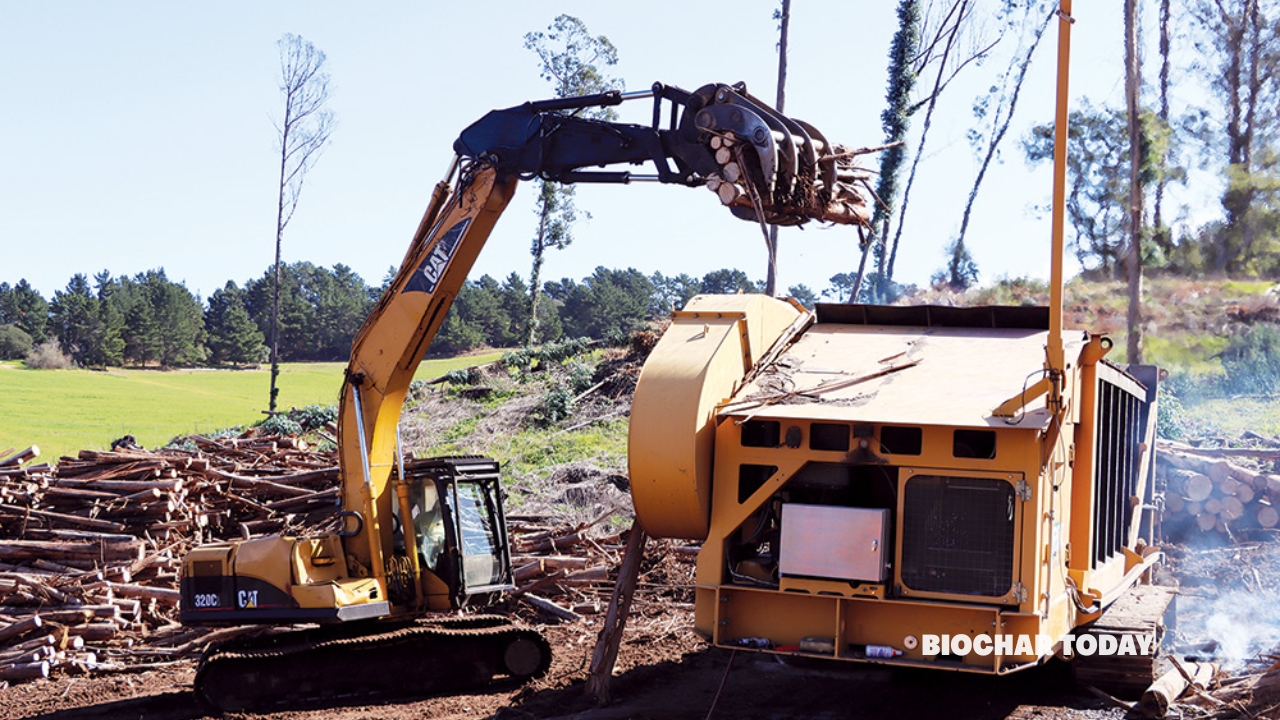
In Monterey County, California, the Elkhorn Slough Foundation (ESF) has launched a multi-agency initiative to convert invasive eucalyptus trees into high-quality biocharBiochar is a carbon-rich material created from biomass decomposition in low-oxygen conditions. It has important applications in environmental remediation, soil improvement, agriculture, carbon sequestration, energy storage, and sustainable materials, promoting efficiency and reducing waste in various contexts while addressing climate change challenges. More. This project, conducted in collaboration with Ventana Forestry and researchers from California State University Monterey Bay (CSUMB), represents a strategic effort to integrate wildfire mitigation with agricultural science. By harvesting fire-prone biomassBiomass is a complex biological organic or non-organic solid product derived from living or recently living organism and available naturally. Various types of wastes such as animal manure, waste paper, sludge and many industrial wastes are also treated as biomass because like natural biomass these More from the Brothers Ranch and Elkhorn Highlands Reserve, the partnership is providing the necessary material for the first field research in the United States specifically focused on the efficacy of eucalyptus-derived biochar in organic farming systems.
The primary challenge addressed by this project is the management of hazardous fuel loads created by non-native, invasive species that threaten both local ecosystems and public safety. Eucalyptus trees are highly flammable and have historically increased wildfire risks in the wildland-urban interface of the Central Coast. Furthermore, the region faces significant environmental pressures, including declining groundwater levels and nutrient runoff from intensive agricultural operations. Traditional methods of biomass disposal, such as open-air burning or landfilling, fail to capture the potential value of this carbon and can contribute to atmospheric emissions.
To resolve these overlapping issues, Ventana Forestry deployed a mobile kiln known as a “Carbonator” to perform on-site pyrolysisPyrolysis is a thermochemical process that converts waste biomass into bio-char, bio-oil, and pyro-gas. It offers significant advantages in waste valorization, turning low-value materials into economically valuable resources. Its versatility allows for tailored products based on operational conditions, presenting itself as a cost-effective and efficient More. This technology processes wood waste at high temperatures in a low-oxygen environment, minimizing emissions while maximizing carbon recovery. Supported by a $1.77 million grant from Cal Fire, the operation successfully converted thousands of tons of eucalyptus logs into stable biochar. This material was then provided to soil scientist Arun Jani at CSUMB for a multi-year study on an organic farm to evaluate how the amendment influences water retention and nutrient cycling in local soils.
The outcomes of this initiative demonstrate a successful circular economy model that links forest management with food security. Initial production phases converted 8,000 tons of eucalyptus into 200 tons of biochar, creating a stabilized carbon sink that will remain in the soil for centuries. Scientifically, the ongoing research aims to prove that this amendment can reduce the agricultural demand for groundwater and mitigate wetland pollution. By transforming a biological liability into a specialized agricultural asset, the organizations involved have established a scalable framework for wildfire resilience and soil health restoration in the United States.

Leave a Reply