

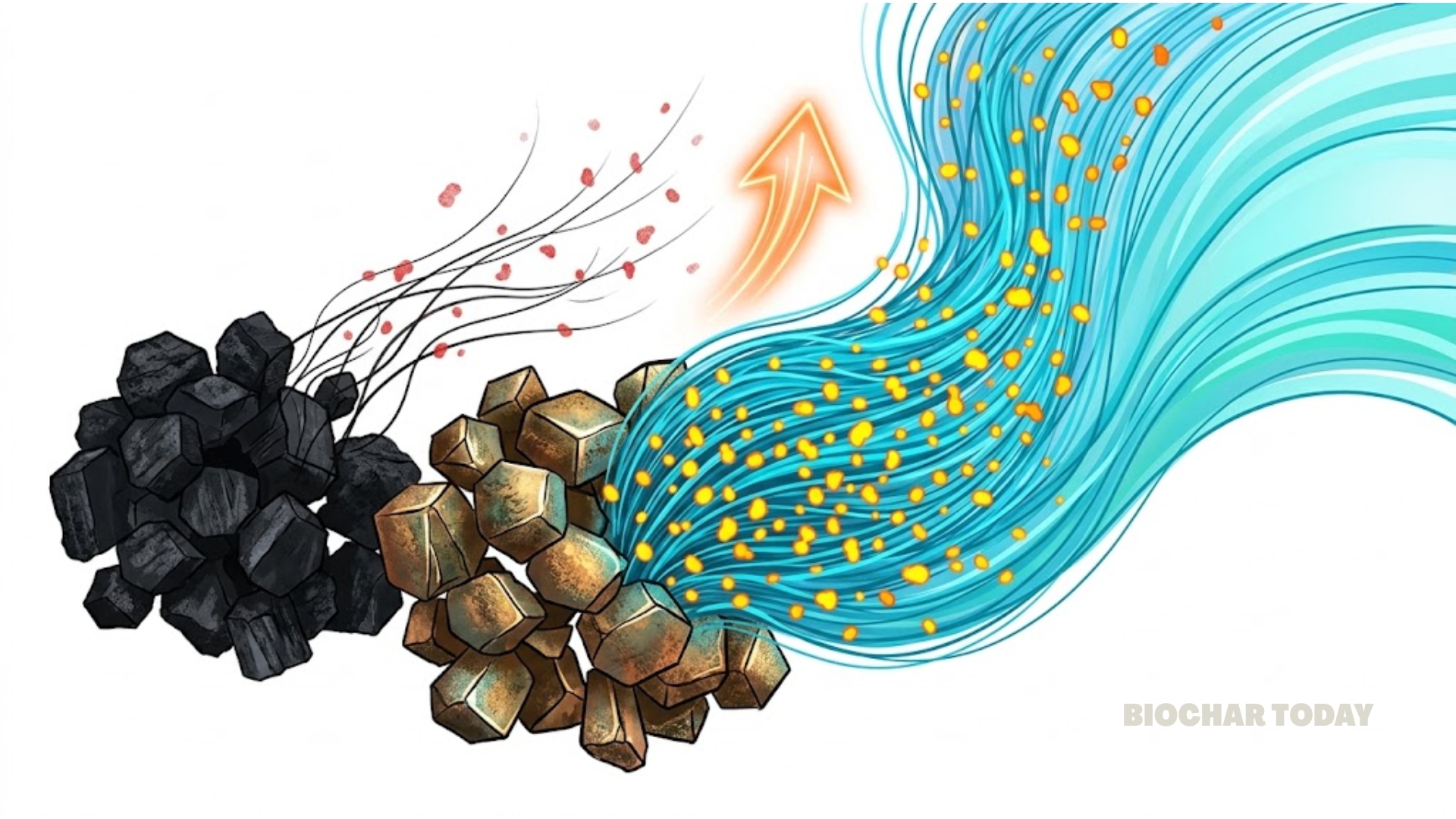
In an article published in BiocharBiochar is a carbon-rich material created from biomass decomposition in low-oxygen conditions. It has important applications in environmental remediation, soil improvement, agriculture, carbon sequestration, energy storage, and sustainable materials, promoting efficiency and reducing waste in various contexts while addressing climate change challenges. More, Huang et al., presented a novel method for recovering lanthanum (La) from water using a metal-organic framework (MOF) modified biochar composite. Rare earth elements (REEs) like lanthanum are critical for advanced technologies, but their extraction and recovery pose environmental challenges. The researchers developed a composite material, MIL-88b@BC, by modifying rice husk biochar with MIL-88b, an iron-based MOF.
The study employed density functional theory (DFT) calculations to understand the adsorption mechanism of La3+ on the composite. The DFT calculations revealed that the primary processes involved in La3+ adsorption were π–π interaction and ligand exchange, with the surface hydroxyl group playing a crucial role. Batch adsorption experiments were conducted to evaluate the performance of MIL-88b@BC in recovering La3+ from water.
The results showed that MIL-88b@BC exhibited a significantly higher adsorption capacity for La3+ compared to unmodified biochar or MOF alone. The maximum La3+ adsorption capacity of MIL-88b@BC was 288.89 mg g−1, achieved at pHpH is a measure of how acidic or alkaline a substance is. A pH of 7 is neutral, while lower pH values indicate acidity and higher values indicate alkalinity. Biochars are normally alkaline and can influence soil pH, often increasing it, which can be beneficial More 6.0. Moreover, the composite material could be recycled at least four times without significant loss of adsorption capacity. This study demonstrates the potential of MOF-modified biochar composites for efficiently recovering REEs from water. The use of biochar as a substrate not only reduces the solubility of MOF but also provides a sustainable and cost-effective material for environmental remediation.
SOURCE: Huang, Q., Zhang, Q., Zhao, S., Zhang, C., Guan, H., & Liu, J. (2025). Efficient recovery of rare metal lanthanum from water by MOF-modified biochar: DFT calculation and dynamic adsorption. Biochar, 7(1), 29. https://doi.org/10.1007/s42773-024-00419-x



Leave a Reply