
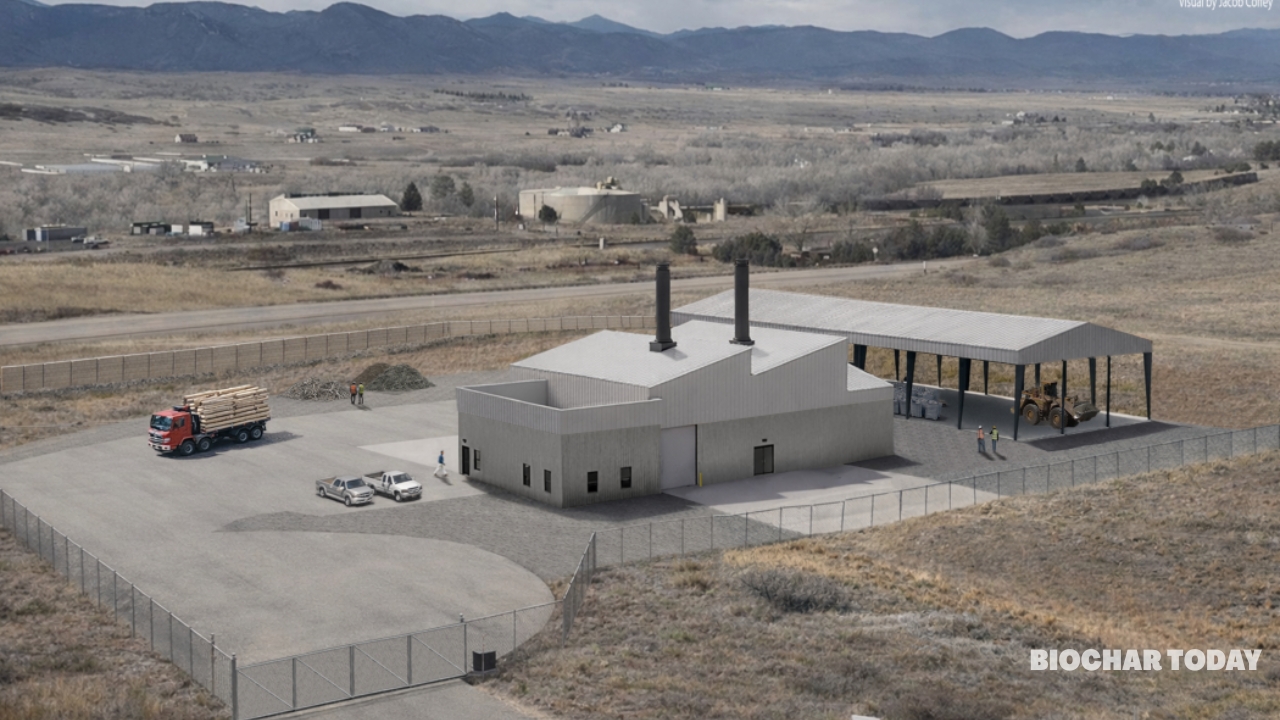
The Douglas County Planning Commission has officially approved the location and extent for an $8 million biocharBiochar is a carbon-rich material created from biomass decomposition in low-oxygen conditions. It has important applications in environmental remediation, soil improvement, agriculture, carbon sequestration, energy storage, and sustainable materials, promoting efficiency and reducing waste in various contexts while addressing climate change challenges. More facility, marking a significant milestone as the first county-operated plant of its kind in the United States. Located in Sedalia, Colorado, the 6,717-square-foot facility is scheduled to begin operations in September 2026. Developed under the guidance of the Wildfire Action Collaborative, the plant is designed to process approximately 10,000 tons of raw woody biomassBiomass is a complex biological organic or non-organic solid product derived from living or recently living organism and available naturally. Various types of wastes such as animal manure, waste paper, sludge and many industrial wastes are also treated as biomass because like natural biomass these More annually, transforming hazardous forest debris into a stable, carbon-rich soil amendmentA soil amendment is any material added to the soil to enhance its physical or chemical properties, improving its suitability for plant growth. Biochar is considered a soil amendment as it can improve soil structure, water retention, nutrient availability, and microbial activity. More.
The primary challenge addressed by this project is the overwhelming volume of woody waste generated by escalating forest restoration and wildfire mitigation efforts in the region. Historically, the disposal of tree trunks, limbs, and branches has incurred high hauling and disposal costs for both public agencies and private contractors. Without local processing infrastructure, these materials often become a logistical bottleneck, potentially slowing the pace of critical safety treatments required to protect Colorado communities from catastrophic wildfires.
The solution centers on localized pyrolysisPyrolysis is a thermochemical process that converts waste biomass into bio-char, bio-oil, and pyro-gas. It offers significant advantages in waste valorization, turning low-value materials into economically valuable resources. Its versatility allows for tailored products based on operational conditions, presenting itself as a cost-effective and efficient More technology capable of converting one ton of wood into one cubic yard of biochar. The facility will provide free drop-off services for Douglas County residents and businesses, accepting clean woody material while excluding treated or contaminated wood. By processing debris on-site, the county eliminates significant transportation expenses and creates a high-value product that can be sold for $150 to $300 per cubic yard. The building’s design also anticipates future growth, featuring the capacity to house a second processing unit should demand continue to rise.
Expected outcomes include the generation of approximately $2.2 million in annual revenue, allowing the facility to become self-sustaining and fully pay for itself within nine years. Revenue and savings from reduced disposal fees will be directly reinvested into further forest mitigation projects, creating a circular economic model for public safety. Beyond financial returns, the facility provides local water providers, conservation districts, and restoration contractors with a reliable source of biochar to improve soil health and water quality across the state.




Leave a Reply