
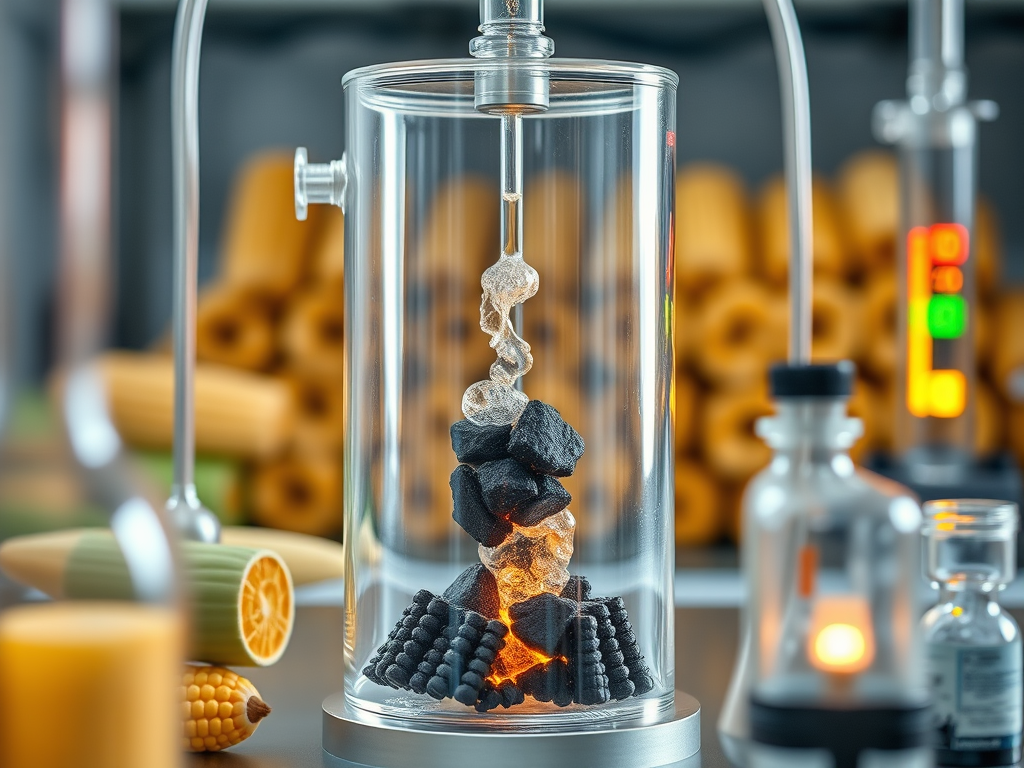
In a recent study published in Carbon Resources Conversion, Mohammed H. Eldesouki, Mohamed Mokhtar Mohamed, and Ahmed Abd El-Moneim have made significant strides in converting carbon monoxide (CO) and carbon dioxide (CO2) into valuable liquid fuels using biochar-supported iron-based catalysts. This research addresses the urgent need to mitigate the environmental impact of these gases, which are major contributors to air pollution and climate change. The team benchmarked their biochar-supported catalysts, derived from agricultural waste like corn cobs, against commercial activated carbonActivated carbon is a form of carbon that has been processed to create a vast network of tiny pores, increasing its surface area significantly. This extensive surface area makes activated carbon exceptionally effective at trapping and holding impurities, like a molecular sponge. It is commonly More under semi-industrial Fischer-Tropsch conditions, demonstrating superior catalytic outcomes.
The catalysts, specifically the zinc-enhanced variant (ZFCK@C), were prepared using ultrasound-assisted dissolution and incipient wetness methods. In CO hydrogenation, conducted at 340∘C and 20 bar, the ZFCK@C catalyst achieved a remarkable 97% conversion rate. This led to a 32% selectivity for longer hydrocarbons (C5+), a 39.6% olefins distribution (C5+), an O/P ratio of 4.0, and a 45.3% distribution of gasoline-range (C5-C12) hydrocarbons. This performance significantly outperformed catalysts supported on activated carbon.
For CO2 hydrogenation, performed at 340∘C and 30 bar, the ZFCK@C catalyst showed a 40% conversion rate, a low methane (CH4) selectivity of 6.1%, and a high C5+ selectivity of 45%. It also yielded a 38.7% olefins distribution (C5+), an O/P ratio of 3.2, and a 45.3% distribution of kerosene-range (C6-C16) hydrocarbons. The introduction of zinc played a crucial role in boosting the production of these higher-chain hydrocarbons.
The enhanced performance of the biochar-supported catalysts is attributed to several factors. BiocharBiochar is a carbon-rich material created from biomass decomposition in low-oxygen conditions. It has important applications in environmental remediation, soil improvement, agriculture, carbon sequestration, energy storage, and sustainable materials, promoting efficiency and reducing waste in various contexts while addressing climate change challenges. More, as a highly porous material with a large surface area, provides an excellent support structure for catalysts, leading to better dispersion and stabilization of the active iron sites. This, in turn, increases catalytic activity and selectivity. The surface functional groups present in biochar, such as hydroxyl, carboxyl, and phenolic groups, facilitate the adsorption and activation of reactant molecules, improving reaction kinetics and efficiency. The study’s characterization analyses, including FTIR, XRD, BET, H2-TPR, and CO2-TPD, confirmed these advantageous properties. For example, ZFCK@C exhibited a higher specific surface area (587 m2/g) compared to activated carbon-supported catalysts (428 m2/g. Furthermore, the stability of the ZFCK@C catalyst was rigorously tested over 100 hours of continuous operation under semi-industrial conditions. The results showed excellent durability with no significant deactivation or sintering, indicating its viability for extended industrial use. The conversion rate difference at the final stage was no more than ±1.0% for all reactions, confirming its stable activity.
This research stands out by employing a semi-industrial fixed-bed reactor, providing a more practical analysis of hydrocarbon distribution compared to previous studies that often used micro-reactors and did not report specific hydrocarbon ranges like gasoline, kerosene, and diesel. By utilizing biochar derived from agricultural waste through an environmentally friendly recycling process, this study presents a sustainable and practical approach to converting CO and CO2 into high-value fuels, offering a promising solution to current environmental challenges.
Source: Eldesouki, M. H., Mohamed, M. M., & El-Moneim, A. A. (2025). Semi-industrial CO and CO2 conversion with biochar-supported Fe-based catalysts. Carbon Resources Conversion.


Leave a Reply