
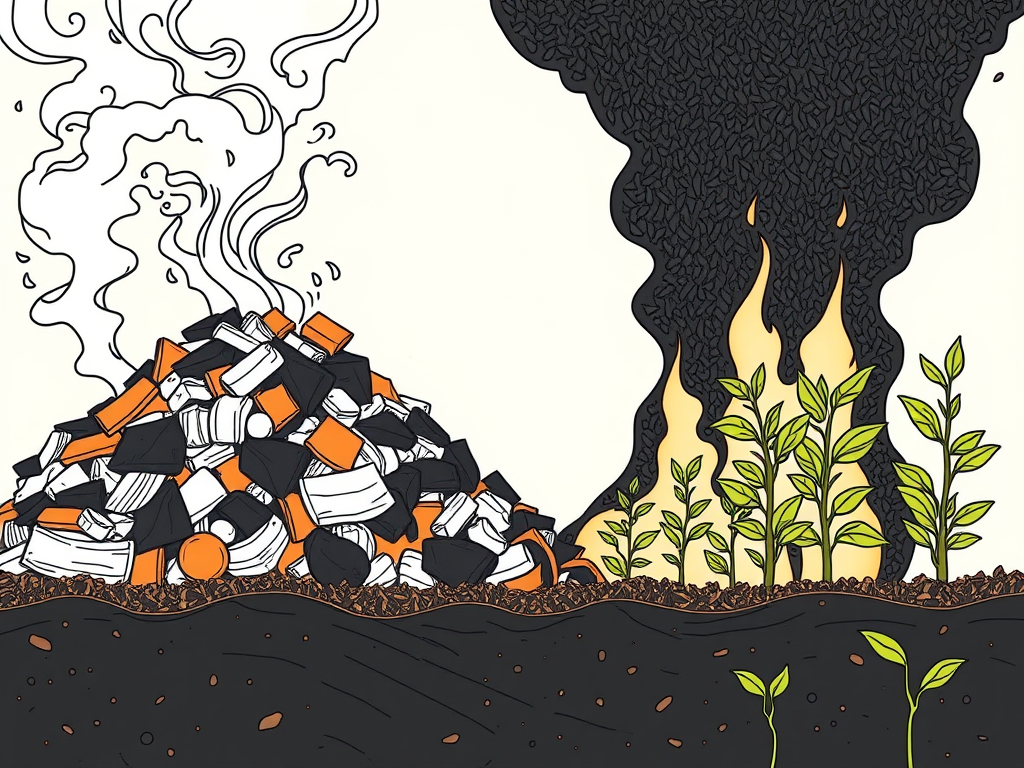
Australia faces a substantial challenge with food waste (FW), generating approximately 31.2 million tonnes annually, placing a significant burden on the economy, environment, and resources, including water usage and greenhouse gas (GHG) emissions. However, a comprehensive review in Carbon Research by Chowdhury et al., highlights a promising and sustainable solution: converting this abundant food waste into biocharBiochar is a carbon-rich material created from biomass decomposition in low-oxygen conditions. It has important applications in environmental remediation, soil improvement, agriculture, carbon sequestration, energy storage, and sustainable materials, promoting efficiency and reducing waste in various contexts while addressing climate change challenges. More through pyrolysisPyrolysis is a thermochemical process that converts waste biomass into bio-char, bio-oil, and pyro-gas. It offers significant advantages in waste valorization, turning low-value materials into economically valuable resources. Its versatility allows for tailored products based on operational conditions, presenting itself as a cost-effective and efficient More. This innovative approach not only addresses the waste problem but also contributes to climate change mitigation and improves soil health, particularly vital for Australia’s often low-fertility soils.
Current waste management practices in Australia, such as landfilling, composting, and anaerobic digestion, have limitations. Landfilling of FW is not environmentally sustainable due to its contribution to methane emissions, a potent greenhouse gas, and associated public health concerns. Composting requires considerable space, and anaerobic digestion can be expensive to set up and maintain. Pyrolysis, a thermochemical process involving heating organic materials like food waste to 300–800°C in a low-oxygen environment, offers a more effective solution by decomposing materials into biochar, gases, and fuels.
The conversion of food waste to biochar yields significant benefits for Australia. Beyond tackling the immediate waste problem, biochar actively combats climate change. It is a stable, carbon-rich material that can sequester carbon for extended periods. This is particularly important as agriculture in Australia was responsible for over half of the methane emissions in 2022-23. By improving soil health, biochar can also enhance agricultural productivity, a crucial factor given Australia’s vulnerability to droughts and existing low soil fertility. Biochar achieves this by increasing organic and total carbon in the soil, improving soil texture, nutrient availability, and microbial activity. For example, studies have shown that using biochar derived from vegetable and fruit waste can increase soil organic carbon (SOC) by 90.10% and 88.61%, respectively. Furthermore, biochar can reduce the need for chemical fertilizers, which are significant sources of GHG emissions.
The properties of biochar, which are influenced by the pyrolysis process parameters like temperature, residence timeResidence time refers to the duration that the biomass is heated during the pyrolysis process. The residence time can influence the properties of the biochar produced. More, heating rate, and particle size, make it highly versatile. For instance, increasing pyrolysis temperature generally reduces char yield as more material converts into gaseous and liquid fuels. However, higher temperatures (e.g., 500°C to 800°C) can also increase the surface area of biochar, enhancing its ability to adsorb pollutants. Biochar’s high porosityPorosity of biochar is a key factor in its effectiveness as a soil amendment and its ability to retain water and nutrients. Biochar’s porosity is influenced by feedstock type and pyrolysis temperature, and it plays a crucial role in microbial activity and overall soil health. Biochar More allows it to retain water and nutrients in the soil. The pHpH is a measure of how acidic or alkaline a substance is. A pH of 7 is neutral, while lower pH values indicate acidity and higher values indicate alkalinity. Biochars are normally alkaline and can influence soil pH, often increasing it, which can be beneficial More of food waste-derived biochar is typically alkaline, and increasing pyrolysis temperature leads to higher pH values, which can be beneficial for acidic soils.
Despite the promising potential, challenges remain. The varying physical and chemical properties of food waste across different locations and over time complicate the assessment of its biochar potential. The high water content of food waste also presents storage and handling difficulties, and there’s a lack of techno-economic analyses for large-scale drying technologies. High production costs at smaller scales and the absence of large-scale production facilities are also obstacles. Future research should focus on optimizing biochar content in construction materials to minimize strength reduction and exploring long-term impacts on soil biota, especially regarding high concentrations of soluble ammonium and sodium. Developing pre-treatment or treatment methods to mitigate adverse effects while retaining biochar’s benefits is also crucial.
The Australian government has recognized the importance of sustainable food waste management, aiming to reduce food waste by 50% by 2030 through its National Food Waste Strategy. Converting food waste to biochar aligns well with this goal and contributes to a circular economy model where waste is transformed into valuable resources. With strong policy support, infrastructure development, and continued research, biochar production from food waste can be a cornerstone of Australia’s strategy to address waste management and climate change challenges.
Source: Chowdhury, P., Chowdhury, T., Chowdhury, H., & Bontempi, E. Food waste to biochar; a potential sustainable solution for Australia: a comprehensive review.


Leave a Reply