
Key Takeaways
- Mixing biocharBiochar is a carbon-rich material created from biomass decomposition in low-oxygen conditions. It has important applications in environmental remediation, soil improvement, agriculture, carbon sequestration, energy storage, and sustainable materials, promoting efficiency and reducing waste in various contexts while addressing climate change challenges. More, compost, and sludge together works better than using any single ingredient to keep water in sandy soil.
- This triple-blend approach significantly reduces the amount of water that drains away and gets lost underground.
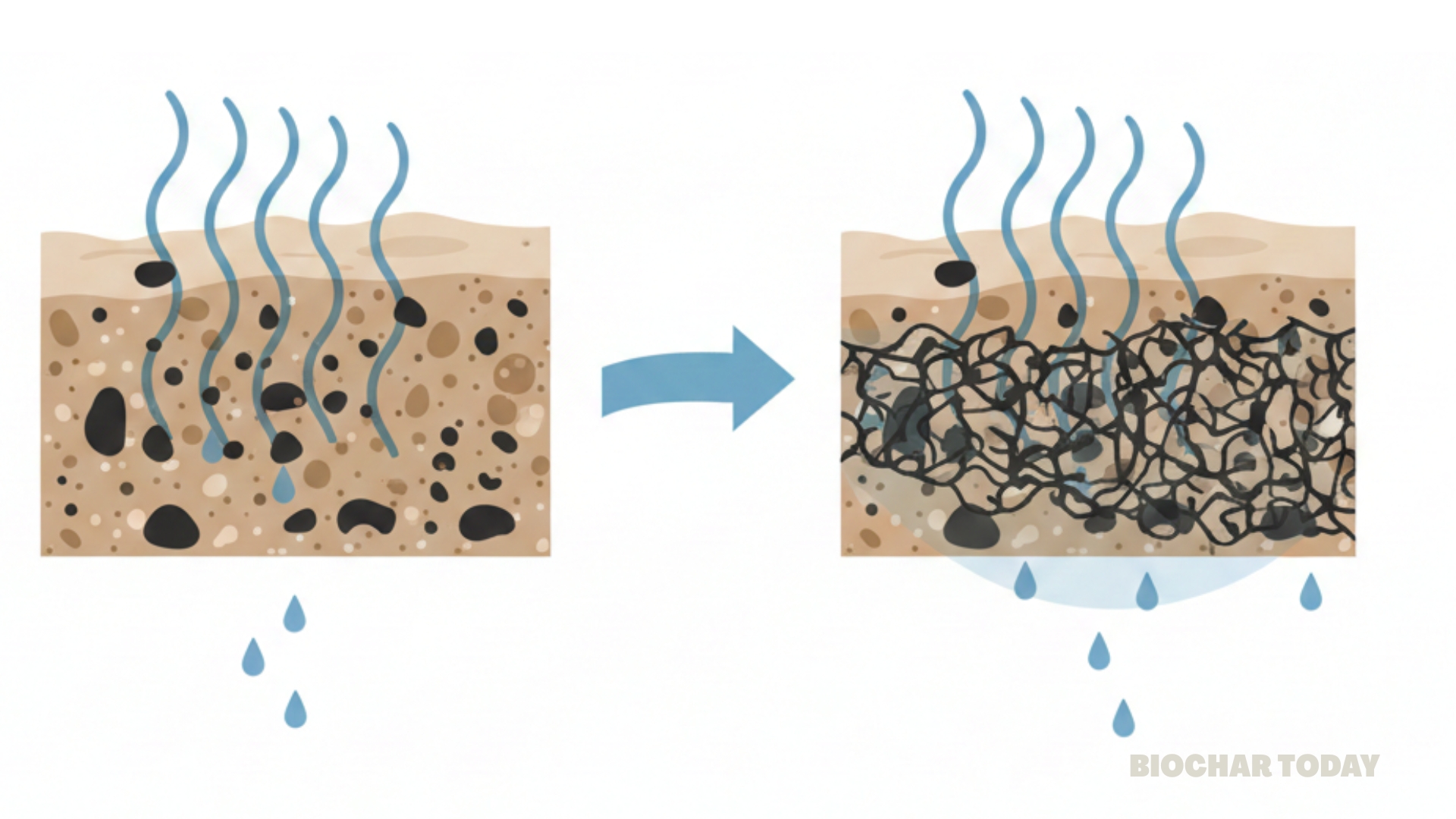
- Biochar creates a sponge-like structure in the soil that traps moisture, while compost and sludge help hold that moisture steady.
- Using these recycled organic materials can help farmers grow food more reliably in dry regions with poor soil.
- Integrated soil treatments make sandy ground more resilient to changing weather and seasonal droughts.
In the journal Biochar, researchers Slaven Tenodi and colleagues explore how different organic additions can transform the hydraulic behavior of marginal sandy soils. Sandy soils are notoriously difficult for sustainable agriculture because they have naturally low water retention and high drainage, meaning water often flows right through them before plants can use it. By conducting a long-term experiment lasting over a year, the study team discovered that combining biochar with compost and sludge creates a powerful synergy that far outperforms any individual amendment. While single amendments provide some relief, the triple-amendment strategy proved to be the most effective for optimizing soil water dynamics and reducing waste.
The most striking finding was that the combination of biochar, sludge, and compost reduced cumulative drainage by more than 40 percent compared to using single amendments. This is vital for water-limited regions where every drop of irrigation or rainfall counts. The researchers noted that biochar acts as a foundational structural support, increasing soil porosityPorosity of biochar is a key factor in its effectiveness as a soil amendment and its ability to retain water and nutrients. Biochar’s porosity is influenced by feedstock type and pyrolysis temperature, and it plays a crucial role in microbial activity and overall soil health. Biochar More and providing tiny internal spaces to trap moisture. Meanwhile, compost and sludge add fine particles and organic matter that further bridge the gaps between large sand grains, creating a more stable soil matrix that resists rapid water loss. Together, these materials transform the soil from a simple sieve into a more complex, water-holding sponge.
The data also showed that treatments containing biochar were particularly skilled at stabilizing water storage across different seasons. Even during fluctuations in rainfall and temperature, the soil treated with the triple blend maintained a higher and more consistent average water content. This stability is crucial for agriculture, as it provides a reliable water source for plants during dry spells, potentially reducing the need for frequent irrigation. Interestingly, while biochar alone improved water-holding capacity, its effects were much more variable when not supported by the buffering organic matter found in compost or sludge. This underscores the importance of a holistic, integrated approach to soil management.
Statistical modeling and laboratory tests confirmed that these improvements in water retention are directly linked to changes in the soil’s internal architecture. The amendments influenced how water moves through the soil by altering hydraulic conductivity and field capacity. The researchers found that sludge was particularly effective at filling large pores to slow down fast drainage, while biochar and compost focused on increasing the volume of water accessible to plant roots. By carefully selecting and combining these materials, it is possible to tailor soil strategies to meet specific environmental goals, such as maximizing water use efficiency in arid agroecosystems.
Ultimately, this research offers a practical and sustainable roadmap for managing difficult sandy soils. By upcycling organic waste products like sludge and compost alongside biochar, land managers can significantly improve the health and productivity of marginal lands. These findings are especially relevant as the global population continues to grow and climate change makes water availability increasingly unpredictable. Moving beyond single-ingredient solutions toward integrated organic strategies appears to be a key step in building more resilient and sustainable agricultural systems for the future.
Source: Tenodi, S., Maletić, S., Isakovski, M. K., Kruse, J., & Weihermüller, L. (2026). Impact of biochar, compost, and sludge amendments on the soil water balance of a sandy soil. Biochar, 8(14).




Leave a Reply