
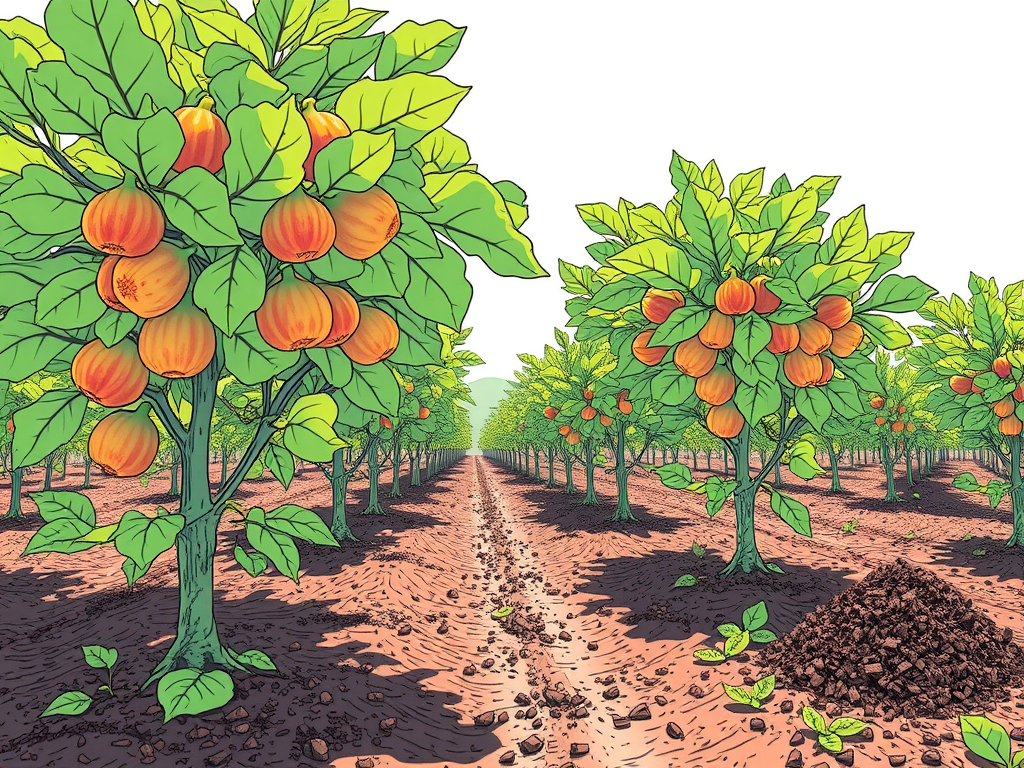
Prolonged drought and low rainfall in semi-arid regions severely impact rain-fed fig groves, leading to reduced soil fertility, poor water retention, and limited productivity. A four-year study by Mohammad Saeed Tadayon, Seyed Majid Mousavi, and Seyed Mashaallah Hosseini, published in the Journal of Soil Science and Plant Nutrition , investigated whether a combined approach of foliar-applied salicylic acid (SA), biocharBiochar is a carbon-rich material created from biomass decomposition in low-oxygen conditions. It has important applications in environmental remediation, soil improvement, agriculture, carbon sequestration, energy storage, and sustainable materials, promoting efficiency and reducing waste in various contexts while addressing climate change challenges. More, and biofertilizers could enhance fig tree resilience and yield. Their findings demonstrate significant improvements in soil water content, plant nutrition, and a remarkable increase in fruit yield.
Drought is a primary challenge for agriculture in semi-arid regions, severely limiting crop productivity due to insufficient soil moisture. This study confirmed biochar’s significant role in improving soil water retention. The application of biochar alone (B1) led to a notable increase in volumetric soil water content at all measured depths: 0-40 cm, 40-80 cm, and 80-120 cm. Specifically, at the 0-40 cm depth, water content rose from 17.28% in untreated control plots (B0) to 22.73% with biochar application (B1). This represents a roughly 31% increase. At the 40-80 cm depth, water content increased from 15.50% (B0) to 23.43% (B1), an approximate 51% improvement. The deepest layer, 80-120 cm, saw an increase from 14.28% (B0) to 19.95% (B1), indicating about a 40% enhancement. When biochar was combined with biofertilizers (B2), soil water content was slightly higher than with biochar alone, but this difference was not statistically significant. This suggests that biochar was the primary driver of improved soil moisture retention. Maintaining higher soil moisture is crucial for sustaining rain-fed fig trees, especially during dry periods, as evidenced by monthly data showing biochar-treated plots staying well above the wilting point even in peak summer.
Beyond water retention, improving nutrient availability and uptake is vital for plant health and productivity, particularly under stressful conditions. The study revealed that the combined application of biochar and biofertilizers (B2) significantly enhanced the concentration of both macro- and micronutrientsThese are essential nutrients that plants need in small amounts, kind of like vitamins for humans. They include things like iron, zinc, and copper. Biochar can help hold onto these micronutrients in the soil, making them more available to plants. More in fig leaves compared to the control (B0). The B2 treatment resulted in substantial increases in various nutrient concentrations: nitrogen (N) by 55.86%, phosphorus (P) by 54.55%, potassium (K) by 60.20%, calcium (Ca) by 50.42%, and magnesium (Mg) by an impressive 82.61%. Micronutrients also saw significant boosts: iron (Fe) by 32.50%, manganese (Mn) by 41.18%, zinc (Zn) by 60.00%, copper (Cu) by 30.00%, and boron (B) by 23.08%. The interaction between salicylic acid (SA) and the B2 treatment had an even more pronounced synergistic effect, particularly at the 1.0 mM SA + B2 level, which produced the highest nutrient concentrations overall. For instance, leaf N concentration in this optimal treatment reached 1.88%, which aligns with sufficient levels for
Ficus carica under well-managed rain-fed conditions. These findings highlight how biofertilizers, especially mycorrhizal fungiThese are friendly fungi that form a partnership with plant roots. They act like an extension of the root system, helping plants access water and nutrients more effectively. Biochar can create a cozy habitat for these helpful fungi, boosting their growth and improving plant health. More and plant growth-promoting rhizobacteria, facilitate nutrient uptake, a process supported by biochar providing a stable environment for these microbes. The most compelling outcome of this research was the significant impact of the combined treatments on fig fruit yield and quality. Salicylic acid (SA) application alone, particularly at 1.0 mM, more than doubled the dry fruit yield from 7.93 kg/tree in the control to 16.49 kg/tree. This concentration also improved fruit size distribution, reducing small fruits and increasing medium and large sizes.
Similarly, the biochar and biofertilizer combined treatment (B2) nearly doubled the dry yield, reaching 16.70 kg/tree compared to 8.06 kg/tree in the control. The synergistic effects truly shone when SA was combined with the biochar-biofertilizer treatment. The optimal 1.0 mM SA + B2 combination resulted in the highest dry fruit yield of 23.61 kg/tree. This represents an increase of over 300% compared to the control (SA0.0 mM + B0), which had a yield of 5.63 kg/tree. This combination also significantly improved fruit quality parameters, including a high total soluble solids (TSS) of 19.12 °Brix and a flavor index of 91.0. This strong positive correlation between improved water relations, nutrient status, and physiological performance directly translated into these remarkable yield and quality benefits.
Beyond the agronomic benefits, the economic analysis provided strong support for the integrated treatment strategy. The 1.0 mM SA + B2 treatment emerged as the most economically viable option, demonstrating a Benefit-Cost Ratio (BCR) of 3.99. This high BCR indicates an exceptional return on investment for rain-fed fig production systems. While other treatments, such as 0.5 mM SA + B2 (BCR = 1.93) and 0.5 mM SA + B1 (BCR = 1.44), also showed favorable economic outcomes, the optimal combination significantly outperformed them. In stark contrast, the control treatment (0.0 mM SA + B0) had a very low BCR of 0.29 and a negative Net Present Value (NPV), highlighting its poor profitability due to low productivity. These economic findings reinforce the potential for farmers in semi-arid regions to adopt this integrated strategy to mitigate climate-induced yield variability and enhance profitability, aligning with goals for sustainable, climate-resilient agriculture.
This four-year field study provides compelling evidence that an integrated approach combining moderate-dose foliar salicylic acid application (1.0 mM) with biochar enriched with microbial and organic biofertilizers is a highly effective, sustainable, and economically viable solution for enhancing drought resilience, soil health, and productivity in rain-fed fig orchards. The success of this strategy lies in its synergistic benefits, where biochar improves soil moisture and structure, biofertilizers enhance nutrient solubilization and uptake, and salicylic acid regulates plant hormonal responses to water stress. Future research should investigate the long-term effects of biochar, refine the timing and rates of SA and biofertilizer applications, and explore the applicability of this integrated method across other fruit crops and diverse environmental conditions.
Source: Tadayon, M. S., Mousavi, S. M., & Hosseini, S. M. (2025). Salicylic Acid and Biochar-Biofertilizer Improve Soil Fertility, Drought Tolerance, and Fig Yield in a Semi-Arid Region. Journal of Soil Science and Plant Nutrition.





Leave a Reply