
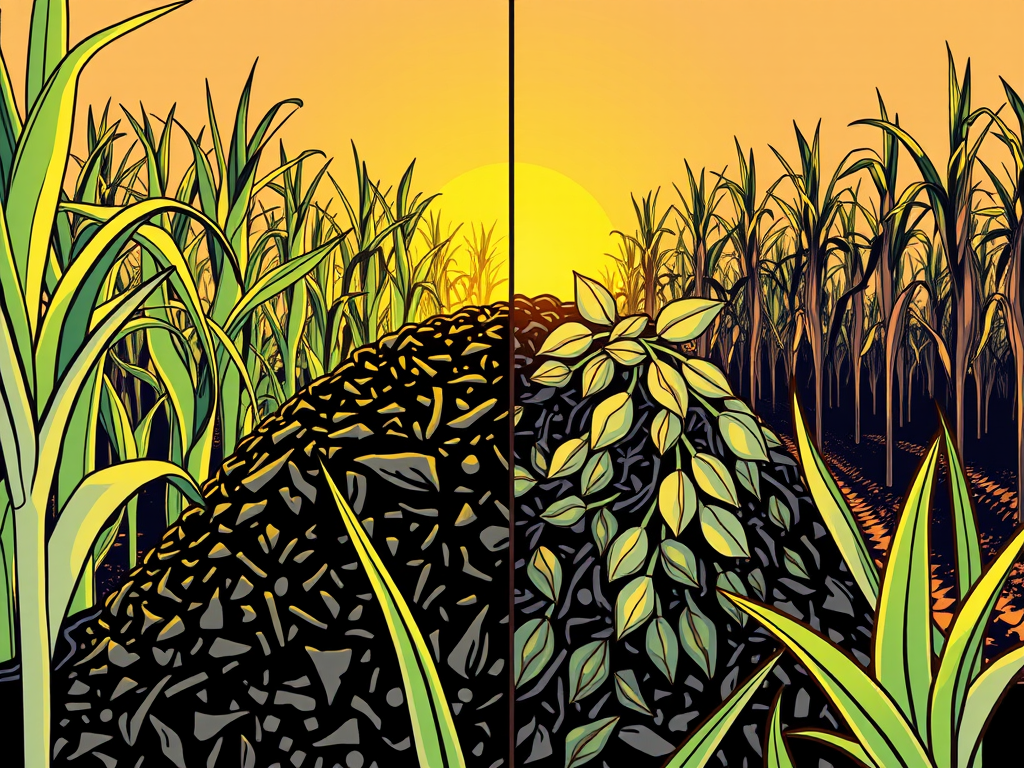
In a study published in Scientific Reports, Jining Zhang and colleagues explored how different fertilization methods affect the properties of biocharBiochar is a carbon-rich material created from biomass decomposition in low-oxygen conditions. It has important applications in environmental remediation, soil improvement, agriculture, carbon sequestration, energy storage, and sustainable materials, promoting efficiency and reducing waste in various contexts while addressing climate change challenges. More derived from maize straw and its potential for agricultural use and carbon sequestration. The research highlights significant differences in biochar characteristics based on whether the maize was grown using organic or chemical fertilizers.
The study revealed that biochar from chemically fertilized maize straw had a higher total carbon content (61.3-74.4 wt%) and a longer mean residence timeResidence time refers to the duration that the biomass is heated during the pyrolysis process. The residence time can influence the properties of the biochar produced. More (MRT) of 232.5-1473.6 years, compared to biochar from organically fertilized maize straw, which showed 54.7-59.1 wt% carbon content and an MRT of 126.7-714.5 years. This suggests that chemical fertilization leads to biochar that could sequester carbon in soil for a more extended period.
Conversely, the biochar from organically fertilized maize straw contained higher potassium (43.6-113.8 g/kg) and phosphorus (9.5-12.3 g/kg) levels. Both types of biochar, produced at a pyrolysisPyrolysis is a thermochemical process that converts waste biomass into bio-char, bio-oil, and pyro-gas. It offers significant advantages in waste valorization, turning low-value materials into economically valuable resources. Its versatility allows for tailored products based on operational conditions, presenting itself as a cost-effective and efficient More temperature of 500°C, are suitable for use as nutrient carriers and can aid in carbon sequestration.
Overall, the study indicates that while chemical fertilization results in biochar with better carbon sequestration potential, organic fertilization produces biochar richer in essential nutrients. The findings contribute valuable insights into tailoring biochar properties for specific agricultural and environmental applications.
SOURCE: Zhang, J., Ge, L. -A., Zhang, X., Wang, C., Sun, H., Chen, H., Huang, J., & Zhou, S. (2025). A valorization analysis towards agricultural application of biochar prepared using maize straw grown using organic or chemical fertilizers. Scientific Reports, 15, 11469.




Leave a Reply