
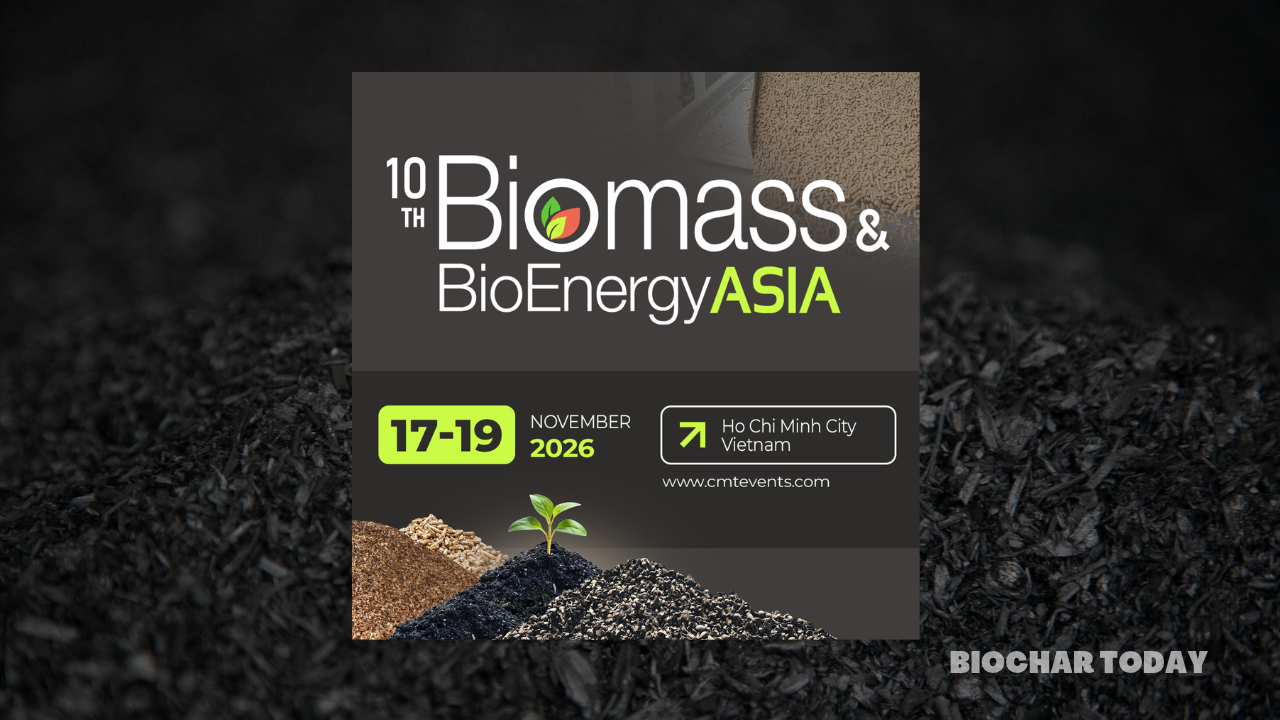
The Centre for Management Technology (CMT) is hosting the 10th BiomassBiomass is a complex biological organic or non-organic solid product derived from living or recently living organism and available naturally. Various types of wastes such as animal manure, waste paper, sludge and many industrial wastes are also treated as biomass because like natural biomass these More & BioEnergy Asia conference from November 18–19, 2026, at Le Méridien Saigon in Ho Chi Minh City, Vietnam. Bringing together nearly 300 regional and international stakeholders, the event addresses Southeast Asia’s biomass sector as it navigates shifting export demands, stricter international sustainability standards like EUDR and RED III, and emerging higher-value industrial applications. Among the key contributors, the Mekong BiocharBiochar is a carbon-rich material created from biomass decomposition in low-oxygen conditions. It has important applications in environmental remediation, soil improvement, agriculture, carbon sequestration, energy storage, and sustainable materials, promoting efficiency and reducing waste in various contexts while addressing climate change challenges. More Initiative, represented by Alex Nguyen, is scheduled to present actionable insights on developing bankable biochar carbon removal initiatives, project financing strategies, and carbon market dynamics specific to Vietnam.
The primary challenges confronting the Southeast Asian biomass and biocarbon sectors center on tightening international sustainability regulations, changing procurement economics in core import destinations like Japan and South Korea, and the financial hurdles associated with scaling higher-value biocarbon applications. Suppliers must continuously ensure certification readiness, quality control, and supply-chain reliability to maintain access to global markets. Furthermore, transitioning from raw biomass trade toward advanced biocarbon utilization requires overcome technical feedstockFeedstock refers to the raw organic material used to produce biochar. This can include a wide range of materials, such as wood chips, agricultural residues, and animal manure. More selection constraints, high production economics, and establishing bankable financing structures for long-term project viability.
To address these operational and financial constraints, industry participants are advancing higher-value processing technologies and structured commercial frameworks. Speakers at the conference, including researchers from SINTEF Energy Research and academic experts, are detailing engineered agricultural biomass solutions and torrefied biomass methods aimed at replacing fossil fuels in heavy industries such as steelmaking. Complementing these technical advancements, the Mekong Biochar Initiative is outlining frameworks to secure carbon market financing and establish bankable biochar removal projects, while entities like Uniexport Group, CellMark Asia, and the Vietnam Wood Pellet Association provide key regional supply-chain support.
These collaborative efforts aim to transition Southeast Asia from a traditional biomass export region into a producer of high-value biocarbon and verified carbon removal credits. The integration of advanced biocarbon into industrial applications, such as coal substitution in metallurgy and utility-scale power, offers a path toward industrial decarbonization while securing higher operating margins for producers. Successful implementation of these project financing models in Vietnam will establish a scalable blueprint for bankable biochar deployment across broader Asian markets.


Leave a Reply