
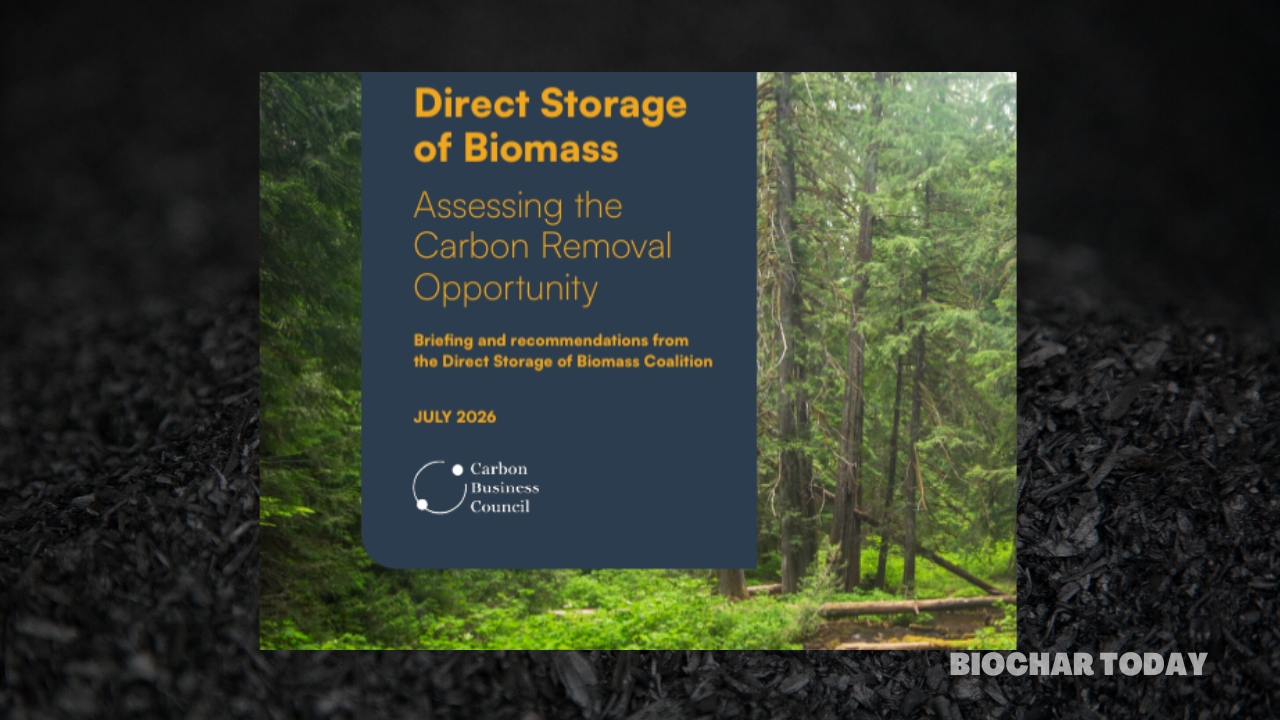
The Carbon Business Council has published a comprehensive issue brief titled “Direct Storage of BiomassBiomass is a complex biological organic or non-organic solid product derived from living or recently living organism and available naturally. Various types of wastes such as animal manure, waste paper, sludge and many industrial wastes are also treated as biomass because like natural biomass these More: Assessing the Carbon Removal Opportunity,” establishing an action-oriented framework for public and private sector deployment. Written and issued by the non-profit trade association, the brief introduces strategic recommendations aimed at advancing global investment in biomass storage technologies. The collaborative publication represents the unified position of the newly formed Direct Storage of Biomass Coalition, an industry working group comprising twenty member organizations. Released in the United States, this foundational brief serves as an operational roadmap to move the biological storage pathway from small-scale pilot projects to global commercial integration.
Deploying effective carbon dioxide removal pathways faces significant hurdles because many technological solutions require massive capital expenditures and take years to build out. Concurrently, environmental managers confront a severe bottleneck regarding organic waste biomass, as wildfire mitigation and agricultural operations generate millions of tons of forest debris and crop residues annually. If left to decay or cleared via burning, this biomass rapidly releases its stored carbon dioxide back into the atmosphere, neutralizing the ecological benefits of regional land management practices while worsening global atmospheric accumulation.
To resolve these interconnected bottlenecks, the coalition advocates for the immediate expansion of the direct storage of biomass as a highly accessible, low-tech climate solution. This operational methodology utilizes existing industrial forestry, agricultural, and waste management supply chains to gather surplus organic matter. The collected materials are permanently interred within engineered subterranean vaults or secure above-ground storage facilities designed to exclude oxygen and moisture. Eliminating these variables prevents natural decomposition, locking the plant-sequestered carbon away within the organic structures for multiple centuries without requiring intensive chemical refining.
The formal adoption of these policy guidelines provides critical environmental, economic, and logistical outcomes for participating regions. Implementing the brief’s recommendations allows land managers to scale up wildfire mitigation projects by leveraging private carbon finance to fund extensive fuel-load reduction. Economically, the storage pathway creates robust revenue diversification for rural communities, agricultural operators, and Native Nations through the monetization of verified carbon removal credits. Ultimately, utilizing established land management infrastructure allows the global carbon market to unlock significant low-cost mitigation potential, sequestering an estimated 55 to 115 million tons of carbon dioxide equivalent annually in American forestry residues alone.



Leave a Reply