
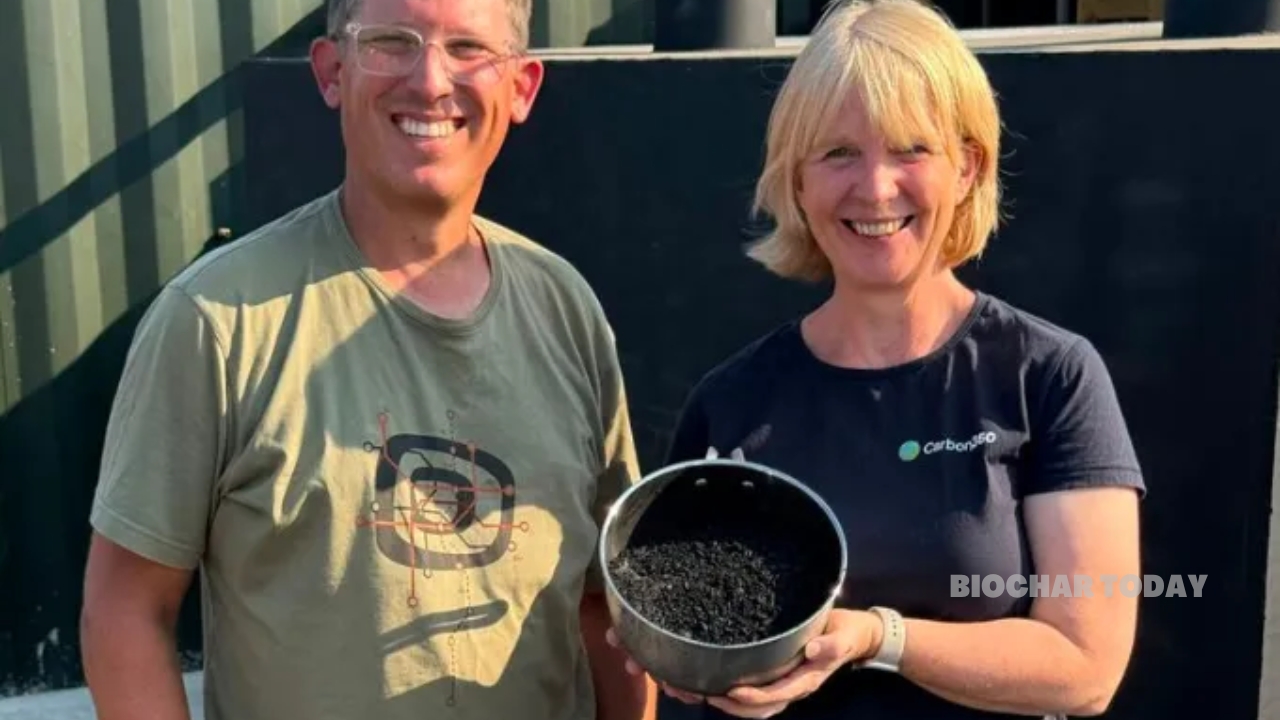
United Kingdom–based technology developer CapChar has announced the installation of its first commercial customer unit at Carbon350’s operational site near Petersfield in the South Downs National Park. Following an initial pilot testing program conducted in Cornwall in collaboration with Restord, this commercial deployment demonstrates an integrated technology suite comprising batch pyrolysisPyrolysis is a thermochemical process that converts waste biomass into bio-char, bio-oil, and pyro-gas. It offers significant advantages in waste valorization, turning low-value materials into economically valuable resources. Its versatility allows for tailored products based on operational conditions, presenting itself as a cost-effective and efficient More production, thermal energy storage, and automated monitoring. The project establishes an operational framework intended to validate decentralized biomassBiomass is a complex biological organic or non-organic solid product derived from living or recently living organism and available naturally. Various types of wastes such as animal manure, waste paper, sludge and many industrial wastes are also treated as biomass because like natural biomass these More processing models within regional supply chains in the United Kingdom.
Establishing localized biocharBiochar is a carbon-rich material created from biomass decomposition in low-oxygen conditions. It has important applications in environmental remediation, soil improvement, agriculture, carbon sequestration, energy storage, and sustainable materials, promoting efficiency and reducing waste in various contexts while addressing climate change challenges. More production networks faces significant technical and economic barriers, particularly regarding energy efficiency and process verification. Standard small-scale thermochemical conversion systems often lose excess thermal energy generated during pyrolysis, reducing overall process efficiency. Furthermore, distributed facilities frequently struggle to implement cost-effective, high-integrity digital monitoring, reporting, and verification (dMRV) systems required to issue reliable carbon removal certificates. Small-scale operators consequently face diminished margins due to uncaptured energy losses and complex verification requirements.
To address these operational constraints, the Petersfield facility integrates three core CapChar innovations into a single processing hub. Batch pyrolysis equipment converts locally sourced woody biomass into carbon-dense material. A patent-pending thermal battery captures high-temperature heat generated during thermochemical conversion, storing thermal energy for immediate or subsequent applications. The facility uses this recovered heat to pre-dry incoming biomass inputs and dry commercial wood products, including logs and kindling. Additionally, CapChar deployed its proprietary dMRV software infrastructure to record process data, establishing direct tracking for carbon removal quantification.
The installation currently operates at 25 percent capacity, with plans to scale to full operational throughput over the next 12 months. Upon reaching maximum capacity, the facility is projected to yield over 100 tonnes of biochar annually, generating approximately 250 tonnes of carbon dioxide equivalent (tCO₂e) in high-integrity carbon removals. By capturing waste heat for secondary drying applications and establishing automated data collection protocols, the project provides a functional benchmark for distributed, regional biomass processing hubs across the United Kingdom.



Leave a Reply