
Key Takeaways
- Rice is a vital staple crop, and maximizing its yield is key for global food security.
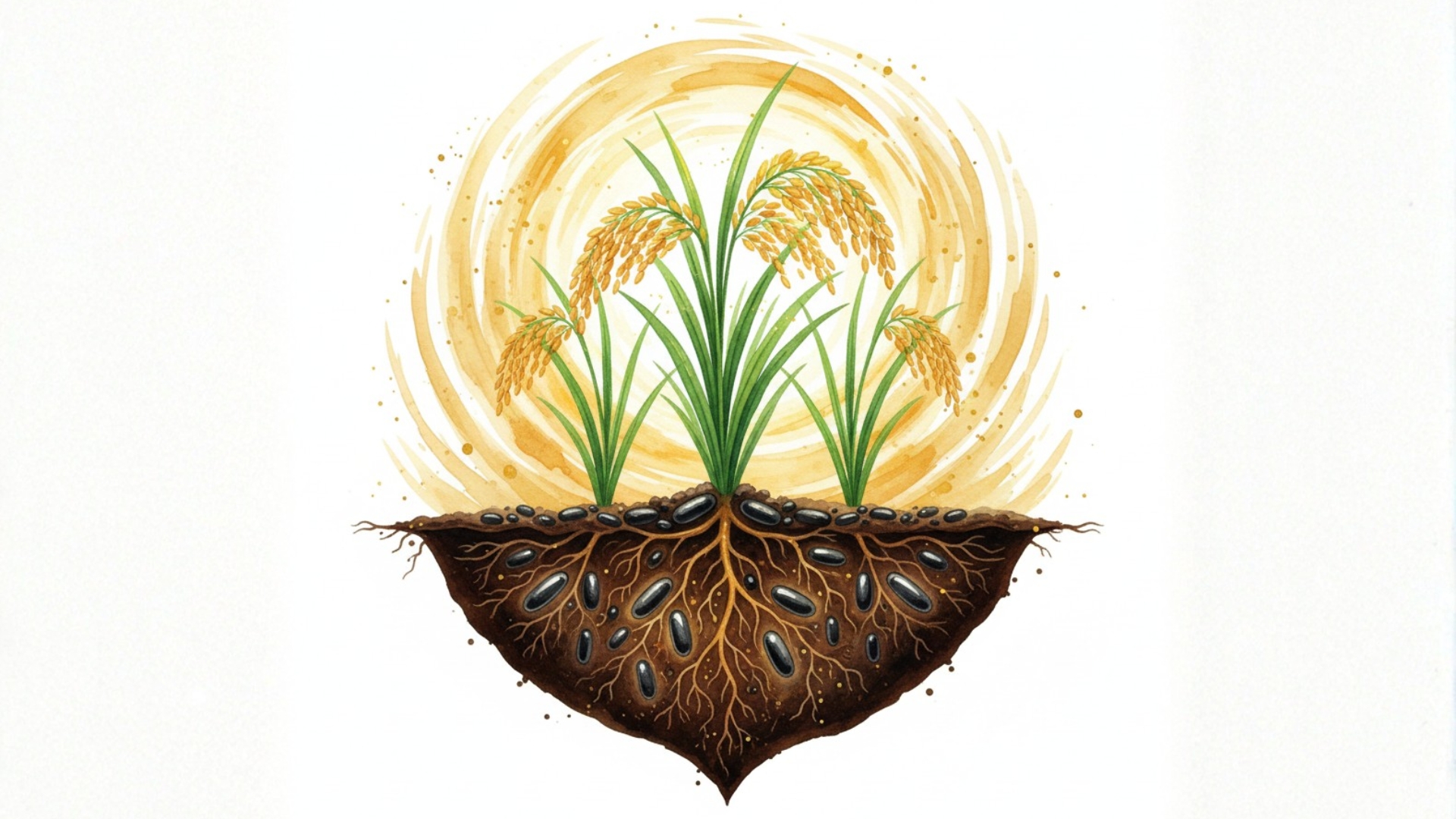
- Applying biocharBiochar is a carbon-rich material created from biomass decomposition in low-oxygen conditions. It has important applications in environmental remediation, soil improvement, agriculture, carbon sequestration, energy storage, and sustainable materials, promoting efficiency and reducing waste in various contexts while addressing climate change challenges. More (like Mehogoni biochar) to the soil is a way to significantly improve plant growth and increase crop yields.
- The variety of rice used is also a critical factor in determining final yield.
- The combination of the BRRI Dhan89 rice variety with Mehogoni biochar (V2B3) was the most effective strategy, resulting in the highest grain yield of 9.40 t ha−1.
- This specific combination is recommended as an effective agricultural technique for enhancing Boro rice production.
The principal staple grain, rice (Oryza sativa L.), is expected to see demand rise by 28% by 2050. With nearly half the world’s population relying on rice as their primary source of nutrition, boosting its production and productivity is crucial for ensuring global food security and sustainable economic growth. This urgency has led to the exploration of technologies like using high-yielding rice varieties (HYV) and employing efficient agronomic management approaches. In a recent investigation published in the Egyptian Journal of Agronomy, Habib et al. set out to determine how different varieties and the application of biochar would affect the growth dynamics and yield characteristics of Boro rice cultivars. The experiment was performed at Sher-e-Bangla Agricultural University in Dhaka, Bangladesh.
The researchers tested two factors: Factor A consisted of four biochar treatments (B0= No Biochar, B1= Rice husk + cowdung Biochar, B2= Mango Biochar, and B3= Mehogoni Biochar), and Factor B included four rice varieties (V1= BRRI Dhan100, V2= BRRI Dhan89, V3= BRRI Dhan84, and V4= BRRI Dhan69). Biochar, produced from the pyrolysisPyrolysis is a thermochemical process that converts waste biomass into bio-char, bio-oil, and pyro-gas. It offers significant advantages in waste valorization, turning low-value materials into economically valuable resources. Its versatility allows for tailored products based on operational conditions, presenting itself as a cost-effective and efficient More of agricultural farm leftovers, is known to contain substantial quantities of organic carbon, calcium, and magnesium, and its application can promote plant growth and increase yields by improving the soil’s permeability, water-holding capacity, and microbial activity. The biochar was applied directly to the soil at a rate of 5.0 t ha−1 prior to Boro transplanting.
The study found that both the type of variety, the type of biochar, and their interaction significantly impacted all measured growth and yield parameters, including plant height, tillers per hill, and leaf area index (LAI). Across all single-factor treatments, Mehogoni biochar (B3) consistently demonstrated increased growth and yield potential compared to other biochar treatments and the control. For instance, B3 resulted in the highest average plant height (e.g., 98.73 cm at harvest) and the highest LAI (e.g., 10.54 at harvest). This beneficial effect of biochar is consistent with prior research showing that it improves the physicochemical qualities of the soil. Among the varieties, V2 (BRRI Dhan89) significantly outperformed the others in terms of overall growth qualities and yield attributes.
Focusing on the most important outcome, grain yield, V2 produced the highest single-effect grain yield (8.71 t ha−1), while B3 produced the highest single-effect grain yield (8.11 t ha−1). The most significant finding, however, was the interaction effect between the variety and biochar. The combination of BRRI Dhan89 and Mehogoni biochar (V2B3) produced the maximum grain yield of 9.40 t ha−1 and the maximum straw yield of 9.52 t ha−1. This was substantially higher than the lowest yield (5.21 t ha−1) recorded for the control treatment combined with the lowest-performing variety (V4B0). This synergistic high yield was supported by superior yield attributes, as the V2B3 combination also produced the highest number of effective tillers per hill (14.76), the maximum filled grains per panicle (201.15), and the highest harvest index (49.69%).
In conclusion, the investigation determined that combining variety BRRI Dhan89 with the application of Mehogoni biochar is an effective agricultural technique for maximizing the development and grain yield of Boro rice. This finding offers a practical, specific strategy for rice farmers aiming to boost productivity and contribute to food security goals.
Source: Habib, Z. F. B., Islam, F., Rasel, S. H., Mahmud, J. A., Masum, S. M., Sayeed, K. M. A. and Munsur, M. A. Z. A. (2025). Impact of Different Varieties and Biochar on Rice Productivity. Egypt. J. Agron., 47(4), 1279-1287.





Leave a Reply