
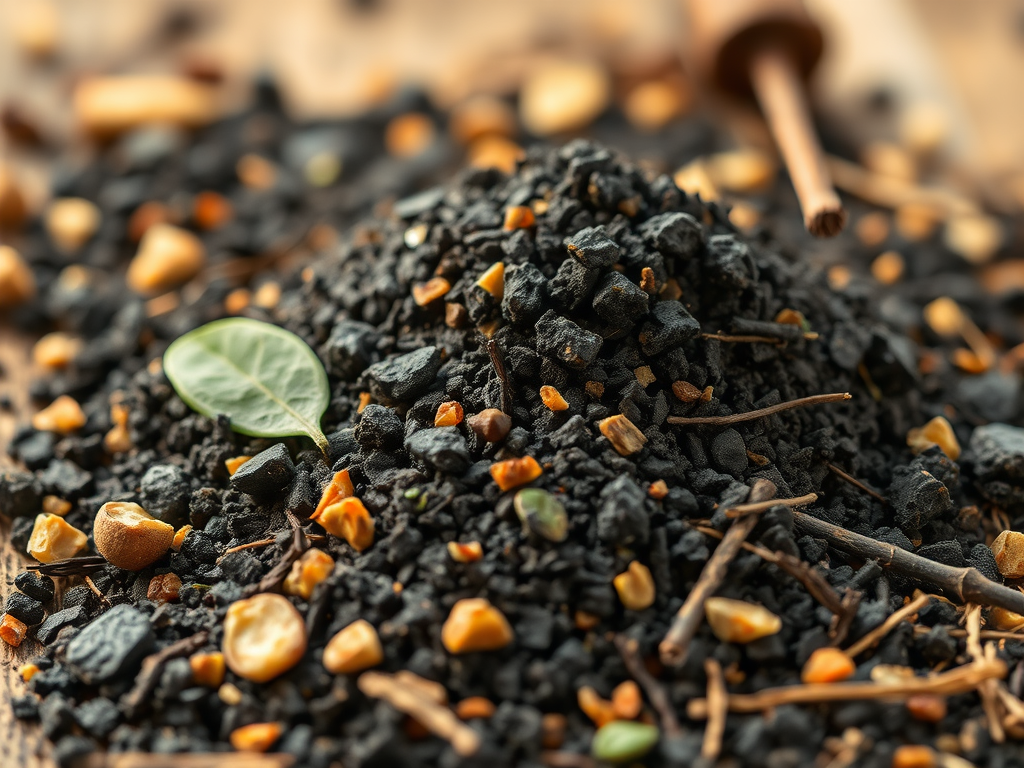
In a significant stride towards sustainable analytical practices, a recent review by Carla Iglesias-Martín, Ana M. Ares, José Bernal, and Adrián Fuente-Ballesteros in the journal Talanta sheds light on the growing importance of biocharBiochar is a carbon-rich material created from biomass decomposition in low-oxygen conditions. It has important applications in environmental remediation, soil improvement, agriculture, carbon sequestration, energy storage, and sustainable materials, promoting efficiency and reducing waste in various contexts while addressing climate change challenges. More in food analysis. This “black gold,” a carbon-rich solid produced from the pyrolysisPyrolysis is a thermochemical process that converts waste biomass into bio-char, bio-oil, and pyro-gas. It offers significant advantages in waste valorization, turning low-value materials into economically valuable resources. Its versatility allows for tailored products based on operational conditions, presenting itself as a cost-effective and efficient More of biomassBiomass is a complex biological organic or non-organic solid product derived from living or recently living organism and available naturally. Various types of wastes such as animal manure, waste paper, sludge and many industrial wastes are also treated as biomass because like natural biomass these More under oxygen-limited conditions, is emerging as a game-changer in sample preparation, a phase traditionally known for its high resource and reagent consumption. Biochar’s appeal lies in its low-cost production and excellent intrinsic properties, including a high surface area, remarkable porosityPorosity of biochar is a key factor in its effectiveness as a soil amendment and its ability to retain water and nutrients. Biochar’s porosity is influenced by feedstock type and pyrolysis temperature, and it plays a crucial role in microbial activity and overall soil health. Biochar More, and the ability to tune its surface for specific applications.
The push for greener methodologies in analytical chemistry has intensified interest in sustainable sorbents. Biochar, derived from agro-industrial residues like fruit waste, nut and seed residues, cereal by-products, lignocellulosic fibers, and wood waste, aligns perfectly with the principles of green analytical chemistry (GAC). This review provides a comprehensive, feedstock-oriented overview, examining each biochar source based on its physicochemical characteristics, extraction efficiency, and performance across diverse food matrices.
One of the most compelling aspects of biochar is its reusability, a critical factor for sustainability. The review highlights that biochar derived from bamboo and corncob demonstrated exceptional reusability, with up to 100 cycles reported without significant loss in performance. Cotton fibers and glucose-derived biochar also showed high reusability, reaching 90 and 80 cycles, respectively. Even less durable options like pomelo peel and kapok fibers achieved up to 30 reuse cycles. This impressive longevity directly contributes to reducing waste generation and minimizing the need for new sorbent synthesis, thereby lowering overall resource consumption and environmental impact.
Biochar preparation involves several key steps, starting with biomass selection, which directly influences the final material’s properties. Slow pyrolysis, characterized by longer heating durations and slower heating rates, is often preferred for biochar production as it yields a higher proportion of stable biochar. Post-treatment and activation processes, such as physical activation or chemical treatments, further enhance biochar’s structural properties, surface characteristics, and adsorption efficiency.
The characterization of biochar is crucial for optimizing its performance. Scanning electron microscopy (SEM) is the most frequently used technique, appearing in 87% of reviewed studies, to examine pore structure and morphological characteristics. Fourier-transform infrared spectroscopy (FTIR), used in 64% of studies, identifies surface functional groups, while the Brunauer-Emmett-Teller (BET) method, employed in 44% of cases, determines specific surface area and pore structure.
When it comes to elution solvents, a significant challenge remains in aligning with GAC principles. Acetonitrile (ACN) was the most frequently employed solvent, used in 36% of cases, followed by methanol (MeOH) at 16%. While water, a greener option, was used in 12% of studies, often in mixtures. The continued use of highly hazardous solvents like hexane and dichloromethane, even in small volumes, highlights an area for future improvement in developing more environmentally friendly desorption strategies.
Fruit waste-derived biochar, accounting for 33% of the raw materials studied, has garnered the most attention due to its abundance and promising performance in extracting pesticides, heavy metals, and pharmaceutical residues from complex food and water matrices. For instance, banana peel-derived biochar achieved pesticide recoveries of 64-133% in fruiting vegetables. Nut residues and seeds, comprising 13%, show high selectivity, especially when functionalized, with soybean shell biochar achieving 93-101% recovery for carbaryl in rice and corn samples. Cereal by-products (10%) demonstrate excellent reusability, with corncob biochar used for 100 extraction cycles for PAHs in bottled water, achieving 82-117% recovery. Lignocellulosic fibers (28%) and wood waste (5%) also show promise, with kapok fiber biochar achieving 88-117% recovery of organochlorine pesticides in beverages.
Despite these advancements, key knowledge gaps persist. A deeper mechanistic understanding of sorbate-sorbent interactions in various food matrices is needed, and standardized benchmarking is rare, making direct comparisons difficult. Complex matrices like dairy and fat-rich foods remain largely unexplored. Furthermore, the lack of regulatory clarity and standardized protocols for biochar sorbents hinders widespread adoption. Future research should prioritize developing greener solvents, improving reusability, enhancing matrix compatibility, and exploring advanced functionalization strategies to fully unlock biochar’s potential in sustainable food analysis.
Source: Iglesias-Martín, C., Ares, A. M., Bernal, J., & Fuente-Ballesteros, A. (2026). Natural-derived sorbents: Application of biochar materials as green extractive approach in food analysis. Talanta, 297, 128608



Leave a Reply