
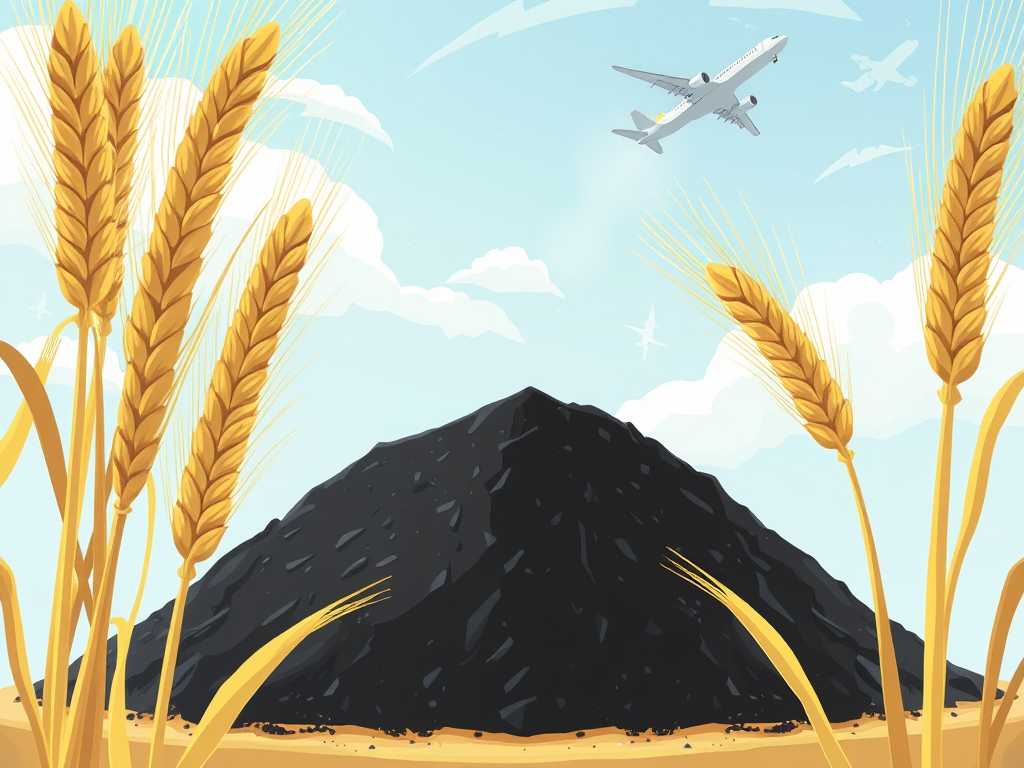
In a significant move for sustainable agriculture and renewable energy, a new project in Vegreville, Canada, is set to transform agricultural waste into high-value biofuels. The initiative, a partnership between the city of Vegreville and startup Provectus Biofuels, centers on a planned biorefinery designed to convert excess wheat straw into sustainable aviation and transportation fuels.
The project addresses a long-standing challenge for local farmers, who often view wheat straw as a byproduct to be discarded. By creating a new market for this agricultural residue, the biorefinery provides farmers with an additional revenue stream while simultaneously tackling global climate solutions. The proposed facility will use a multi-step process, beginning with the gasificationGasification is a high-temperature, thermochemical process that converts carbon-based materials into a gaseous fuel called syngas and solid by-products. It takes place in an oxygen-deficient environment at temperatures typically above 750°C. Unlike combustion, which fully burns material to produce heat and carbon dioxide (CO2), gasification More of wheat straw to produce syngasSyngas, or synthesis gas, is a fuel gas mixture consisting primarily of hydrogen and carbon monoxide. It is produced during gasification and can be used as a fuel source or as a feedstock for producing other chemicals and fuels. More. This syngas is then catalytically converted into methanol, which serves as a building block for the final liquid fuels.
The end products, which can include renewable jet fuel and gasoline, are a cleaner alternative to their fossil-fuel counterparts. The renewable gasoline, for example, is noted for its significantly lower carbon intensity and is free of sulfur, offering a more efficient and environmentally friendly option for consumers.
Perhaps most notably for the biocharBiochar is a carbon-rich material created from biomass decomposition in low-oxygen conditions. It has important applications in environmental remediation, soil improvement, agriculture, carbon sequestration, energy storage, and sustainable materials, promoting efficiency and reducing waste in various contexts while addressing climate change challenges. More sector, the process also produces a valuable and sought-after byproduct: biochar. This material is well-known for its ability to enhance soil health and its crucial role in sequestering atmospheric carbon, directly contributing to climate change mitigation efforts.
The integration of biochar production into the biorefinery model showcases a holistic approach to resource management, ensuring that every part of the wheat straw is utilized to its maximum potential. Biochar made from straw biomasses is also characterised by a strong water holding capacityWater holding capacity is the amount of water that soil can retain. Biochar can significantly increase the water holding capacity of soil, improving its ability to withstand drought conditions and support plant growth. More, which could lend itself well to the agricultural systems it is sourced from. This innovative project stands as a powerful example of how agricultural communities can be at the forefront of the clean energy transition, linking rural economies with global sustainability goals.
Source: Between field and sky: A Canadian project seeks to convert wheat straw into biofuels for aviation. [English Title]



Leave a Reply