
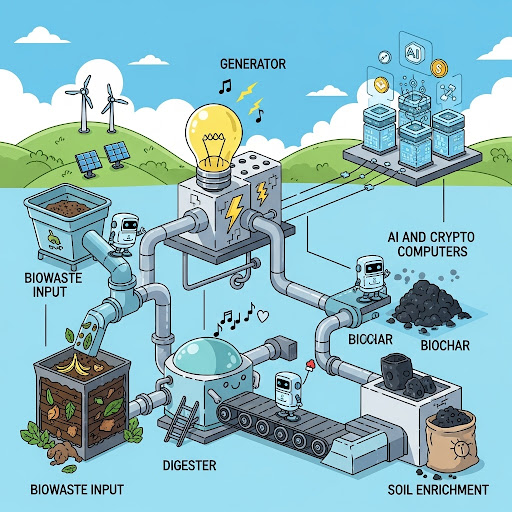
BioEnergy Development Inc. has announced the launch of a new decentralized microgrid platform, marking a significant development for the biocharBiochar is a carbon-rich material created from biomass decomposition in low-oxygen conditions. It has important applications in environmental remediation, soil improvement, agriculture, carbon sequestration, energy storage, and sustainable materials, promoting efficiency and reducing waste in various contexts while addressing climate change challenges. More and sustainability sectors. The system is engineered to supply the substantial power needs of the AI computing and crypto mining industries, which are known for their high energy consumption. What makes this new platform particularly relevant is its core technology: it utilizes mobile, modular bioreactors (with 40-foot chambers) to convert biowaste materials—such as wood waste and cattle manure—into electricity.
Crucially, this process isn’t just about power generation. The system operates on a co-production model, yielding valuable by-products in the form of biochar and biocarbon products. This multi-faceted approach addresses both the need for reliable energy and the sustainable management of organic waste streams, while also creating a marketable product with numerous applications. For those in the biochar industry, this demonstrates a scalable and innovative use case for biochar production that is directly tied to an emerging and highly demanding market.
The company states the microgrid can deliver approximately 1 GWh of net, dispatchable electricity, providing a consistent and scalable power source. By leveraging waste streams, the technology offers enhanced resilience and a pathway to decarbonization. It also presents a potentially low-cost operational model compared to traditional energy sources. The company is actively pursuing pilot projects with large-scale industrial operators to implement this solution.
This initiative highlights the growing intersection of sustainable technology and high-performance computing. It presents a tangible example of how waste-to-energy technologies can be integrated with biochar production to create a solution that is both economically viable and environmentally beneficial. By addressing the energy needs of cutting-edge sectors, this microgrid platform could serve as a powerful model for future sustainable infrastructure projects.




Leave a Reply