
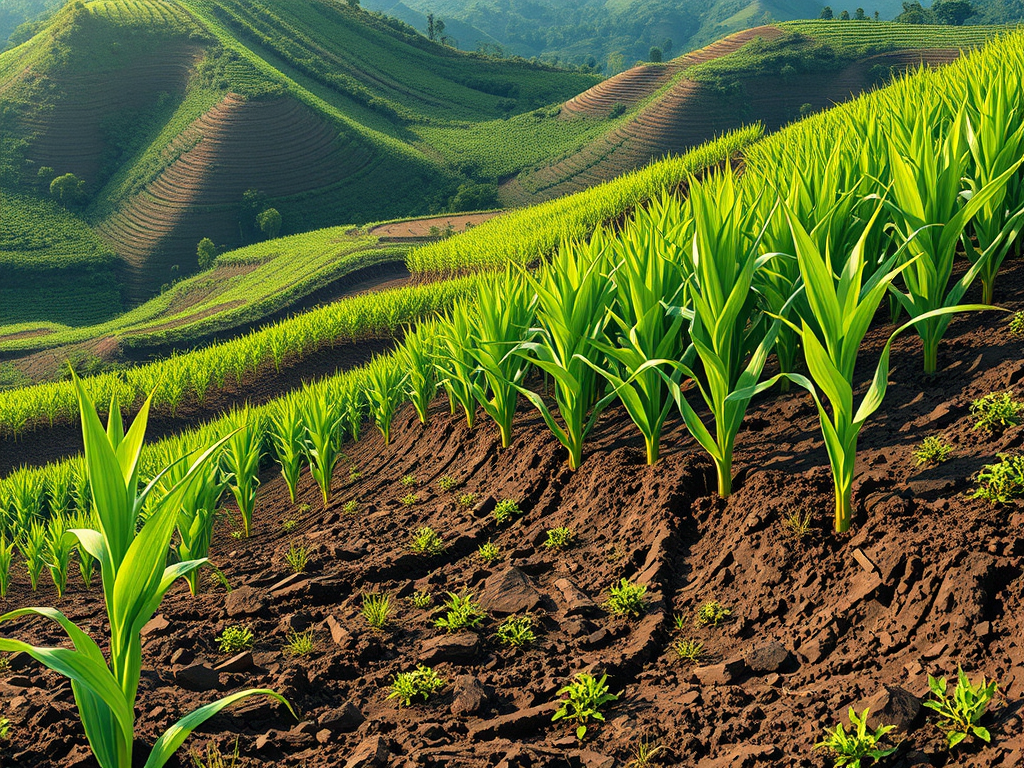
A two-year study conducted in the upland maize fields of Nan Province, Thailand, by Wanwisa Pansak, Jean-Louis Janeau, Suphannika Intanon, Chanisara Rodprai, Khwanrawee Anusorn, Claude Hammecker, Dorian Rumeau, and Séraphine Grellier, and published as a Journal Pre-proof in International Soil and Water Conservation Research, provides crucial insights into the effectiveness of biocharBiochar is a carbon-rich material created from biomass decomposition in low-oxygen conditions. It has important applications in environmental remediation, soil improvement, agriculture, carbon sequestration, energy storage, and sustainable materials, promoting efficiency and reducing waste in various contexts while addressing climate change challenges. More application and the influence of toposequence on soil erosion and nutrient loss under natural rainfall conditions. Their findings highlight the potential of biochar for nutrient retention, particularly nitrogen, but also underscore the importance of considering spatial variations in soil properties for effective soil management.
Soil erosion and nutrient loss are major challenges in upland agriculture, especially in regions like Southeast Asia, where intensive monocrop maize cultivation has replaced traditional practices. Biochar, a carbon-rich material produced from biomassBiomass is a complex biological organic or non-organic solid product derived from living or recently living organism and available naturally. Various types of wastes such as animal manure, waste paper, sludge and many industrial wastes are also treated as biomass because like natural biomass these More pyrolysisPyrolysis is a thermochemical process that converts waste biomass into bio-char, bio-oil, and pyro-gas. It offers significant advantages in waste valorization, turning low-value materials into economically valuable resources. Its versatility allows for tailored products based on operational conditions, presenting itself as a cost-effective and efficient More, is recognized for its potential to improve soil health, enhance water retention, and reduce nutrient leachingLeaching is the process where nutrients are dissolved and carried away from the soil by water. This can lead to nutrient depletion and environmental pollution. Biochar can help reduce leaching by improving nutrient retention in the soil. More. This study aimed to investigate how these benefits manifest under natural rainfall across different slope positions.
The researchers established 24 plots, each 1 square meter, at four distinct positions along a toposequence: top, upper, middle, and downslope. Biochar was incorporated into the topsoil at a depth of 5 cm in half of the plots at a rate of 2 kilograms per square meter (20 tonnes per hectare), while the other half served as control plots. Over two rainy seasons (2018 and 2019), measurements were taken for runoff volume, total sediment loss, and nutrient losses (nitrogen, phosphorus, and potassium). Soil moisture, hydraulic conductivity (Ks), and surface features like vegetation cover and crust formation were also monitored.
The study revealed nuanced effects of biochar and toposequence. In 2019, biochar application led to a 34% reduction in nitrogen loss through runoff, a significant improvement. This aligns with other studies showing biochar’s capacity to decrease soil nitrogen losses. Biochar-treated plots also exhibited increased soil moisture in both years, with a 59% increase in hydraulic conductivity observed in 2018, indicating improved water infiltration. Additionally, biochar application increased vegetation cover by 29% in 2018 and reduced the presence of free elements (micro-aggregates, gravels, carbon nodules) and surface crust formation by 54%. The re-emergence of previously integrated biochar on the soil surface, forming a crust, was noted after eight months under natural conditions.
Despite these positive impacts on nutrient retention and soil properties, the study found no significant effect of biochar on total runoff or sediment loss. This outcome may be attributed to insufficient biochar incorporation depth or the application rate being inadequate for the clay and silty clay soils of the study site. The complex interaction between soil type, rainfall intensity, and plot size could also contribute to these results, as comparable studies with different soil textures or larger plot sizes have shown varied outcomes.
Toposequence position played a significant role in erosion dynamics. Runoff and total sediment loss were significantly higher at the top slope position compared to middle and downslope positions. This is likely due to steeper slopes and higher surface crust formation observed at the top, which impede infiltration despite better soil aggregation (higher mean weight diameter). Soil texture also influenced moisture levels, with higher soil moisture found in middle and upper positions where clay content was greater. Nutrient losses, particularly nitrogen, also varied with slope position, exhibiting different trends between the two study years, influenced by runoff volume and nutrient concentration.
The study concludes that while biochar is promising for nutrient retention and improving certain soil properties, its application must be adapted to specific slope positions and soil characteristics for optimal effectiveness in controlling sediment and runoff. Uniform soil management practices across a toposequence are discouraged, emphasizing the need for tailored strategies to maximize biochar’s ecological benefits. Long-term monitoring of soil structure and the categorization of toposequences into homogeneous units are recommended for future research and effective conservation measures.
Source: Pansak, W., Janeau, J.-L., Intanon, S., Rodprai, C., Anusorn, K., Hammecker, C., Rumeau, D., & Grellier, S. (2025). Spatial variations in runoff, sediment, and nutrient losses induced by toposequence and biochar application in upland maize farming. International Soil and Water Conservation Research.




Leave a Reply