
Key Takeaways
- BiocharBiochar is a carbon-rich material created from biomass decomposition in low-oxygen conditions. It has important applications in environmental remediation, soil improvement, agriculture, carbon sequestration, energy storage, and sustainable materials, promoting efficiency and reducing waste in various contexts while addressing climate change challenges. More significantly increased the growth of both clover and mustard plants in urban soil, while basalt rock dust showed no measurable impact on plant size.
- Adding biochar reduced the amount of toxic metals like cadmium and zinc that plants absorbed from the soil.
- While basalt was intended to help remove carbon dioxide from the air through a natural process called weathering, researchers found no evidence that this occurred during the 550-day study.
- Basalt addition increased levels of nickel and chromium in the soil, but these metals were held in a stable form that plants could not easily take up.
- Using biochar in urban gardens and community spaces can provide immediate benefits for soil quality and plant health, making it a reliable tool for greening cities.
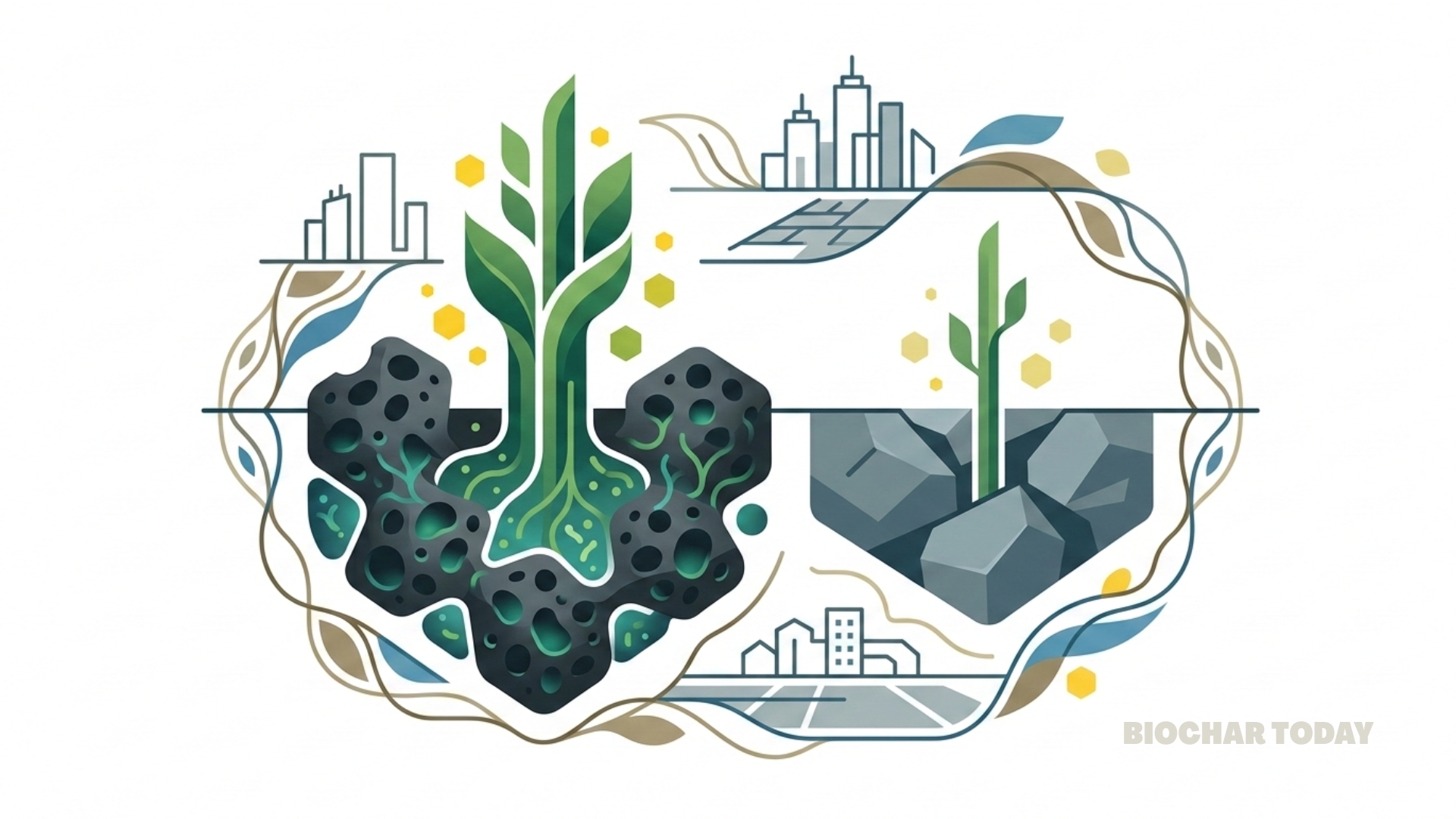
In a research article published in Biogeosciences, authors Arthur Vienne, Jennifer Newell, and their colleagues detail the results of a field experiment conducted in an urban residential area of Belfast, Northern Ireland. The study focused on two promising carbon dioxide removal techniques: enhanced weathering using basalt rock dust and soil amendmentA soil amendment is any material added to the soil to enhance its physical or chemical properties, improving its suitability for plant growth. Biochar is considered a soil amendment as it can improve soil structure, water retention, nutrient availability, and microbial activity. More with biochar. By testing these methods on plots of clover and mustard, the team sought to understand their impact on soil carbon storage, plant productivity, and the movement of heavy metals in typically heterogeneous urban soils.
The experiment revealed a stark difference in the effectiveness of the two treatments within the specific context of alkaline urban soil. Basalt amendment, applied at a rate of 40 tons per hectare, did not result in detectable inorganic carbon sequestration or an increase in base cations in the soil over the 550-day observation period. The researchers suggest that the weathering of the basalt may have been limited by the soil’s alkalinity, the relatively coarse size of the rock particles, and a mineral composition dominated by slow-dissolving albite. Furthermore, any released cations might have been quickly trapped in secondary minerals that were not captured by the standard testing methods.
In contrast, the application of biochar at 33 tons per hectare delivered clear and immediate agronomic benefits. Biochar significantly boosted the biomassBiomass is a complex biological organic or non-organic solid product derived from living or recently living organism and available naturally. Various types of wastes such as animal manure, waste paper, sludge and many industrial wastes are also treated as biomass because like natural biomass these More of both crops, with mustard showing a 110% increase and clover a 19% increase compared to untreated plots. This growth was partially attributed to a fertilization effect, as the digestate-derived biochar used in the study was naturally rich in phosphorus and other essential minerals. Beyond promoting growth, biochar acted as a powerful remediator by reducing the concentrations of several toxic trace metals in the plants’ aboveground tissues. In mustard, biochar decreased the uptake of manganese, zinc, and cadmium, while in clover, it reduced levels of titanium, vanadium, iron, gallium, and germanium.
The study also addressed concerns regarding heavy metal contamination from basalt dust, which naturally contains elements like nickel and chromium. While basalt addition did increase the total amount of these metals in the soil, they were primarily found in less bioavailable fractions. Crucially, the researchers observed no increase in metal concentrations within the plants themselves, suggesting that the risk of these elements entering the food chain was low in this alkaline environment.
Surprisingly, the researchers found no synergistic effects when basalt and biochar were applied together. It had been hypothesized that biochar might speed up the weathering of basalt by retaining water or capturing released ions, but the data showed that their effects were simply additive rather than mutually reinforcing. This finding suggests that while both tools have merit, their successful deployment depends heavily on local soil conditions, such as pHpH is a measure of how acidic or alkaline a substance is. A pH of 7 is neutral, while lower pH values indicate acidity and higher values indicate alkalinity. Biochars are normally alkaline and can influence soil pH, often increasing it, which can be beneficial More and existing mineralogy.
Ultimately, the results underscore the immediate value of biochar for urban nature-based solutions aimed at improving soil health and boosting biological carbon capture through plant growth. While enhanced weathering with basalt remains a potential long-term strategy for carbon removal, its effectiveness in alkaline urban settings appears limited in the short term. The study highlights the need for continued research across diverse soil types and mineral configurations to fully realize the potential of these carbon removal technologies in the fight against climate change.
Source: Vienne, A., Newell, J., Roussard, J., Doherty, R., Cox, S. F., Lyons, G., & Vicca, S. (2026). Effects of basalt and biochar addition on base cations and trace metals in plants and soil in an urban field trial. Biogeosciences, 23, 1681-1695.



Leave a Reply