
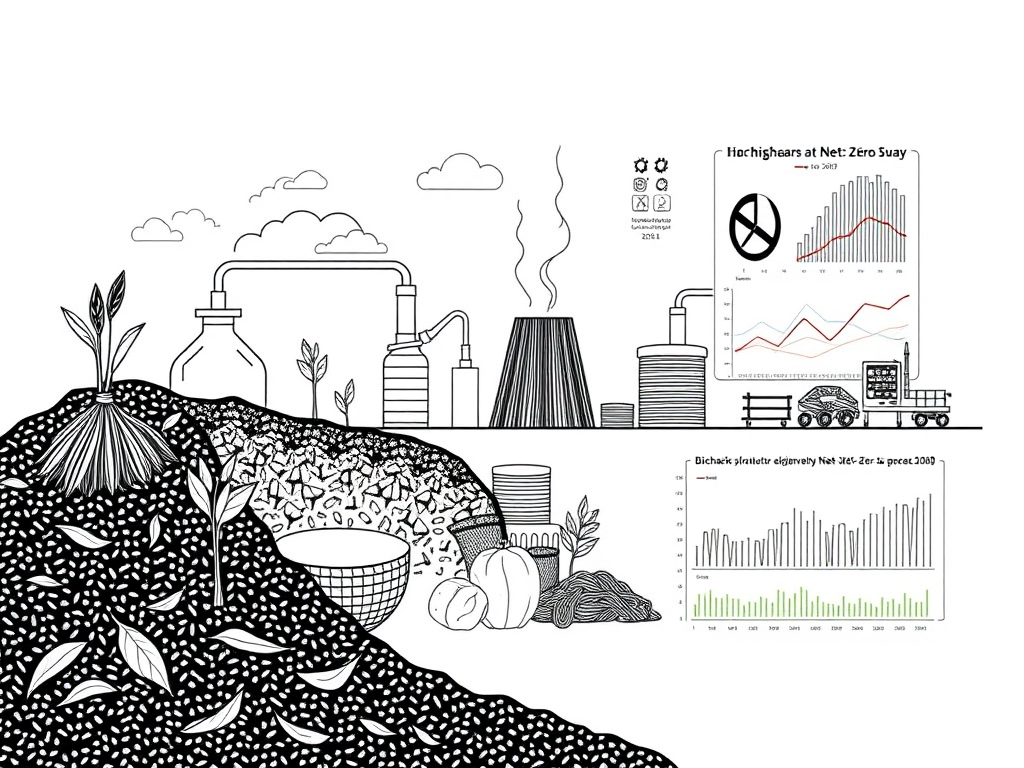
In the global push toward Net-Zero emissions, biocharBiochar is a carbon-rich material created from biomass decomposition in low-oxygen conditions. It has important applications in environmental remediation, soil improvement, agriculture, carbon sequestration, energy storage, and sustainable materials, promoting efficiency and reducing waste in various contexts while addressing climate change challenges. More has emerged as a key negative emission technology. However, the diverse methods of production, ranging from different feedstocks to various scales, lead to a wide range of environmental impacts that are not yet fully understood. A new review by Kavindi Gajasinghe, Longlong Tang, and Yuma Sasaki, presented at the 19th Annual Meeting of the Japan LCA Society, addresses this challenge by providing a systematic bibliometric analysis of life cycle assessment (LCA) studies on biochar. The authors used the VOSviewer software to scrutinize the current research landscape, focusing on the influential parameters and future trends that will shape the industry. This analysis provides a much-needed overview of a rapidly evolving field, highlighting the critical gaps in knowledge that must be addressed to unlock biochar’s full potential.
The review begins by outlining the explosive growth of research in the field. After a steady increase in publications for several years, biochar LCA studies began an exponential growth trajectory from 2019 onward. The year 2022 was a landmark year for the research, recording the highest number of publications at 46 papers, which accounted for approximately 25% of the total papers reviewed. This surge in research indicates a growing global interest in understanding the complexities of biochar, moving beyond foundational studies to more advanced topics. The overlay maps in the study highlight a shift in research focus from fundamental concepts to more intricate connections, such as techno-economic analysis and the fine-tuning of production processes. This transition reflects the scientific community’s effort to develop not only high-quality materials but also economically viable and sustainable solutions that can support a circular economy.
The analysis of keywords revealed that biochar LCA research is clustered around four main areas: energy production, environmental impacts, biomassBiomass is a complex biological organic or non-organic solid product derived from living or recently living organism and available naturally. Various types of wastes such as animal manure, waste paper, sludge and many industrial wastes are also treated as biomass because like natural biomass these More utilization, and the pyrolysisPyrolysis is a thermochemical process that converts waste biomass into bio-char, bio-oil, and pyro-gas. It offers significant advantages in waste valorization, turning low-value materials into economically valuable resources. Its versatility allows for tailored products based on operational conditions, presenting itself as a cost-effective and efficient More process. This clustering provides a clear picture of the primary concerns of researchers in the field. For instance, an analysis of carbonization methods found that gasificationGasification is a high-temperature, thermochemical process that converts carbon-based materials into a gaseous fuel called syngas and solid by-products. It takes place in an oxygen-deficient environment at temperatures typically above 750°C. Unlike combustion, which fully burns material to produce heat and carbon dioxide (CO2), gasification More was the most prominent keyword, with 18 occurrences, while fast pyrolysis had 10 occurrences. This finding suggests a strong focus on utilizing biochar production for energy. Many of the studies on gasification aim to enhance the quality and quantity of syngasSyngas, or synthesis gas, is a fuel gas mixture consisting primarily of hydrogen and carbon monoxide. It is produced during gasification and can be used as a fuel source or as a feedstock for producing other chemicals and fuels. More, which is a critical component in addressing the global energy crisis. Despite the focus on biochar as a primary product, other by-products like syngas, bio-oil, and hydrogen are also being considered for sustainable clean energy generation. The most prominent feedstocks identified in the literature were municipal solid waste, straw, and food waste, chosen most likely because of their site-specific abundance.
The review also outlines the global landscape of biochar LCA research, highlighting the contributions of different regions. According to the country-specific co-authorship analysis, both Asia and Europe are leading the way in this field. While Europe was an early adopter, Asia has recently gained more attention with a significant increase in biochar studies. India, in particular, is an emerging leader with a focus on the techno-economic aspects of biochar, aiming to pave the way for commercialization. Malaysia is also a significant contributor, with extensive research on resource utilization and sustainability. In contrast, the African region has seen only a few studies, although countries like Egypt are playing a pivotal role in assessing the environmental impact of biochar through energy and techno-economic analyses. The authors note that despite technical barriers and limited access, some studies in these areas have successfully overcome obstacles using available resources and conventional charring techniques.
The study, however, also points out a key limitation: while the VOSviewer tool is effective at visualizing broad research trends, it is less effective at providing a clear overview of process-level information from different biochar production systems due to the limited availability of such data in abstracts. The authors suggest that a more comprehensive understanding of the environmental impacts of biochar will require a combination of tools and methods to better ascertain the intricate interconnections within the research. This review is an important step in consolidating the current state of biochar research and underscores the need for continued, precise, and integrated studies to fully realize biochar’s promise as a sustainable solution for environmental and energy challenges.
SOURCE: Gajasinghe, K., Tang, L., & Sasaki, Y. (2024). Elucidation of Environmental Impacts of Biochar by LCA: A Bibliometric Review. Paper presented at the 19th Annual Meeting of the Japan LCA Society, Tokyo, Japan.


Leave a Reply