
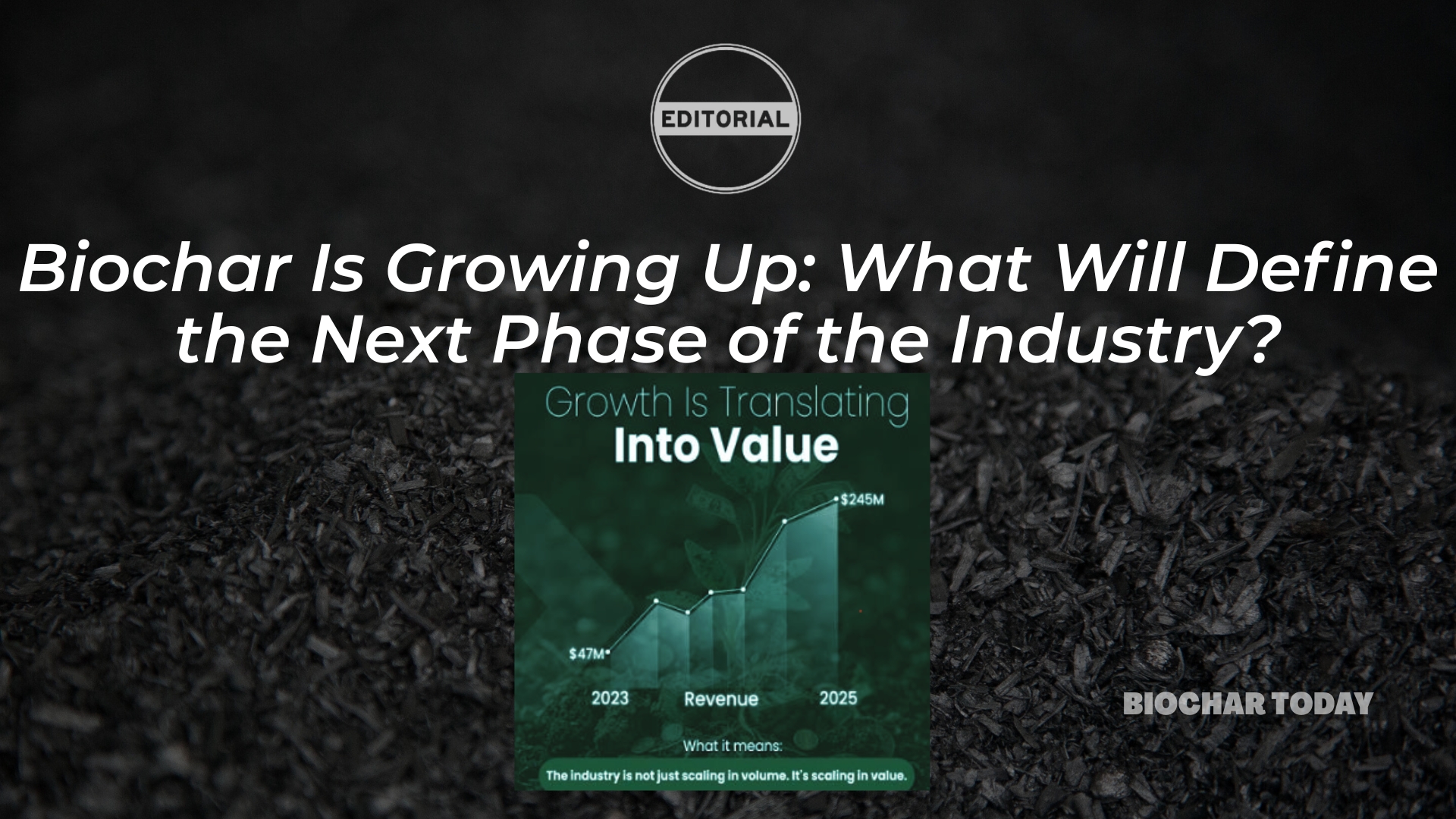
BiocharBiochar is a carbon-rich material created from biomass decomposition in low-oxygen conditions. It has important applications in environmental remediation, soil improvement, agriculture, carbon sequestration, energy storage, and sustainable materials, promoting efficiency and reducing waste in various contexts while addressing climate change challenges. More is entering a different stage of its development.
For years, much of the conversation around biochar has focused on what it could do: convert biomassBiomass is a complex biological organic or non-organic solid product derived from living or recently living organism and available naturally. Various types of wastes such as animal manure, waste paper, sludge and many industrial wastes are also treated as biomass because like natural biomass these More residues into biochar material, support soil health, reduce emissions, treat water, and create value from materials that might otherwise be burned or discarded. Today, the conversation is increasingly shifting toward a more practical question: how do we produce the right biochar, from the right feedstockFeedstock refers to the raw organic material used to produce biochar. This can include a wide range of materials, such as wood chips, agricultural residues, and animal manure. More, for the right application, and demonstrate that it actually delivers?
That shift matters. The future of biochar will not be determined simply by how much biochar the industry can produce. It will depend on whether producers can consistently demonstrate quality, environmental performance, economic viability, and suitability for the markets they are entering.
The Feedstock Question Comes First
Before discussing reactors, carbon credits or markets, there is a more basic question: what is going into the system?
Agricultural residues, forestry byproducts, food waste and animal manures can provide locally available feedstocks while supporting circular resource use. But feedstock availability, moisture, composition, transport distance and contamination risks can vary considerably between regions. These differences affect both production economics and the characteristics of the resulting biochar. This becomes particularly important when less conventional feedstocks are considered. Materials such as sewage sludge or certain industrial wastes may offer an abundant carbon source, but they can also introduce contaminants that require careful treatment and validation before agricultural use. A feedstock should therefore not be judged only by whether it is available. The more useful question is whether it makes sense environmentally, technically and economically for the intended application.
A Reactor Does Not Make a Biochar Strategy
Technology is another area where the industry needs to look beyond equipment specifications. PyrolysisPyrolysis is a thermochemical process that converts waste biomass into bio-char, bio-oil, and pyro-gas. It offers significant advantages in waste valorization, turning low-value materials into economically valuable resources. Its versatility allows for tailored products based on operational conditions, presenting itself as a cost-effective and efficient More remains one of the most widely used approaches, while gasificationGasification is a high-temperature, thermochemical process that converts carbon-based materials into a gaseous fuel called syngas and solid by-products. It takes place in an oxygen-deficient environment at temperatures typically above 750°C. Unlike combustion, which fully burns material to produce heat and carbon dioxide (CO2), gasification More, torrefaction and hydrothermal carbonization offer different pathways for processing different types of biomass. Temperature, residence timeResidence time refers to the duration that the biomass is heated during the pyrolysis process. The residence time can influence the properties of the biochar produced. More, oxygen availability and feedstock characteristics can all influence the resulting material and co-products.
This means that choosing a production technology is not simply a question of selecting the newest or largest system. A technology that works well for a dry agricultural residue may not be appropriate for a high-moisture biomass. A system designed primarily for energy recovery may have different priorities from one designed to produce a consistent soil amendmentA soil amendment is any material added to the soil to enhance its physical or chemical properties, improving its suitability for plant growth. Biochar is considered a soil amendment as it can improve soil structure, water retention, nutrient availability, and microbial activity. More or a carbon removal product.
For producers, the important question is therefore not simply, Can this technology make biochar? It is Can it reliably make the quality and quantity of biochar required for our intended market?
The Product Needs Evidence Behind It
As the industry expands, claims about biochar will increasingly need to be supported by evidence.
Independent laboratory testing, scientific validation and technical documentation can help establish whether a product is suitable for its intended use. This becomes particularly important where feedstocks have potential contamination concerns or where biochar is being marketed for specific environmental functions. Quality cannot be assumed from the feedstock alone. Nor can performance be assumed from the fact that a material is called “biochar.” The industry still has important research gaps around long-term stability, greenhouse gas effects, interactions with different soil types and environmental impacts. Addressing these gaps is not merely an academic exercise. Better evidence can help producers communicate more accurately with farmers, investors, regulators and carbon market participants.
Carbon Removal Is an Opportunity, Not a Shortcut
Carbon markets have added another dimension to the biochar business.
The possibility of generating carbon removal credits can create an additional revenue stream for producers, but it also raises the standard of evidence expected from projects. Carbon accounting requires more than measuring how much biomass enters a production facility. Feedstock sourcing, production emissions, transport, biochar characteristics, application and permanence all matter when determining the net climate benefit. This is where certification and third-party verification become increasingly relevant. Standards and methodologies can provide structured pathways for demonstrating environmental performance and accessing carbon markets.
For producers, the lesson is straightforward: carbon revenue should be built on a sound production and measurement system, rather than treated as a substitute for one.
One Biochar Market May Not Be Enough
Agriculture remains one of the most familiar applications for biochar, but it is not the only potential market. Research and commercial activity are also exploring applications in water treatment, construction, stormwater management, urban green infrastructure and waste management. These markets may require different material properties, processing approaches and quality criteria. That opens an interesting possibility for the industry: rather than treating biochar as one standardized commodity, producers may increasingly develop materials for specific applications. A biochar intended for soil amendment does not necessarily need the same characteristics as a material designed for contaminant adsorption or incorporation into a construction product.
The question may therefore shift from “How can we sell more biochar?” to “What problem are we designing this biochar to solve?”
Scaling Is Where Many Questions Become Real
Laboratory performance and pilot-scale success do not automatically translate into a commercially viable operation. At larger scales, feedstock logistics, moisture management, energy requirements, process consistency, transportation, capital costs and market demand become increasingly important. Maintaining consistent biochar quality while processing variable biomass can be particularly challenging. Techno-economic analysis and life-cycle assessment can help reveal these realities before large investments are made. They can also help identify whether a proposed system creates genuine environmental value once transportation, energy use and other operational impacts are included.
In other words, scaling biochar is not simply about building a bigger reactor. It is about building a system in which feedstock, technology, product quality, market demand and environmental performance remain aligned.
Trust May Become the Industry’s Most Valuable Asset
There is another factor that is easy to underestimate: trust.
Farmers want to know whether a product is safe and useful for their soils. Companies purchasing carbon removals need confidence in the underlying claims. Regulators need evidence that environmental risks are being managed. Investors need to understand the economics. Communities need to know what happens to locally sourced biomass and whether the project creates meaningful local benefits. Scientific validation, transparent communication and credible certification can help address these questions. Marketing still has a role, but the strongest stories are likely to be those supported by measurements, field results and clearly defined boundaries. A successful pilot, independently tested product or documented improvement in soil or water management can be more informative than a broad sustainability claim.
The Next Competitive Advantage May Be Adaptability
The biochar sector is developing across very different geographical, agricultural and industrial contexts. Feedstock availability in India will not look the same as in Europe or North America. Infrastructure, regulation, soil conditions and potential markets will also vary.
That makes a single universal production model difficult to imagine. What may prove more valuable is the ability to adapt: matching locally available biomass with appropriate processing technology, testing the resulting material, understanding its intended application and building a business model around the realities of the region. The industry’s own strengths and challenges point in this direction. Biochar offers diverse applications and growing interest in carbon removal, but producers also face feedstock limitations, high initial costs, knowledge gaps, logistical barriers, regulatory requirements and increasing competition.
The Question for the Next Decade
The biochar industry does not need to prove that biochar is interesting. That part of the conversation has already happened. The more important task now is to demonstrate where it works, under what conditions, at what cost, with what environmental trade-offs, and for whom. That requires better feedstock decisions, fit-for-purpose technologies, reliable quality control, credible measurement, scientific validation and business models that can survive beyond pilot projects.
Biochar has the potential to connect waste management, agriculture, carbon removal and environmental remediation. But realizing that potential will depend less on how loudly the industry talks about its possibilities and more on how carefully it builds the evidence behind them. Perhaps that is the real opportunity ahead: not simply to produce more biochar, but to build a biochar industry that knows why, where and when its products create value.



Leave a Reply