
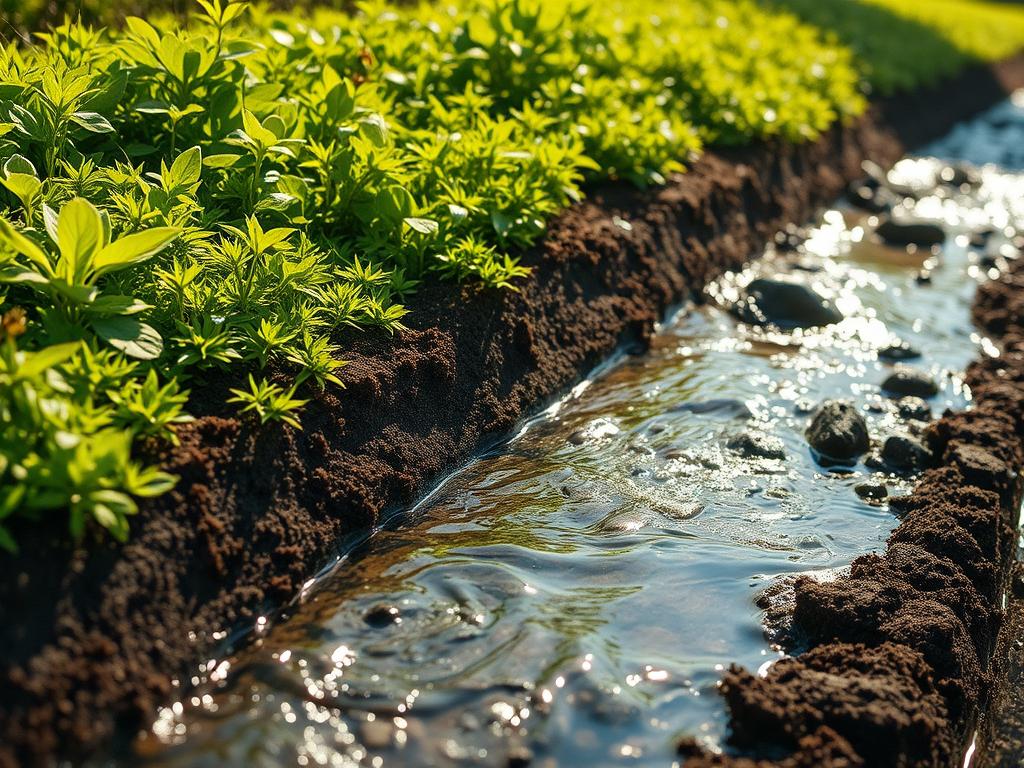
Managing non-point source pollution from urban highway runoff is a persistent challenge for civil engineers and environmental managers. This runoff carries a range of pollutants, including solids, organic compounds, and heavy metals, into nearby water bodies. In a study published in Total Environment Engineering, researchers Ahmed I. Yunus, George Yuzhu Fu, Yongsheng Chen, and Joe F. Bozeman III investigated the effectiveness of using biochar-amended topsoil as a cost-effective and sustainable solution for highway runoff treatment. Their findings show that while this approach is highly successful at removing solids and organic pollutants, it presents complex and variable results for heavy metals like lead (Pb), zinc (Zn), and copper (Cu).
The study evaluated the performance of bioslopes using biocharBiochar is a carbon-rich material created from biomass decomposition in low-oxygen conditions. It has important applications in environmental remediation, soil improvement, agriculture, carbon sequestration, energy storage, and sustainable materials, promoting efficiency and reducing waste in various contexts while addressing climate change challenges. More, a carbon-rich material from heated biomassBiomass is a complex biological organic or non-organic solid product derived from living or recently living organism and available naturally. Various types of wastes such as animal manure, waste paper, sludge and many industrial wastes are also treated as biomass because like natural biomass these More, combined with four types of locally sourced topsoil from Georgia: Tifton, Cecil, Pacolet, and Cowarts. The biochar was added at varying weight ratios of 0%, 5%, 7%, and 10%. The results for physical and organic pollutants were consistently impressive. Biochar-amended topsoils achieved over 60% removal efficiency for total suspended solids (TSS), total dissolved solids (TDS), and total solids (TS). For example, with a 5% biochar amendment, all topsoils except Cecil achieved over 95% TSS removal, surpassing the Georgia Department of Transportation’s (GDOT) target of 80%. Chemical oxygen demand (COD) removal exceeded 80%, and oil and grease removal surpassed 20%. Specifically, adding 5% biochar dramatically improved oil and grease removal, achieving 81.31% for Tifton and Pacolet topsoils compared to their unamended controls which showed removal efficiencies of 25.23% and 43.93% respectively.
However, the effectiveness for heavy metal removal was inconsistent and highly variable. The removal of total Pb, Zn, and Cu varied significantly depending on the topsoil type and biochar concentration. For example, most biochar-amended topsoils achieved over 50% total Pb removal, but Pacolet topsoil showed very low efficiency, and some combinations even increased total Pb concentrations in the treated effluent, suggesting a pH-induced release of previously adsorbed Pb. The study found no significant removal of dissolved Pb in any setup, with treated effluent showing a 2% to 457% increase in dissolved Pb concentrations. Dissolved Zn and Cu removal also varied, with some combinations showing over 60% efficiency, while others saw increased concentrations in the treated effluent.
These inconsistencies are attributed to several factors. The study found that biochar-amended treatments increased both the pHpH is a measure of how acidic or alkaline a substance is. A pH of 7 is neutral, while lower pH values indicate acidity and higher values indicate alkalinity. Biochars are normally alkaline and can influence soil pH, often increasing it, which can be beneficial More and conductivity of the treated runoff. The raw stormwater pH of 6.92 rose to as high as 8.5 after infiltration through the biochar-amended topsoil. The rise in conductivity (from 51.5 μS/cm to 110−1160 μS/cm) indicated the leachingLeaching is the process where nutrients are dissolved and carried away from the soil by water. This can lead to nutrient depletion and environmental pollution. Biochar can help reduce leaching by improving nutrient retention in the soil. More of dissolved salt ions and alkaline ashAsh is the non-combustible inorganic residue that remains after organic matter, like wood or biomass, is completely burned. It consists mainly of minerals and is different from biochar, which is produced through incomplete combustion. Ash Ash is the residue that remains after the complete More from the biochar, which reduced the biochar’s ability to retain heavy metals over time due to competitive adsorption. The authors also noted that biochar saturation from repeated use, as observed in the third infiltration cycle, limited its capacity to adsorb additional heavy metals and organics.
The research concludes that a 5% biochar amendment in Tifton and Cecil topsoils offers the best balance for removing solids, organics, and heavy metals while minimizing negative effects like increased pH and conductivity. The study highlights that while biochar is a cost-effective and sustainable material for treating many stormwater pollutants, careful consideration must be given to its specific interactions with heavy metals and the potential for unintended consequences like their release back into the environment.
Source: Yunus, A. I., Fu, G. Y., Chen, Y., & Bozeman III, J. F. (2025). Biochar-Amended Topsoil for Highway Runoff Treatment: Unintended Consequences of Heavy Metal Release Amid Success in Solids and Oil & Grease Removal. Total Environment Engineering.




Leave a Reply